Richard Ford - Independence Day
Здесь есть возможность читать онлайн «Richard Ford - Independence Day» весь текст электронной книги совершенно бесплатно (целиком полную версию без сокращений). В некоторых случаях можно слушать аудио, скачать через торрент в формате fb2 и присутствует краткое содержание. Год выпуска: 1996, Издательство: Vintage, Жанр: Современная проза, на английском языке. Описание произведения, (предисловие) а так же отзывы посетителей доступны на портале библиотеки ЛибКат.
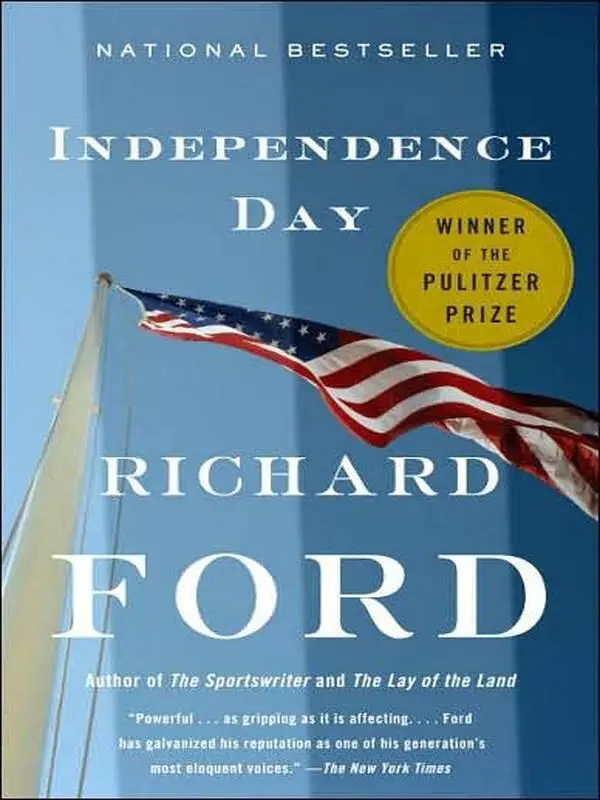
- Название:Independence Day
- Автор:
- Издательство:Vintage
- Жанр:
- Год:1996
- ISBN:нет данных
- Рейтинг книги:3 / 5. Голосов: 1
-
Избранное:Добавить в избранное
- Отзывы:
-
Ваша оценка:
Independence Day: краткое содержание, описание и аннотация
Предлагаем к чтению аннотацию, описание, краткое содержание или предисловие (зависит от того, что написал сам автор книги «Independence Day»). Если вы не нашли необходимую информацию о книге — напишите в комментариях, мы постараемся отыскать её.
, Richard Ford deepens his portrait of one of the most unforgettable characters in American fiction, and in so doing gives us an indelible portrait of America. Frank Bascombe, in the aftermath of his divorce and the ruin of his career, has entered an "Existence Period," selling real estate in Haddam, New Jersey, and mastering the high-wire act of normalcy. But over one Fourth of July weekend, Frank is called into sudden, bewildering engagement with life.
is a moving, peerlessly funny odyssey through America and through the layered consciousness of one of its most compelling literary incarnations, conducted by a novelist of astonishing empathy and perception.
Independence Day — читать онлайн бесплатно полную книгу (весь текст) целиком
Ниже представлен текст книги, разбитый по страницам. Система сохранения места последней прочитанной страницы, позволяет с удобством читать онлайн бесплатно книгу «Independence Day», без необходимости каждый раз заново искать на чём Вы остановились. Поставьте закладку, и сможете в любой момент перейти на страницу, на которой закончили чтение.
Интервал:
Закладка:
I now think of this balancing of urgent forces as having begun the Existence Period, the high-wire act of normalcy, the part that comes after the big struggle which led to the big blow-up, the time in life when whatever was going to affect us “later” actually affects us, a period when we go along more or less self-directed and happy, though we might not choose to mention or even remember it later were we to tell the story of our lives, so steeped is such a time in the small dramas and minor adjustments of spending quality time simply with ourselves.
Certain crucial jettisonings, though, seemed necessary for this passage to be a success — just as Ted Houlihan mentioned to Joe Markham an hour ago but which probably didn’t register. Most people, once they reach a certain age, troop through their days struggling like hell with the concept of completeness, keeping up with all the things that were ever part of them, as a way of maintaining the illusion that they bring themselves fully to life. These things usually amount to being able to remember the birthday of the first person they “surrendered” to, or the first calypso record they ever bought, or the poignant line in Our Town that seemed to sum life up back in 1960.
Most of these you just have to give up on, along with the whole idea of completeness, since after a while you get so fouled up with all you did and surrendered to and failed at and fought and didn’t like, that you can’t make any progress. Another way of saying this is that when you’re young your opponent is the future; but when you’re not young, your opponent’s the past and everything you’ve done in it and the problem of getting away from it. (My son Paul may be an exception.)
My own feelings were that since I’d jettisoned employment, marriage, nostalgia and swampy regret, I was now rightfully a man a-quiver with possibility and purpose — similar to a way you might feel just prior to taking up the sport of, say, glacier skiing; and not for sharpening your acuities or tempting grisly death, but simply to celebrate the hum of the human spirit. (I could not, of course, have told you what my purpose actually was, which probably meant my purpose was just to have a purpose. Though I’m certain I was afraid that if I didn’t use my life, even in a ridiculous way, I’d lose it — what people used to say about your dick when I was a kid.)
My qualifications for a new undertaking were, first, that I was not one bit preoccupied with how things used to be . You’re usually wrong about how things used to be anyway, except that you used to be happier — only you may not have known it at the time, or might’ve been unable to seize it, so stuck were you in life’s gooeyness; or, as is often the case, you might never have been quite as happy as you like to believe you were.
The second of my qualifications was that intimacy had begun to matter less to me. (It had been losing ground since my marriage came to a halt and other attractions failed.) And by intimacy I mean the real kind, the kind you have with only one person (or maybe two or three) in a lifetime; not the kind where you’re willing to talk to someone you’re close to about laxative choices or your dental problems; or, if it’s a woman, about her menstrual cycle, or your aching prostate. These are private, not intimate. But I mean the real stuff— silent intimacies —when spoken words, divulgences, promises, oaths are almost insignificant: the intimacy of the fervently understood and sympathized with, having nothing to do with being a “straight shooter” or a truth teller, or with being able to be “open” with strangers (these don’t mean anything anyway). To none of these, though, was I in debt, and in fact I felt I could head right into my new frame of reference — whatever was beginning — pretty well prepared and buttoned up.
Third, but not last, I wasn’t actually worried that I was a coward. (This seemed important and still does.) Years earlier, in my sportswriting days, Ann and I were once walking out of a Knicks-Bullets night game at the Garden, when some loony up ahead began brandishing a pistol and threatening to open up on everybody all around. Word went back like a windstorm over wheat stalks. “Gun! He’s got a GUN! Watch it!” I quickly pulled Ann inside a men’s room door, hoping to get some concrete between the gun muzzle and us. Though in twenty seconds the gunman was tackled and kicked to sawdust by a squad of New York’s quick-witted finest, and thank God no one was hurt.
But Ann said to me when we were in the car, waiting in a drizzle to enter the bleak tunnel back to New Jersey, “Did you realize you jumped behind me when that guy had his gun?” She smiled at me in a tired but sympathetic way.
“That’s not what I did!” I said. “I jumped in the rest room and pulled you in with me.”
“You did that too. But you also grabbed me by my shoulders and got behind me. Not that I blame you. It happened in a hurry.” She drew a wavy vertical line in the window fog and put a dot at the bottom.
“It did happen in a hurry. But you’re wrong about what happened,” I said, flustered because in fact it had all happened fast, I’d acted solely on instinct and couldn’t remember much.
“Well, if that’s what happened,” she said confidently, “then tell me if the man — if it was a man — was colored or white.” Ann has never gotten over her old man’s Michigan racial epithets.
“I don’t know,” I said as we made the curve down into the lurid world of the tunnel. “It was too crowded. He was too far up ahead. We couldn’t see him.”
“I could,” she said, sitting straighter and flattening her skirt across her knees. “He wasn’t actually that far. He might’ve shot one of us. He was a small brown-colored man, and he had a small black revolver. If we passed him on the street I’d recognize him again. Not that it matters. You were trying to do the right thing. I’m happy I was no less than the second person you thought to protect when you thought you were in danger.” She smiled at me again and patted my leg infuriatingly, and we were all the way to Exit 9 before I could think of anything to say.
But for years it bothered me (who wouldn’t be bothered?). My belief had always been with the ancient Greeks, that the most important events in life are physical events. And it bothered me that in (I now realize) the last opportunity I might’ve had to throw myself in front of my dearest loved one, it appeared I’d pushed my dearest loved one in front of myself as cravenly as a slinking cur (appearances are just as bad when cowardliness is at issue).
And yet I found that when Ann and I divorced because she couldn’t put up with me and my various aberrations of grief and longing owing to the death of our first son, and just flew the coop (a physical act if there ever was one), I quit worrying about cowardice almost immediately and decided she’d been wrong. Though even if she’d been right, I felt it was braver to live with the specific knowledge of cowardice and look for improvements than never to know anything about myself on that front; and better, too, to go on believing, as we all do in our daydreams, that when the robber jumps out of the alley brandishing the skinning knife or the large-caliber pistol, terrorizing you and your wife and plenty of innocent bystanders (old people in wheelchairs, your high-school math teacher, Miss Hawthorne, who was patient when you couldn’t get the swing of plane geometry and thus changed your life forever), that there’ll be time for you (me) to act heroically (“I just don’t think you’ve got nuts big enough to use that thing, mister, so you might as well hand it over and get out of here”). Better to wish the best for yourself; better also (and this isn’t easy) that others wish it too.
Читать дальшеИнтервал:
Закладка:
Похожие книги на «Independence Day»
Представляем Вашему вниманию похожие книги на «Independence Day» списком для выбора. Мы отобрали схожую по названию и смыслу литературу в надежде предоставить читателям больше вариантов отыскать новые, интересные, ещё непрочитанные произведения.

Обсуждение, отзывы о книге «Independence Day» и просто собственные мнения читателей. Оставьте ваши комментарии, напишите, что Вы думаете о произведении, его смысле или главных героях. Укажите что конкретно понравилось, а что нет, и почему Вы так считаете.