Richard Ford - Independence Day
Здесь есть возможность читать онлайн «Richard Ford - Independence Day» весь текст электронной книги совершенно бесплатно (целиком полную версию без сокращений). В некоторых случаях можно слушать аудио, скачать через торрент в формате fb2 и присутствует краткое содержание. Год выпуска: 1996, Издательство: Vintage, Жанр: Современная проза, на английском языке. Описание произведения, (предисловие) а так же отзывы посетителей доступны на портале библиотеки ЛибКат.
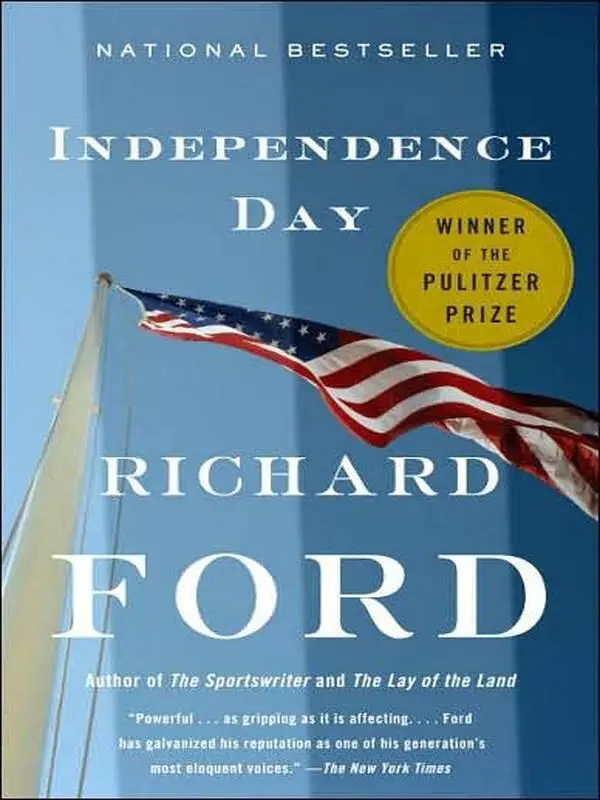
- Название:Independence Day
- Автор:
- Издательство:Vintage
- Жанр:
- Год:1996
- ISBN:нет данных
- Рейтинг книги:3 / 5. Голосов: 1
-
Избранное:Добавить в избранное
- Отзывы:
-
Ваша оценка:
Independence Day: краткое содержание, описание и аннотация
Предлагаем к чтению аннотацию, описание, краткое содержание или предисловие (зависит от того, что написал сам автор книги «Independence Day»). Если вы не нашли необходимую информацию о книге — напишите в комментариях, мы постараемся отыскать её.
, Richard Ford deepens his portrait of one of the most unforgettable characters in American fiction, and in so doing gives us an indelible portrait of America. Frank Bascombe, in the aftermath of his divorce and the ruin of his career, has entered an "Existence Period," selling real estate in Haddam, New Jersey, and mastering the high-wire act of normalcy. But over one Fourth of July weekend, Frank is called into sudden, bewildering engagement with life.
is a moving, peerlessly funny odyssey through America and through the layered consciousness of one of its most compelling literary incarnations, conducted by a novelist of astonishing empathy and perception.
Independence Day — читать онлайн бесплатно полную книгу (весь текст) целиком
Ниже представлен текст книги, разбитый по страницам. Система сохранения места последней прочитанной страницы, позволяет с удобством читать онлайн бесплатно книгу «Independence Day», без необходимости каждый раз заново искать на чём Вы остановились. Поставьте закладку, и сможете в любой момент перейти на страницу, на которой закончили чтение.
Интервал:
Закладка:
In the ensuing winter, the previously mentioned Dr. Flaherty, then age twenty-three and not yet a doctor, interrupted her medical studies at Dartmouth and flew to Paris to spend “a season” with me — entirely against her father’s best judgment (who could blame him?) and without the slightest expectance that the world held out any future for her and me together or that the future even needed to be taken into account. The two of us struck off on a driving tour in a rented Peugeot to wherever seemed interesting on the European map, with me paying the freight from the proceeds of my magazine-stock buyout and Catherine doing all the complicated map reading, food ordering, direction seeking, bathroom locating, phone calling, and bellman paying. She had, naturally, been to Europe at least twenty times before she was out of Choate and could in all instances remember and easily lead us straight to a “neat little hilltop restaurant” above the Dordogne, or “an interesting place for very late lunch” near the Palacio in Madrid, or find the route to a house that was once Strindberg’s wife’s home outside Helsinki. The whole trip had for her the virtue of an aimless, nostalgic return to past triumphs in the company of a non-traditional “other,” just before life — serious adult life — began in earnest and fun was forgotten forever; while for me it was more of an anxious dash across a foreign but thrilling exterior landscape, commenced in hopes of arriving at a temporary refuge where I’d feel rewarded, revived, less anxious, possibly even happy and at peace.
It’s not necessary to say much of what we did. (Such pseudo-romantic excursions must all be more or less alike and closed-ended.) We eventually “settled” in the town of Saint-Valéry-sur-Somme, in Channel-side Picardy. There we passed the better part of two months together, spent a great deal of my money, rode bicycles, read plenty of books, visited battlefields and cathedrals, tried sculling on the canals, walked pensively along the grassy verge of the old estuarial river, watching French fishermen catch perch, walked pensively around the bay to the alabaster village of Le Crotoy, then walked back, made much love. I also practiced my college French, chatted up the English tourists, stared at sailboats, flew kites, ate many gritty moules meunières , listened to much “traditional” jazz, slept when I wanted to and even when I didn’t, woke at midnight and stared at the sky as though I needed to get a clearer view of something but wasn’t sure what it was. I did all this until I felt perfectly okay, not in love with Catherine Flaherty but not unhappy, although also futureless, disused and bored — the way, I imagine, extended time in Europe makes any American who cares to stay an American feel (possibly similar to how a larcenous small-town road commissioner feels during the latter part of his stay in the Penns Neck minimum security facility).
Though what I in time began to sense in France was actually a kind of disguised urgency (disguised, as urgency often is, as unurgency), a feeling completely different from the old clicking, whirly, suspenseful perturbations I’d felt in my last days as a sportswriter: of being divorced, full of regret, and needing to pursue women just to keep myself pacified, amused and slightly dreamy. This new variety was more a deep-beating urgency having to do with me and me only, not me and somebody. It was, I now believe, the profound low thrum of my middle life seeking to be seized rather than painlessly avoided. (There’s nothing like spending eight weeks alone with a woman two decades your junior to make you wise to the fact that you’ll someday disappear, make you bored daffy by the concept of youth, and dismally aware how impossible it is ever to be “with” another human being.)
One evening then, over a plate of ficelle picarde and one more glass of tolerable Pouilly-Fumé, it occurred to me that being there with winsome, honey-haired, sweetly ironic Catherine was indeed a kind of dream and a dream I’d wanted to have, only it was now a dream that was holding me back — from what, I wasn’t sure, but I needed to find out. Needless to say, she had to have been bored silly by me but had gone on acting, in a vaguely amused way, as if I was a “pretty funny ole guy” with pretty interesting, eccentric habits, not one bit to be taken lightly “as a man,” and that being in Saint-Valéry with me had made all the difference in getting her young life started in the most properly seasoned way, and she would remember it all forever. She didn’t, however, mind if I left or if she stayed, or if we both left or stayed. She already had plans to leave, which she hadn’t thought to tell me about yet; and in any case, when I was seventy and in adult Pampers, she’d have been fiftyish, in a surly mood from all she’d missed and in no rush to humor me — which by then would be all I’d want. So that there was no thought of a long haul for the two of us.
But in just that short an order and on that very evening, and without a harsh word, we kissed and broke camp — she back to Dartmouth, and me back to …
Haddam. Where I landed not only with a new feeling of great purpose and a fury to suddenly do something serious for my own good and possibly even others’, but also with the feeling of renewal I’d gone far to look for and that immediately translated into a homey connectedness to Haddam itself, which felt at that celestial moment like my spiritual residence more than any place I’d ever been, inasmuch as it was the place I instinctively and in a heat came charging back to. (Of course, having come first to life in a true place , and one as monotonously, lankly itself as the Mississippi Gulf Coast, I couldn’t be truly surprised that a simple setting such as Haddam — willing to be so little itself — would seem, on second look, a great relief and damned easy to cozy up to.)
Before, when I was in town writing sports, as a married, then latter, divorced man, I’d always fancied myself a spectral presence, like a ship cruising foggy banks, hoping to hang near and in hearing distance of the beach but without ever bashing into it. Now, though, by reason of Haddam’s or any suburb’s capacity to accommodate any but the rankest outsider (a special lenience which can make us miss even the most impersonal housing tract or condo development), I felt towny: a guy who shares a scuzzy joke with the Neapolitan produce man, who knows exactly the haircut he’ll get at Barber’s barbershop but goes there anyway, who’s voted for more than three mayors and can remember how things used to be before something else happened and as a result feels right at home. These feelings of course ride the froth of one’s sense of hope and personal likelihood.
Every age of life has its own little pennant to fly. And mine upon returning to Haddam was decidedly two-sided. On one side was a feeling of bright synchronicity in which everything I thought about — regaining a close touch with my two children after having flown the coop for a while, getting my feet wet in some new life’s enterprise, possibly waging a campaign to reclaim lost ground with Ann — all these hopeful activities seemed to be, as though guided by a lightless beam, what my whole life was all about. I was in a charmed state in which nothing was alien and nothing could resist me if I turned my mind to it. (Psychiatrists like the one my son visits warn us about such feelings, flagging us all away from the poison of euphoria and hauling us back to flat earth, where they want us to be.)
The other feeling, the one that balanced the first, was a sensation that everything I then contemplated was limited or at least underwritten by the “plain fact of my existence”: that I was after all only a human being, as untranscendent as a tree trunk, and that everything I might do had to be calculated against the weight of the practical and according to the standard considerations of: Would it work? and, What good would it do for me or anybody?
Читать дальшеИнтервал:
Закладка:
Похожие книги на «Independence Day»
Представляем Вашему вниманию похожие книги на «Independence Day» списком для выбора. Мы отобрали схожую по названию и смыслу литературу в надежде предоставить читателям больше вариантов отыскать новые, интересные, ещё непрочитанные произведения.




Обсуждение, отзывы о книге «Independence Day» и просто собственные мнения читателей. Оставьте ваши комментарии, напишите, что Вы думаете о произведении, его смысле или главных героях. Укажите что конкретно понравилось, а что нет, и почему Вы так считаете.