Richard Ford - Independence Day
Здесь есть возможность читать онлайн «Richard Ford - Independence Day» весь текст электронной книги совершенно бесплатно (целиком полную версию без сокращений). В некоторых случаях можно слушать аудио, скачать через торрент в формате fb2 и присутствует краткое содержание. Год выпуска: 1996, Издательство: Vintage, Жанр: Современная проза, на английском языке. Описание произведения, (предисловие) а так же отзывы посетителей доступны на портале библиотеки ЛибКат.
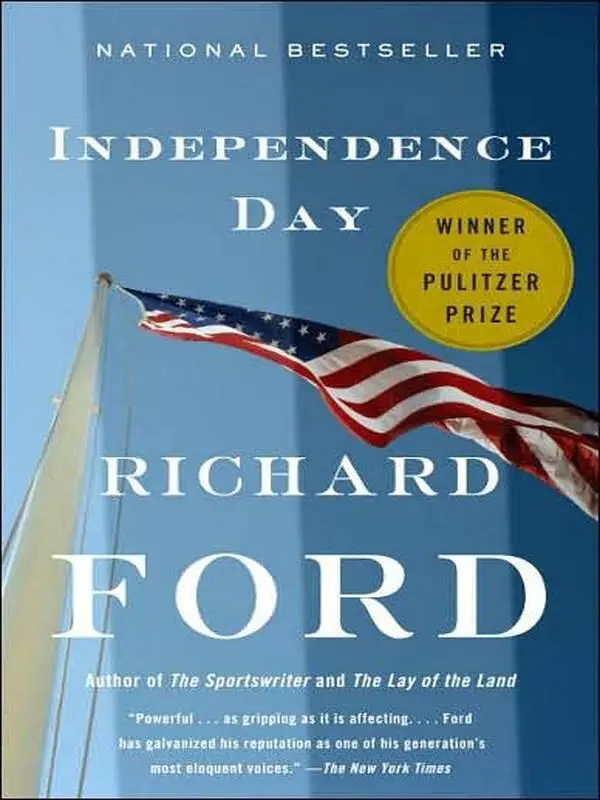
- Название:Independence Day
- Автор:
- Издательство:Vintage
- Жанр:
- Год:1996
- ISBN:нет данных
- Рейтинг книги:3 / 5. Голосов: 1
-
Избранное:Добавить в избранное
- Отзывы:
-
Ваша оценка:
Independence Day: краткое содержание, описание и аннотация
Предлагаем к чтению аннотацию, описание, краткое содержание или предисловие (зависит от того, что написал сам автор книги «Independence Day»). Если вы не нашли необходимую информацию о книге — напишите в комментариях, мы постараемся отыскать её.
, Richard Ford deepens his portrait of one of the most unforgettable characters in American fiction, and in so doing gives us an indelible portrait of America. Frank Bascombe, in the aftermath of his divorce and the ruin of his career, has entered an "Existence Period," selling real estate in Haddam, New Jersey, and mastering the high-wire act of normalcy. But over one Fourth of July weekend, Frank is called into sudden, bewildering engagement with life.
is a moving, peerlessly funny odyssey through America and through the layered consciousness of one of its most compelling literary incarnations, conducted by a novelist of astonishing empathy and perception.
Independence Day — читать онлайн бесплатно полную книгу (весь текст) целиком
Ниже представлен текст книги, разбитый по страницам. Система сохранения места последней прочитанной страницы, позволяет с удобством читать онлайн бесплатно книгу «Independence Day», без необходимости каждый раз заново искать на чём Вы остановились. Поставьте закладку, и сможете в любой момент перейти на страницу, на которой закончили чтение.
Интервал:
Закладка:
I told Roily Mounger I’d give his suggestion some serious thought, even though I said the idea pretty much came out of left field. He said there was no hurry to make a decision about becoming a realtor, that down at their office everyone had gotten there by different routes and timetables, and there were no two alike. He himself, he said, had been a supermarket developer and before that a policy strategist for a Libertarian state senate candidate. One person had a Ph.D. in American literature; another had left a seat on the Exchange; a third was a dentist! They all worked as independents but acted in concert whenever possible, which gave everybody a damn good feeling. Everybody had made a “ton of money” in the last few years and expected to make a ton more before the big correction came (“the whole industry” knew it was coming). From his point of view, which he admitted favored the commercial side, all you needed to do to wake up rich was “get with your money people, put some key factors and some financing on the table,” locate some unimproved parcels your group can handle the debt service and taxes on for twelve to eighteen months, then once the time’s up sell out the whole trunkload to some Johnny-come-lately Arabs or Japs and start cashing in your chips. “Let your money people run the risk gauntlet,” Roily said. “You just sit tight in the middle seat and take your commissions.” (You could always, of course, “participate” yourself, and he admitted he had. But the exposure could be substantial.)
To figure all this out took me no time at all. If everybody came at it from all angles, I thought maybe I could find one of my own to work — relying on the concept that you don’t sell a house to someone, you sell a life (this had so far been my experience). In this way I could still pursue my original plan to do for others while looking after Number One, which seemed a good aspiration as I entered a part of life when I’d decided to expect less, hope for modest improvements and be willing to split the difference.
I went down to the office in three days and got introduced around to everybody — a crew of souls who seemed like people you wouldn’t mind working out of the same office with. A short, bunchy-necked, thick-waisted dyke in a business suit and wing tips, named Peg, with Buick-bumper breasts, braces on her teeth and hair bleached silver (she was the Ph.D.). There was a tall, salt-and-pepper, blue-blazer Harvard grad in his late fifties — this was Shax Murphy, who’s since bought the agency and who’d retired out of some brokerage firm and still owned a house in Vinalhaven. He had his long, gray-flanneled legs stretched out in the aisle between desks, one big shiny cordovan oxford on top of the other, his face red as a western sunset from years of gentlemanly drinking, and I took to him instantly because when I shook his hand he had just put down a dog-eared copy of Paterson , which made me think he probably had life in pretty much the right perspective. “You just need to remember the three most important words in the ‘relaty budnus,’ Frank, and you’ll do fine in this shop,” he said, jiggering his heavy brows up and down mock seriously. ‘Locution, locution, locution.’” He sniffed loudly through his big ruby nose, rolled his eyes and went right back to reading.
Everyone else in the office at that time — two or three young realtor associates and the dentist — has left since the ’86 slide began to seem like a long fall-off. All of them were people without solid stakes in town or capital to back them up, and they quickly scattered back out of sight — to vet school at Michigan State, back home to New Hampshire, one in the Navy, and of course Clair Devane, who came later and met an unhappy end.
Old man Schwindell accorded me only the briefest, most cursory of interviews. He was an old, palely grim, wispy-haired, flaking-skinned little tyrant in an out-of-season seersucker suit and whom I’d seen in town for years, knew nothing about and viewed as a curio — though it was he who’d done the behind-the-scenes knitting of my deal with the Institute. He was also the “dean” of New Jersey realtors and had thirty plaques on his office wall saying as much, along with framed photos of himself with movie stars and generals and prizefighters he’d sold homes to. No longer officially active, he held forth in the back office, hunched behind a cluttered old glass-topped desk with his coat always on, smoking Pall Malls.
“Do you believe in progress, Bascombe?” Old man Schwindell squinted his almost hueless blue eyes up at me. He had a big mustache yellowed by eight million Pall Malls, and his grizzled hair was thick on the sides and growing out his ears but was thin on top and falling out in clusters. He suddenly groped behind himself without looking, clutched at the clear plastic hose attached to a big oxygen cylinder on wheels, yanked it and strapped a little elastic band around his head so that a tiny clear nozzle fit up into his nose and fed him air. “You know that’s our motto,” he gasped, routing his eyes down to monkey with his lifeline.
“That’s what Rolly’s told me,” I said. Roily had never mentioned word one about progress, had talked only about risk gauntlets, capital gains taxes and exposure, all of which he was dead against.
“I’m not going to ask you about it now. Don’t worry,” old man Schwindell said, not entirely satisfied with his flow, straining around to twist a green knob on the cylinder and succeeding only in getting half a good breath. “When you’ve been around here and know something,” he said with difficulty, “FU ask you to tell me your definition of progress. And if you give me the wrong answer, FU get rid of you on the spot.” He swiveled back around and gave me a mean little ocher-toothed leer, his air apparatus getting in the way of his mouth, though his breathing was going much more smoothly, so that he might’ve felt like he wasn’t about to die that very minute. “How’s that? Is that fair?”
“I think that’s fair,” I said. “I’ll try to give you a good answer.”
“Don’t give me a good answer. Give me the right answer!” he shouted. “Nobody should graduate the sixth grade without an idea of what progress is all about. Don’t you think so?”
“I agree completely,” I said, and I did, though mine had been suffering some setbacks.
“Then you’re good enough to start. You don’t have to be any good anyway. Realty sells itself in this town. Or it used to.” He started fiddling more furiously with his breathing tubes, trying to get the holes to line up better with his old hairy nostrils. And my interview was over, though I stood there for almost another minute before I recognized he wasn’t going to say anything else, so that I just eventually let myself out.
And for all practical purposes I was on my sweet way after that. Roily Mounger took me to lunch at The Two Lawyers. I’d have a “break-in period,” he told me, of about three months, when I’d be on salary (no insurance or benefits). Everybody would chip in and rotate me around the office, see to it I learned the MLS hardware and the office lingo. I’d go on “beaucoup” house showings and closings and inspections and realty caravans, “just to get to know whatever,” all this while I was going to class at my own expense—“three hundred bucks más o menos.” At the end of the course I’d take the state exam at the La Quinta in Trenton, then “jump right in on the commission side and start root-hoggin’.”
“I wish I could tell you there was one goddamn hard thing about any of this, Frank,” Roily said in amazement. “But”—and he shook his jowly, buzz-cut head—“if it was so goddamned hard why would I be doing it? Hard work’s what the other asshole does.” And with that he cut a big bracking fart right into his Naugahyde chair and looked all around at the other lunchers, grinning like a farm boy. “You know, your soul’s not supposed to be in this,” he said. “This is realty. Reality’s something else — that’s when you’re born and you die. This is the in-between stuff here.”
Читать дальшеИнтервал:
Закладка:
Похожие книги на «Independence Day»
Представляем Вашему вниманию похожие книги на «Independence Day» списком для выбора. Мы отобрали схожую по названию и смыслу литературу в надежде предоставить читателям больше вариантов отыскать новые, интересные, ещё непрочитанные произведения.



Обсуждение, отзывы о книге «Independence Day» и просто собственные мнения читателей. Оставьте ваши комментарии, напишите, что Вы думаете о произведении, его смысле или главных героях. Укажите что конкретно понравилось, а что нет, и почему Вы так считаете.