Richard Ford - Independence Day
Здесь есть возможность читать онлайн «Richard Ford - Independence Day» весь текст электронной книги совершенно бесплатно (целиком полную версию без сокращений). В некоторых случаях можно слушать аудио, скачать через торрент в формате fb2 и присутствует краткое содержание. Год выпуска: 1996, Издательство: Vintage, Жанр: Современная проза, на английском языке. Описание произведения, (предисловие) а так же отзывы посетителей доступны на портале библиотеки ЛибКат.
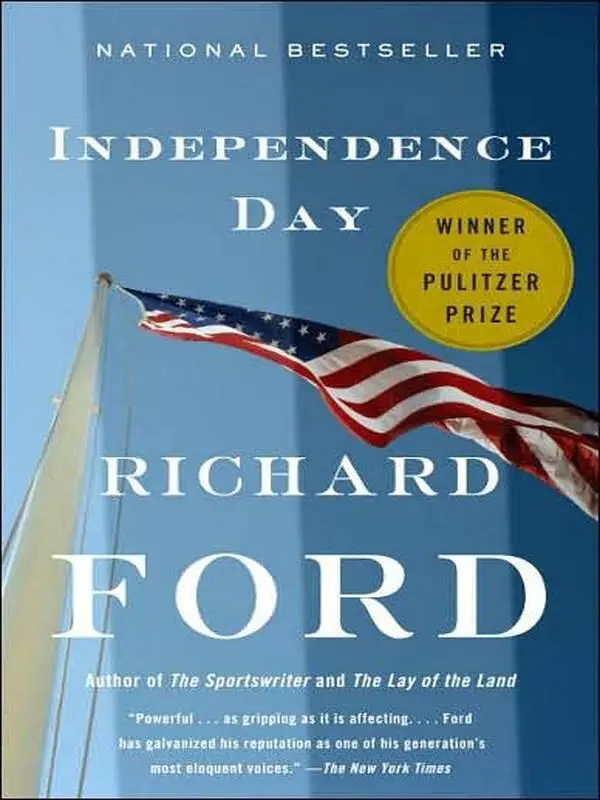
- Название:Independence Day
- Автор:
- Издательство:Vintage
- Жанр:
- Год:1996
- ISBN:нет данных
- Рейтинг книги:3 / 5. Голосов: 1
-
Избранное:Добавить в избранное
- Отзывы:
-
Ваша оценка:
Independence Day: краткое содержание, описание и аннотация
Предлагаем к чтению аннотацию, описание, краткое содержание или предисловие (зависит от того, что написал сам автор книги «Independence Day»). Если вы не нашли необходимую информацию о книге — напишите в комментариях, мы постараемся отыскать её.
, Richard Ford deepens his portrait of one of the most unforgettable characters in American fiction, and in so doing gives us an indelible portrait of America. Frank Bascombe, in the aftermath of his divorce and the ruin of his career, has entered an "Existence Period," selling real estate in Haddam, New Jersey, and mastering the high-wire act of normalcy. But over one Fourth of July weekend, Frank is called into sudden, bewildering engagement with life.
is a moving, peerlessly funny odyssey through America and through the layered consciousness of one of its most compelling literary incarnations, conducted by a novelist of astonishing empathy and perception.
Independence Day — читать онлайн бесплатно полную книгу (весь текст) целиком
Ниже представлен текст книги, разбитый по страницам. Система сохранения места последней прочитанной страницы, позволяет с удобством читать онлайн бесплатно книгу «Independence Day», без необходимости каждый раз заново искать на чём Вы остановились. Поставьте закладку, и сможете в любой момент перейти на страницу, на которой закончили чтение.
Интервал:
Закладка:
Myrlene Beavers comes scraping out onto her porch, a yellow cordless phone to her ear. A few neighbors have appeared on their porches to see what’s what. One of them also has a cordless. She and Myrlene are doubtless connected up.
“Well,” Sergeant Balducci says, dotting a few i’s and shoving his notebook back in his pocket. He is still smiling mockingly. “We’ll check this out.”
“Fine,” I say, “but I didn’t try to break into this house.” And I’m breathless again. “That old lady’s nuts across the street.” I glare over at the traitorous Myrlene, gabbling away like a goose to her neighbor two houses down.
“People all watch out for each other in this neighborhood, Mr. Bascombe,” Sergeant Balducci says, and looks up at me pseudo-seriously, then looks at Betty McLeod. “They have to. If you have any more trouble, Mrs. McLeod, just give us a call.”
“All right,” is all Betty McLeod says.
“She didn’t have any trouble this time!” I say, and give Betty a betrayed look.
Sergeant Balducci takes a semi-interested glance up at me from the concrete walk of my house. “I could give you some time to cool off,” he says in an uninflected way.
“I am cooled off,” I say angrily. “I’m not mad at anything.”
“That’s good,” he says. “I wouldn’t want you to get your bowels in an uproar.”
On the tip of my tongue are these words: “Gee thanks. And how would you like to bite my ass?” Only the look of his short, stout arms stuffed like fat salamis into his short blue shirtsleeves makes me suspect Sergeant Balducci is probably a specialist in broken collarbones and deadly chokeholds of the type practiced on my son. And I literally bite the tip of my tongue and look bleakly across Clio Street at Myrlene Beavers, blabbing on her cheap Christmas phone and watching me — or some blurry image of a white devil she’s identified me to be — as if she expected me to suddenly catch flame and explode in a sulfurous flash. It’s too bad her husband’s gone, is what I know. The good Mr. Beavers would’ve made this all square.
Sergeant Balducci begins ambling back toward his cruiser Plymouth, his waist radio making fuzzy, meaningless crackles. When he opens the door, he leans in and says something to his partner and they both laugh as the Sarge squeezes in and notes something on a clipboard stuck to the dash. I hear the word “owner,” and another laugh. Then the door shuts and they ease away, their big duals murmuring importantly.
Betty McLeod has not moved behind her screen, her two little mulatto kids now peeping around each side of her housecoat. Her face reveals no sympathy, no puzzlement, no bitterness, not even a memory of these.
“I’ll just come back when Larry’s home,” I say hopelessly.
“All right then.”
I fasten a firm, accusing look on her. “Who else is here?” I say. “I heard the toilet running.”
“My sister,” Betty says. “Is that any of your business?”
I look hard at her, trying to read truth in her beaky little features. A sibling from Red Cloud? A willowy, big-handed Sigrid, taking a holiday from her own Nordic woes to commiserate with her ethical sis. Conceivable, but not likely. “No,” I say, and shake my head.
And then Betty McLeod, on no particular cue, simply shuts her front door, leaving me on the porch empty-handed with the equatorial sun beating on my head. Inside, she goes through the relocking-the-locks ritual, and for a long moment I stand listening and feeling forlorn; then I just start off toward my car with nothing left of good to do. I will now be after the 4th getting my rent, if I get it then.
Myrlene Beavers is still on the porch of her tiny white abode with sweet peas twirling up the posts, her hair frazzled and damp, her big fingers clenching the rubber walker like handholds on a roller coaster. Other neighbors have now gone back inside.
“Hey!” she calls out at me. “Did they catch that guy?” Her little yellow phone is hooked to her walker with a plastic coat-hanger rig-up. No doubt her kids have bought it so they can all keep in touch. “They was tryin’ to break in over at Larry’s. You musta scared him off.”
“They caught him,” I say. “He’s not a threat anymore.”
“That’s good!” she says, a big falsey-toothy smile opening onto her face. “You do a wonderful job for us. We’re all grateful to you.”
“We just do our best,” I say.
“Did you never know my husband?”
I put my hands on my doorframe and look consolingly at poor fast-departing Myrlene, soon to join her beloved in the other place. “I sure did,” I say.
“Now he was a wonderful man,” Mrs. Beavers says, taking the words from my very thought. She shakes her head at his lost visage.
“We all miss him,” I say.
“I guess we do,” she says, and starts her halting, painful way back inside her house. “I guess we sho ’nuf do.”
5
I drive windingly out Montmorency Road into Haddam horse country — our little Lexington — where fences are long, white and orthogonal, pastures wide and sloping, and roads (Rickett’s Creek Close, Drumming Log Way, Peacock Glen) slip across shaded, rocky rills via wooden bridges and through the quaking aspens back to rich men’s domiciles snugged deep in summer foliage. Here, the Fish & Game quietly releases hatchery trout each spring so well-furnished sportsmen/home owners with gear from Hardy’s can hike down and wet a line; and here, wedges of old-growth hardwoods still loom, trees that saw Revolutionary armies rumble past, heard the bugles, shouts and defiance cries of earlier Americans in their freedom swivet, and beneath which now tawny-haired heiresses in jodhpurs stroll to the paddock with a mind for a noon ride alone. Occasionally I’ve shown houses out this way, though their owners, fat and bedizened as pharaohs, and who should be giddy with the world’s gifts, always seem the least pleasant people in the world and the most likely to treat you like part-time yard help when you show up to “present their marvelous home.” Mostly, Shax Murphy handles these properties for our office, since by nature he possesses the right brand of inbred cynicism to find it all hilarious, and likes nothing more than peeling the skin off rich clients a centimeter at a time. I, on the other hand, cleave to the homier market, whose homespun spirit I prize.
I think now, with regard to the disagreeable McLeods, that my mistake has been pretty plain: I should’ve hauled them over for a cookout the minute I closed on their house, gotten them into some lawn chairs on the deck, slammed a double margarita in both of them, served up a rack of ranch-style ribs, corn on the cob, tomato and onion salad and a key lime pie, and all after would’ve been jake. Later, when matters took a sour turn (as always happens between landlord and tenant, unless the tenants are inclined toward gratitude, or the landlord’s a fool), we’d have had some instant history for ballast against suspicion and ill will, which are now unhappily the status quo. Why I didn’t I don’t know, except that it’s not my nature.
I literally bashed right into Franks one summer night a year ago, driving home tired and foggy-eyed from the Red Man Club, where I’d fished till ten. In its then incarnation as Bemish’s Birch Beer Depot, it rose appealingly up out of the night as I rounded a curve on Route 31, my eyes smarting and heavy, my mouth dry as burlap, the perfect precondition for a root beer.
Everybody over forty (unless they were born in the Bronx) has pristine and uncomplicated memories of such places: low, orange-painted wooden bunker boxes with sliding-screen customers’ windows, strings of yellow bulbs outside, whitewashed tree trunks and trash barrels, white car tires designating proper parking etiquette, plenty of instructional signs on the trees and big frozen mugs of too-cold root beer you could enjoy on picnic tables by a brook or else drink off metal trays with your squeeze in the dark, radio-lit sanctity of your ’57 Ford.
Читать дальшеИнтервал:
Закладка:
Похожие книги на «Independence Day»
Представляем Вашему вниманию похожие книги на «Independence Day» списком для выбора. Мы отобрали схожую по названию и смыслу литературу в надежде предоставить читателям больше вариантов отыскать новые, интересные, ещё непрочитанные произведения.






Обсуждение, отзывы о книге «Independence Day» и просто собственные мнения читателей. Оставьте ваши комментарии, напишите, что Вы думаете о произведении, его смысле или главных героях. Укажите что конкретно понравилось, а что нет, и почему Вы так считаете.