Richard Ford - Independence Day
Здесь есть возможность читать онлайн «Richard Ford - Independence Day» весь текст электронной книги совершенно бесплатно (целиком полную версию без сокращений). В некоторых случаях можно слушать аудио, скачать через торрент в формате fb2 и присутствует краткое содержание. Год выпуска: 1996, Издательство: Vintage, Жанр: Современная проза, на английском языке. Описание произведения, (предисловие) а так же отзывы посетителей доступны на портале библиотеки ЛибКат.
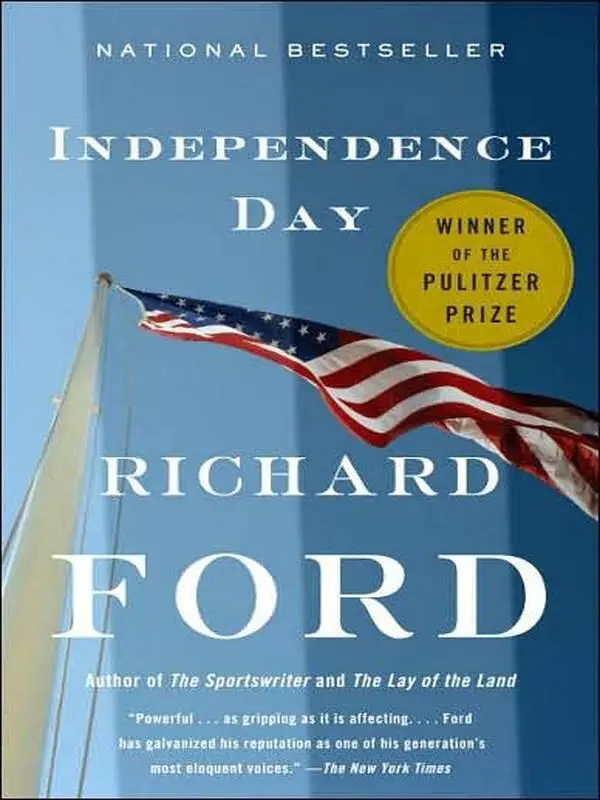
- Название:Independence Day
- Автор:
- Издательство:Vintage
- Жанр:
- Год:1996
- ISBN:нет данных
- Рейтинг книги:3 / 5. Голосов: 1
-
Избранное:Добавить в избранное
- Отзывы:
-
Ваша оценка:
Independence Day: краткое содержание, описание и аннотация
Предлагаем к чтению аннотацию, описание, краткое содержание или предисловие (зависит от того, что написал сам автор книги «Independence Day»). Если вы не нашли необходимую информацию о книге — напишите в комментариях, мы постараемся отыскать её.
, Richard Ford deepens his portrait of one of the most unforgettable characters in American fiction, and in so doing gives us an indelible portrait of America. Frank Bascombe, in the aftermath of his divorce and the ruin of his career, has entered an "Existence Period," selling real estate in Haddam, New Jersey, and mastering the high-wire act of normalcy. But over one Fourth of July weekend, Frank is called into sudden, bewildering engagement with life.
is a moving, peerlessly funny odyssey through America and through the layered consciousness of one of its most compelling literary incarnations, conducted by a novelist of astonishing empathy and perception.
Independence Day — читать онлайн бесплатно полную книгу (весь текст) целиком
Ниже представлен текст книги, разбитый по страницам. Система сохранения места последней прочитанной страницы, позволяет с удобством читать онлайн бесплатно книгу «Independence Day», без необходимости каждый раз заново искать на чём Вы остановились. Поставьте закладку, и сможете в любой момент перейти на страницу, на которой закончили чтение.
Интервал:
Закладка:
The batting cage boys have now shoved off, their metal bats leaned outside the fence, all three cages empty and inviting.
“I believe we have to take a few chops, whatta you think?” I say to Paul. I am not at full strength but am ready, suddenly, for something .
Paul estimates the cages from a distance, his clumsy feet turned out now, as slew-footed as the least athletic of boys, heavy and uninspirable.
“Come on,” I say, “you can coach.” Possibly he makes a tiny double eeeck or a fugitive bark; I’m not certain. Though he comes.
Like a militant camp counselor, I lead us straight across to the fenced cages, which are fitted out with fifty-cent coin boxes and draped inside with green netting to keep careening balls from maiming people and injuring the pitching machines, which are themselves big, dark-green, boxy, industrial-looking contraptions that work by feeding balls from a plastic hopper through a chain-drive circuitry that ends with two rubber car tires spinning in opposite tangency at a high rate of speed and from between which each “pitch” is actually expelled . Signs posted all around remind you to wear a helmet, protective glasses and gloves, to keep the gates closed, to enter the cage alone, to keep small children, pets, bottles, anything breakable including wheelchair occupants out — and if none of these warnings is convincing, all risk is yours anyway (as if anybody thought different).
The three metal bats leaning on the fence are identically too short, too light, their taped grips much too thin. I tell Paul to stand clear while I “test” one bat, holding it up in front of me like a knight’s sword, sighting down its blue aluminum shaft (as I used to do long ago when I played in military school) and for some reason waggling it. I turn sideways of Paul — my camera still on my shoulder — cock the bat behind my ear in a natural-feeling Stan Musial knees-in stance and peer straight at him as though he were Jim Lonborg, the old BoSox righty, ready to rare, kick and fire.
“This is how Stan the Man used to stand in there,” I say over my left elbow, my eyes hooded. I trigger a wicked swing, which feels clumsy and ridiculous. Some necessary leverage between my wrists and shoulders feels sprung now, so that my swing could only possibly contact the ball with a slapping motion that wouldn’t drive a fruit fly out of the phone booth but would absolutely make me look like a girl.
“Is that how Stan the Man swung?” Paul says.
“Yeah, and it went a fuckin’ mile,” I say. I hear shouts, a chorus of “I got it, I got it,” from inside Doubleday Field. I look around and above the grandstand where we were five minutes ago; white balls arch through the sky, two and three at once, all to be caught but invisible to us here.
Each cage has a title to colorfully reflect the speed of its pitches: “Dyno-Express” (75 mph). “The Minors” (65 mph). “Hot Stove League” (55 mph). I have no reservations about trying my skills in the “Dyno-Express” and so give Paul my camera and two quarters, leaving the batting helmets on their fence hook. I step right inside, close the gate, walk to the batter’s box and look out toward the mean green machine as I seek out solid footing a bat’s length from the outside corner of the regulation rubber plate that’s planted between two scruffy rectangular AstroTurf pads put there to make things look authentic. I once again assume my Musial stance, make a slow, measuring pass of the bat barrel through my putative strike zone, square my knuckles on the handle, rotate the trademark back and line my deck-shoe toes with the center-field flag (though of course there is no flag, only the pitching machine itself and the protective netting, behind which is a sign that says “Home Run?”). I take and release a breath, once more deliberately extend the bat over the plate, then slowly bring it back.
“What time is it?” Paul says.
“Ten. There’s no clock in baseball.” I glimpse him over my shoulder through the diamond fence wires. He is looking up at the sky and back at the grandstand entrance, where a few fantasy players and their young-looking wives are strolling happy-go-lucky into the sunshine, gloved hands draped over soft shoulders, ball caps turned sideways, everyone ready for a beer, a bratwurst and a few yucks before the big game with Boston.
“Weren’t we supposed to do something else?” he says, and looks at me. “Something about a hall of fame?”
“You’ll get there,” I say. “Trust me.”
I again have to establish my stance and settle on a proper balance and repose. But once I’m fixed I say loudly to Paul, “Slap the money in the box,” and he does, after which and for a long moment there is calm as the machine radiates a kind of patient human immanence, though this is broken after several seconds by a deep mechanical humming during which a heretofore unnoticed red bulb begins to brighten on top, after which the plastic hopper full of balls begins to vibrate. The machine gives no other sign it means business, but I stare riveted at the black confluence of rubber tires, which have not moved.
“Those greaseballs fucked it up,” Paul says behind me. “You wasted your money.”
“I don’t think so,” I say, keeping my balance and stance, my calm intact, bat back, eyes to the machine. My palms and fingers squeeze the bat tape, my shoulders stiffen, though I feel my wrists begin to bend back in a way Stan would deplore but that feels necessary for the raised bat barrel to descend quickly enough to the plane of the ball for me to avoid the girlish slap motion I don’t want to be “my swing.” I hear someone shout out, “Look at that asshole,” and can’t resist a quick look to see who’s being referred to but see no one, then quickly return my gaze to the machine and the two tires, where there’s still nothing happening to indicate a “pitch.” Until I slightly relax my shoulders to avoid “binding,” and it’s then the machine makes a more portentous, metallic whirring noise. The black tires start to spin at an instantly great rate. A single ball teeters in full view down a previously unremarked metal channel, then goes “underground” into a smaller slot, after which it or one just like it is viciously spit from between the spinning rubber rings and crosses the plate at a speed so fast and at a distance so easily reachable that I don’t even swing, merely let the ball whang the fence behind me and bound back through my legs and out toward an unobserved concrete bunker in front of me whose duty is to route balls back to the hopper. (The basketball version was much jazzier.)
Paul is silent. I do not even turn his way, refixing instead like a sniper on what is my opponent, the slit between the spinning tires. Another interior whirring sound becomes audible. I watch as another ball wobbles down the metal track, disappears and then is shot through space, hissing across the plate directly under my fists and again whanging the fence behind me, untouched and unswung at.
Paul again says nothing. Not “Strike two” or “It sounded high” or “Just try and make contact, Dad.” No chuckle or raspberry or fart noise. Not even a bark of encouragement. Only adjudicating silence.
“How many do I get?” I say, merely to hear a sound.
“I just got here,” he says.
Though just as I’m picturing the numeral five as the likeliest number, another orange-stitched ball comes rocketing across the plate and rattles the screen, suggesting the machine has possibly quick-pitched me.
Sweat has now appeared upward of my hairline. For ball number four, I extend the stubby bat barrel like a gate barrier straight out into my strike zone and hold it there stiff until the machine generates another pitch, which hits the bat and ricochets off the metal sweet spot with a dink-poink , and fouls off against one of the warning signs, finally bouncing back and actually striking me on the heel.
Читать дальшеИнтервал:
Закладка:
Похожие книги на «Independence Day»
Представляем Вашему вниманию похожие книги на «Independence Day» списком для выбора. Мы отобрали схожую по названию и смыслу литературу в надежде предоставить читателям больше вариантов отыскать новые, интересные, ещё непрочитанные произведения.




Обсуждение, отзывы о книге «Independence Day» и просто собственные мнения читателей. Оставьте ваши комментарии, напишите, что Вы думаете о произведении, его смысле или главных героях. Укажите что конкретно понравилось, а что нет, и почему Вы так считаете.