Richard Ford - Independence Day
Здесь есть возможность читать онлайн «Richard Ford - Independence Day» весь текст электронной книги совершенно бесплатно (целиком полную версию без сокращений). В некоторых случаях можно слушать аудио, скачать через торрент в формате fb2 и присутствует краткое содержание. Год выпуска: 1996, Издательство: Vintage, Жанр: Современная проза, на английском языке. Описание произведения, (предисловие) а так же отзывы посетителей доступны на портале библиотеки ЛибКат.
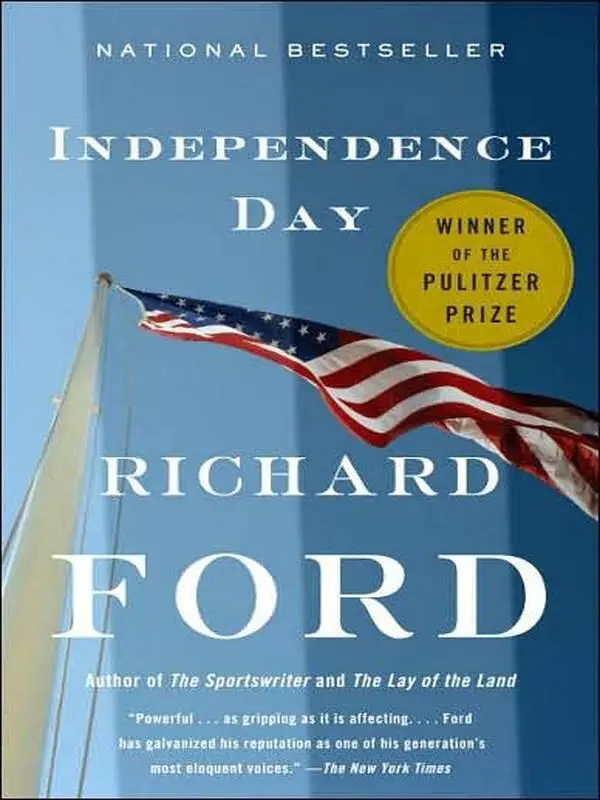
- Название:Independence Day
- Автор:
- Издательство:Vintage
- Жанр:
- Год:1996
- ISBN:нет данных
- Рейтинг книги:3 / 5. Голосов: 1
-
Избранное:Добавить в избранное
- Отзывы:
-
Ваша оценка:
Independence Day: краткое содержание, описание и аннотация
Предлагаем к чтению аннотацию, описание, краткое содержание или предисловие (зависит от того, что написал сам автор книги «Independence Day»). Если вы не нашли необходимую информацию о книге — напишите в комментариях, мы постараемся отыскать её.
, Richard Ford deepens his portrait of one of the most unforgettable characters in American fiction, and in so doing gives us an indelible portrait of America. Frank Bascombe, in the aftermath of his divorce and the ruin of his career, has entered an "Existence Period," selling real estate in Haddam, New Jersey, and mastering the high-wire act of normalcy. But over one Fourth of July weekend, Frank is called into sudden, bewildering engagement with life.
is a moving, peerlessly funny odyssey through America and through the layered consciousness of one of its most compelling literary incarnations, conducted by a novelist of astonishing empathy and perception.
Independence Day — читать онлайн бесплатно полную книгу (весь текст) целиком
Ниже представлен текст книги, разбитый по страницам. Система сохранения места последней прочитанной страницы, позволяет с удобством читать онлайн бесплатно книгу «Independence Day», без необходимости каждый раз заново искать на чём Вы остановились. Поставьте закладку, и сможете в любой момент перейти на страницу, на которой закончили чтение.
Интервал:
Закладка:
“How many times do you think you’ll get married?” Paul says, still watching the faraway skier, not wanting to trade eyes with me on this subject — one he does care about. He looks quickly around behind the grill at the big wall-size color photo of a hamburger on a clean white plate, with a bowl of strangely red soup and a fountain Coke, all coated with grease enough to hold a fly captive till Judgment Day. He has asked me this question as recently as two days ago, I think.
“Oh, I don’t know,” I say. “Eight, nine times before I’m good ‘n’ done, I guess.” I shut my eyes, then slowly open them so he is in dead center. “What the hell do you care? Have you got some old bag in the stripping business you want me to meet down in Oneonta?” He, of course, knows Sally from our visits to the Shore but has remained significantly silent about her, as he should.
“It doesn’t matter,” he says almost inaudibly, my fear — the ordinary and abiding parent’s fear that he’ll miss his childhood — clearly unfounded, given the look on his face. Though Ann’s fear, of harm and of his frailty, rises to my mind’s view like a warning — a boating mishap, a collision at a bad intersection, a kid’s punch-out whereby his tender forehead kisses a curb. Letting him sly away into the dark unguarded last night would definitely be frowned on by the experts, might possibly even be seen as abusive.
He is pick-picking at the duct tape that holds together The Water’s Edge’s ancient plastic booths. “I wish we could stay here another day,” he says.
“Well, we’ll have to come back.” I’m out with my camera then in half a second. “Lemme make yer pitcher to prove you really came.” Paul quickly looks behind him as if to find out who’ll mind having his picture taken. The coffee drinkers have slipped away and wandered off down the dock. The poker player has his back humped over his machine. The cook is occupied whipping up a breakfast of his own. Paul looks back at me across the little table, his eyes troubled by a wish for something more, for more to get in the picture — me, possibly. But that’s not possible. He is all there is.
“Tell me another good joke,” I say in behind my Olympus, through which his girlish boy’s face is small but fully captured.
“Have you got the hamburger in the picture?” he says, and looks stern.
“Yeah,” I say, “the hamburger’s in.” And it is.
“That’s what I was worried about,” he says, then brightly, wonderfully smiles at me.
And that is the picture I will keep of him forever.
U p the welcomingly warm morning hill we trudge, side by each, bound finally for the Hall of Fame. It’s 9:30, and time is in fact a-wastin’. Though when we round the corner onto sunny Main, a half block from the Hall — red brick, with Greek pediments and dubious trefoils on the gable ends, an architectural rattlebag resembling the building-fund dream of some overzealous flock of Wesleyans — something again is amiss. Out front, on the sidewalk, another or possibly the same cadre of men and women, boys and girls, is marching a circle, hoisting placards, sporting sandwich boards and chanting what from here — the red-white-and-blue-buntinged corner by Schneider’s German Bakery — sounds again like “shooter, shooter, shooter.” Though there seem to be more marchers now, plus an encircling group of spectators — fathers and sons, larger families, assorted oldsters, alongside normal every-Sunday parishioners just sprung by Father Damien down at Our Lady — all crowding and observing the marchers and spilling back into the street, slowing traffic and jamming the building entry, the exact coordinates Paul and I are vectored for.
“What’s this happy horseshit again?” he says, scowling at the crowd and its nucleus of noisy protesters, which suddenly blossoms into two circles rotating in opposite directions, so that ingress to the Hall is essentially stoppered.
“I guess something is worth protesting at the Hall of Fame,” I say, admiring the protesters, their (from here) illegible signs jutting in the air and their chants becoming louder as stronger-voiced marchers rotate our way. To me it all has a nice collegial feel of my Ann Arbor days (though I was never involved back then, being a scared-stiff, Dudley Doright frat-rat possessor of a highly revocable NROTC scholarship). Yet it feels laudable today that a spirit of manageable unrest and disagreement can be alive still on the fruited plain, even if it’s not associated with anything important.
Paul, however, doesn’t know what to say in the face of other people’s dissension, accustomed only to his own. “So okay, what’re we supposed to do — wait?” he says, and crosses his arms like an old scold. Potential new Hall visitors are drifting past us but stopping soon to take in the spectacle. Some Cooperstown police are standing across Main Street, two bulky men and two small, blue-shirted, terrier women, thumbs in their belts, amused by the whole event, now and then pointing toward something or someone they think is especially comical.
“Protests never last very long, in my experience,” I say.
Paul says nothing, only scowls and raises his hand to his teeth and gives his wart a delicate but incisive bite. All this is making him uneasy; his good-kid spirit has gone with the dew. “Can’t we just go in around ’em?” he says, tasting his own flesh and blood.
No one, I notice, is getting through or even trying. Most of the spectators, in fact, are looking entertained and talking at the protesters, or taking their pictures. It’s nothing too serious. “The idea is for us to be inconvenienced a while, then they’ll let us go on in. They have some point they want to make.”
“I think the cops oughta arrest ’em,” Paul says. He makes one emphatic little eeeck midway down his throat and grimaces. (Clearly he has spent more time with Charley than is healthy, since his human-rights attitude favors bulldozer privilege: faced with a blind beggar suffering an epileptic seizure in the revolving door of the University Club, you damn well find a way to bowl through for your court time in the sixty-and-over double-elimination consolation round.) I could easily pose a canny analogy to our nation’s early days, in which legitimate grievances were ignored and a crisis followed, but it would fall on uncaring ears. However, I mean to respect the protestors’ line even without knowing what it’s about. There’s time enough for the little we hope to do.
“Let’s take a walk,” I say, and set my hand on my son’s shoulder like a regular ole dad and guide us both out into crowded Main toward the Cooperstown Fire and Rescue station, where glistening yellow vehicles sit out in the driveway on Sunday display, uniformed firefighters and paramedics lounging around the bay doors watching Breakfast at Wimbledon . More church cars and several packed Gay Nineties trolleys are stacking up noisily, a few drivers willing to lean on their horns and poke heads irritably out windows to find out what’s what. Paul, I can see, is plainly troubled by this delay and mixup, and I’d like to get us out of the action and avoid another run-in of our own. So I proceed us up the sidewalk against the pedestrian traffic, past more storefronts with sports paraphernalia and trading cards, two open-early taprooms showing nonstop World Series games from the Forties, a movie theater and the tweedy realty office I saw yesterday from the car, with snazzy color snapshots in the window. Where we’re headed, I don’t know. But unexpectedly as we walk across an open side alley, there, straight left and down the narrow passageway, which widens out at the other sunny end, sits Doubleday Field, hallowed and deep green and decidedly vest pocket in the midmorning light — a most perfect place to see and play a ball game (and distract your bad-tempered son). From somewhere nearby and right on cue, a tootling steam organ begins to play “Take Me Out to the Ball Game,” as if our aimless activities were being watched.
Читать дальшеИнтервал:
Закладка:
Похожие книги на «Independence Day»
Представляем Вашему вниманию похожие книги на «Independence Day» списком для выбора. Мы отобрали схожую по названию и смыслу литературу в надежде предоставить читателям больше вариантов отыскать новые, интересные, ещё непрочитанные произведения.


Обсуждение, отзывы о книге «Independence Day» и просто собственные мнения читателей. Оставьте ваши комментарии, напишите, что Вы думаете о произведении, его смысле или главных героях. Укажите что конкретно понравилось, а что нет, и почему Вы так считаете.