Richard Ford - Independence Day
Здесь есть возможность читать онлайн «Richard Ford - Independence Day» весь текст электронной книги совершенно бесплатно (целиком полную версию без сокращений). В некоторых случаях можно слушать аудио, скачать через торрент в формате fb2 и присутствует краткое содержание. Год выпуска: 1996, Издательство: Vintage, Жанр: Современная проза, на английском языке. Описание произведения, (предисловие) а так же отзывы посетителей доступны на портале библиотеки ЛибКат.
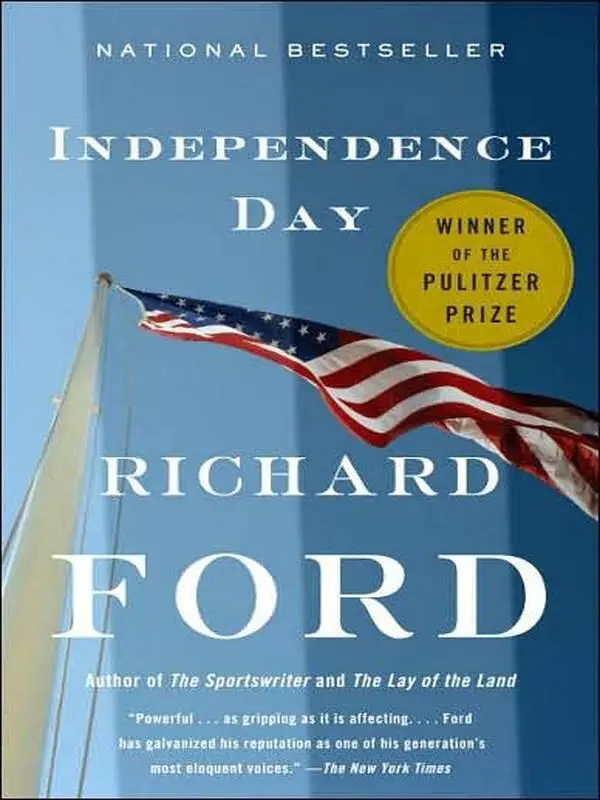
- Название:Independence Day
- Автор:
- Издательство:Vintage
- Жанр:
- Год:1996
- ISBN:нет данных
- Рейтинг книги:3 / 5. Голосов: 1
-
Избранное:Добавить в избранное
- Отзывы:
-
Ваша оценка:
Independence Day: краткое содержание, описание и аннотация
Предлагаем к чтению аннотацию, описание, краткое содержание или предисловие (зависит от того, что написал сам автор книги «Independence Day»). Если вы не нашли необходимую информацию о книге — напишите в комментариях, мы постараемся отыскать её.
, Richard Ford deepens his portrait of one of the most unforgettable characters in American fiction, and in so doing gives us an indelible portrait of America. Frank Bascombe, in the aftermath of his divorce and the ruin of his career, has entered an "Existence Period," selling real estate in Haddam, New Jersey, and mastering the high-wire act of normalcy. But over one Fourth of July weekend, Frank is called into sudden, bewildering engagement with life.
is a moving, peerlessly funny odyssey through America and through the layered consciousness of one of its most compelling literary incarnations, conducted by a novelist of astonishing empathy and perception.
Independence Day — читать онлайн бесплатно полную книгу (весь текст) целиком
Ниже представлен текст книги, разбитый по страницам. Система сохранения места последней прочитанной страницы, позволяет с удобством читать онлайн бесплатно книгу «Independence Day», без необходимости каждый раз заново искать на чём Вы остановились. Поставьте закладку, и сможете в любой момент перейти на страницу, на которой закончили чтение.
Интервал:
Закладка:
Beeeeeeeeeeeeeeeeeeep , click, then the yawning, paralyzing opportunity to leave the most appropriate of messages. “Hi, Cathy?” I say, exhilarated. “It’s Frank.” (Less exhilarated.) “Um. Bascombe. Nothing special, really. I’m, uh, it’s the Fourth of July, or right about then. I’m just up here in Cooperstown, just happened to think about you.” At 8 a.m. “I’m glad to know you’re at the hospital. That’s a good sign. I’m pretty fine. Up here with my son, Paul, who you don’t know.” A long pause while the tape’s running. “Well, that’s about it. By the way, you can tell Steve for me that he can kiss my ass, and I’d be happy to beat the shit out of him any day he can find the time. Bye.” Click. I stand a moment, the receiver in my sweaty hand, assessing what I’ve just done in terms of how it has left me feeling, and also in terms of its character as a small but rash act, possibly foolish and demeaning. And the answer is: better. Much better. Unaccountably. Some idiotic things are well worth doing.
I hike back upstairs to pack, roll Paul out and get the day whacking, since at least for my main purpose (the Markhams aside) it still has some rudiments of promise based on last night’s edgy rapprochement and in any case will end soon enough far from here, with Sally at Rocky and Carlo’s.
Paul meets me at the head of the stairs, hauling along his Paramount bag and wearing his Walkman ear calipers on his neck. He’s groggy and wet-haired, but he’s put on fresh baggy maroon shorts, fresh Day-Glo-orange socks and a big new black tee-shirt that for reasons I know nothing of says Clergy in white on the front (possibly a rock group). When he sees me coming up he offers me his fat-cheeked, impassive expression, as if knowing about me was one thing but seeing me quite another. “I’m surprised to see a fart-smeller like you up here,” he says, then makes a little throaty oink and passes on down the stairs.
In five minutes, though, after making a check for telltale wetness in Paul’s sheets (nothing), I’m back downstairs with my suit bag and my Olympus, ready for breakfast, except the big dining room is still packed with poky breakfasters and Paul is standing at the doorway, staring in with amused disdain. Charlane, in a tight tee-shirt and the same faded jeans from last night, is serving more plates of flapjacks and bacon and bowls of steaming instant scrambled. She looks at me but seems not to recognize me. So that I quickly decide there’s no use waiting (and being ministered to spitefully by Charlane) when we can just as well stash our gear in the car, hike to Main and scare up breakfast for ourselves before the Hall of Fame opens at nine. In other words, let the old Deerslayer sink into history.
Though it hasn’t been that bad a place, lack of an honor bar notwithstanding. Inside its walls, I may have ended the seemingly unendable with Ann, dodged a ricochet with Charlane and, possibly, set things on the rails with Sally Caldwell. Plus, Paul and I have skirmished nearer each other’s trust, and I have been able at least to speak a few of the way-pointing words I’d prepared for that purpose. All noteworthy accomplishments. With only slightly better luck, the Deerslayer could’ve become a hallowed and even sacred place where, say, early next century, Paul could come back alone or with a wife or girlfriend or his own troublesome brood, and tell them this was a place he “used to come with his late dad,” where life-altering wisdom that made all the difference in later life was passed along — though he might not be able to say with complete certainty what the wisdom was.
Several munching breakfasters (I see no one I recognize) have raised wintry eyes up from their plates to where Paul and I are standing at the dining room door, briefly transfixed by deep currents of good coffee, smoked sausage, hash browns, sticky buns, pancake syrup, scrapple and powdered eggs. Their guarded eyes say, “Hey, we won’t be hurried.” “We’ve paid for this.” “We’re entitled to our own pace.” “It’s our vacation.” “Waitchyerturn.” “Isn’t that the joker who was shouting on the phone?” “What about this ‘Clergy’ shirt?” “Something’s fishy here.”
Paul, though, his Paramount bag slung to his pudgy shoulder, suddenly sets both his hands palms out against the invisible wall and begins sliding them place to place, here and there, up, down, side to side, a look of empty-mouthed horror contorting his sweet boy’s face, and whispering “Help me, help me. I don’t want to die.”
“So I don’t think there’s room at the inn for us, son,” I say.
“Please don’t let me die,” Paul continues softly, so only I can hear. “Just don’t drop the tablet in the acid. Please, warden.” He is a sweet, tricky boy and after my heart — my ally just when (or almost when) I feel most in need.
He turns his dying-man’s face of hollow-yap horror up to me, his hands now to his cheeks in silent, stricken astonishment. No one in the room has the will to look at him now, their noses back in their vittles like jailbirds. He makes two plainly audible eeecks that seem to come out of the bottom of a shallow well. “Alias Sibelius,” he says.
“What’s that mean?” I hike my suit bag up, ready to roll.
“It’s a good punch line. I can’t think of the joke, though. Mom puts arsenic in my food since she got a boyfriend. So my IQ’s dropping.”
“I’ll try to talk to her,” I say, and then we are off, no one noticing as we step together out into the morning’s hot brilliance, bound for the Hall of Fame.
C hurch bells now clang and clatter all over town, rounding ’em up for morning worship. Well-dressed, pale-faced family groups of three, four and even six march two abreast down every village sidewalk, veering this way toward the Second Methodist, that way toward the Congregationalists, across to Christ Church Episcopal and the First Prez. Others, less well turned out — men in clean but unpressed work khakis and polo shirts, women in red wraparounds, no stockings and a scarf — exit cars to dash into Our Lady of the Lake for a brief and breathless brush with grace before heading off to a waitress job, a tee time or an assignation in some other village.
Paul and I, on the other hand, fit in well with the pilgrim feel of things temporal — nonworshipful, nonpious, camera-toting dads and sons, dads and daughters, in summery togs, winding our certain but vaguely embarrassed way toward the Hall of Fame (as if there were something shameful about going). Cars are moving by us, the Gay Nineties trolleys toting “senior groups” to the town’s other attractions — the Fenimore House and the Farmers’ Museum, where there are displays and demos of things as they used to be when the world was better. Plus, all the shops are open, ice cream’s for sale, music’s in the air, the lake’s full of water, nothing a visitor could want wouldn’t be taken into at least partial account by somebody.
We have parked our gear in the car behind the inn and hiked by dead reckoning down to the marina and into a booth in a little aqua-blue eatery with oversize windows called The Water’s Edge, built right out over the water like Charley’s studio, only on creosote pilings. Inside, though, it’s so rigidly cold that the cheese fries and Denver omelet aromas seem as dank as the inside of an old ice chest, making me feel, in spite of scenic lake views, that we would’ve been smarter to wait for a place where we’d already paid.
Paul, on our walk over through the short, lakeside back streets lined with homey blue-collar abodes, has raised himself to the best good humor of the trip, and once we’re in our red booth has commenced a wide-ranging discourse of what it’d be like to live in Cooperstown.
Читать дальшеИнтервал:
Закладка:
Похожие книги на «Independence Day»
Представляем Вашему вниманию похожие книги на «Independence Day» списком для выбора. Мы отобрали схожую по названию и смыслу литературу в надежде предоставить читателям больше вариантов отыскать новые, интересные, ещё непрочитанные произведения.



Обсуждение, отзывы о книге «Independence Day» и просто собственные мнения читателей. Оставьте ваши комментарии, напишите, что Вы думаете о произведении, его смысле или главных героях. Укажите что конкретно понравилось, а что нет, и почему Вы так считаете.