Richard Ford - Independence Day
Здесь есть возможность читать онлайн «Richard Ford - Independence Day» весь текст электронной книги совершенно бесплатно (целиком полную версию без сокращений). В некоторых случаях можно слушать аудио, скачать через торрент в формате fb2 и присутствует краткое содержание. Год выпуска: 1996, Издательство: Vintage, Жанр: Современная проза, на английском языке. Описание произведения, (предисловие) а так же отзывы посетителей доступны на портале библиотеки ЛибКат.
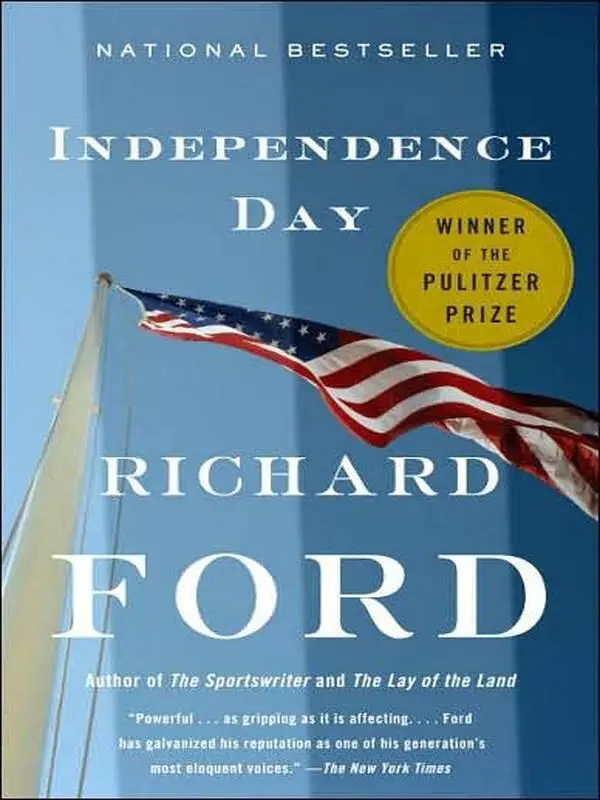
- Название:Independence Day
- Автор:
- Издательство:Vintage
- Жанр:
- Год:1996
- ISBN:нет данных
- Рейтинг книги:3 / 5. Голосов: 1
-
Избранное:Добавить в избранное
- Отзывы:
-
Ваша оценка:
Independence Day: краткое содержание, описание и аннотация
Предлагаем к чтению аннотацию, описание, краткое содержание или предисловие (зависит от того, что написал сам автор книги «Independence Day»). Если вы не нашли необходимую информацию о книге — напишите в комментариях, мы постараемся отыскать её.
, Richard Ford deepens his portrait of one of the most unforgettable characters in American fiction, and in so doing gives us an indelible portrait of America. Frank Bascombe, in the aftermath of his divorce and the ruin of his career, has entered an "Existence Period," selling real estate in Haddam, New Jersey, and mastering the high-wire act of normalcy. But over one Fourth of July weekend, Frank is called into sudden, bewildering engagement with life.
is a moving, peerlessly funny odyssey through America and through the layered consciousness of one of its most compelling literary incarnations, conducted by a novelist of astonishing empathy and perception.
Independence Day — читать онлайн бесплатно полную книгу (весь текст) целиком
Ниже представлен текст книги, разбитый по страницам. Система сохранения места последней прочитанной страницы, позволяет с удобством читать онлайн бесплатно книгу «Independence Day», без необходимости каждый раз заново искать на чём Вы остановились. Поставьте закладку, и сможете в любой момент перейти на страницу, на которой закончили чтение.
Интервал:
Закладка:
“Step back a bit, son,” I say again as the machine goes into its girdering second windup, humming and shuddering, and emits another blue darter just past Paul’s belly, again thrashing the fence I’m now well back of. (He has, I believe, actually inched in closer.) “Get your bat up to the hitting position,” I say. We have performed hitting rituals since he was five, in our yard, on playgrounds, at the Revolutionary War battlefield, in parks, on Cleveland Street (though not recently).
“How fast is it coming?” He says this not to me but to anyone, the machine, the fates that might assist him.
“Seventy-five,” I say. “Ryne Duren threw a hundred. Spahn threw ninety. You can get a swing. Don’t close your eyes” (like I did). I hear the steam organ playing: “No use in sit-ting a-lone on the shelf, life is a hol-i-day.”
The machine goes again into its Rube Goldberg conniption. Paul leans over the plate this time, his bat still on his shoulder, gazing, I assume, at the crease where the ball will originate. Though just as it does, he sways an inch back and lets it thunder past and whop the screen again. “Too close, Paul,” I say. “That’s too close, son. You’re gonna brain yourself.”
“It’s not that fast,” he says, and makes a little eeeck and a grimace. The machine circuits then into its next-to-last motion. Paul, his bat on his shoulder, watches a moment, and then, to my surprise, takes a short ungainly step forward onto the plate and turns his face to the machine, which, having no brain, or heart, or forbearance, or fear, no experience but throwing, squeezes another ball through its dark warp, out through the sprightly air, and hits my son full in the face and knocks him flat down on his back with a terrible, loud thwock . After which everything changes.
In time that does not register as time but as humming motor noise solid in my ear, I am past the metal gate onto the turf and beside him; it is as if I had begun before he was hit. Dropped to my knees, I grab his shoulder, which is squeezed tight, his elbows into his sides, both his hands at his face — covering his eyes, his nose, his cheek, his jaw, his chin — underneath all of which there is a long and almost continuous wheeee sound, a sound he makes bunched on the plate, a hard, knees-contracted bundle of fright and lightning pain centered where I can’t see, though I want to, my hands busy but helpless and my heart sounding in my ears like a cannon, my scalp prickly, damp, airy with fear.
“Let’s see it, Paul”—my voice a half octave too high, trying to say it calmly. “Are you all right?” I am hit by ball number five, a sharp blow like a punch off the back of my neck and scalp, skipping smartly on into the netting.
“Wheeee, wheeee, wheeee.”
“Let’s see, Paul,” I say, the air between him and me oddly red-tinted. “Are you all right? Let’s see, Paul, are you all right?”
“Wheeee, wheeee, wheeeeee.”
People. I hear their footsteps on the concrete. “Just call right now,” someone says. “I could hear it halfway to Albany.” “Oh boy.” “Ohhh boy.” The cage door clanks. Shoes. Breathing. Trouser cuffs. Someone’s hands. An oiled-leather ball-glove smell. Chanel No. 5.
“Ohhhh!” Paul says in a profound exhalation conceding hurt, and writhes sideways, his elbows still pinned to his sides, his face still covered by his hands, his ear still bleeding from my having grabbed him too hard.
“Paul,” I say, all the air still reddish, “let me see, son,” my voice giving way slightly, and I am tapping his shoulder with my fingers as if I could wake him up and something else could happen, something not nearly as bad.
“Frank, there’s an ambulance coming,” someone says from among the legs, hands, breaths all around me, someone who knows me as Frank (other than my son). A man. I hear other footsteps and look up and around, frightened. Braves and A’s are outside the fence, gawking in, their wives beside them, their faces dark, troubled. “Wasn’t he wearing his helmet?” I hear one inquiry. “No, he wasn’t,” I say out loud to anyone. “He wasn’t wearing anything.”
“Wheeee, wheeee,” Paul cries out again, his face covered with his hands, his brown head of hair resting squarely on the filthy white plate. These are cries I don’t know, cries he has never cried in my hearing.
“Paul,” I say. “Paul. Just be still, son.” Nothing feels like it’s happening to bring help. Though not very far away I hear two sharp bwoop-bwoops , then a heavy engine roar, then bwoop-bwoop-bwoop . Someone says, “Okay, great.” I’m aware of more feet scuffling. I have my hands pressed tight into Paul’s shoulder — his back is to me — feeling how hard his body has become, how unambiguously concentrated on injury it is. Someone says, “Frank, let’s let these people try to help. They’ll help him. Let them get where you are.”
This. This is the worst thing ever.
I stand dizzily and step backward among many others. Someone has my upper arm in his big hand, assisting me gently back, while a stumpy white woman in a white shirt, tight blue shorts, with a huge butt, and then a thinner man in the same clothes but with a stethoscope on his neck, slip past and get onto their hands and knees on the AstroTurf and begin to practice on my son procedures I can’t see but that make Paul scream out “Nooooo!” and then “Wheeee” again. I push forward and find myself saying to the people who are here now all around, “Let me talk to him, let me talk to him. It’ll be all right,” as if he could be persuaded out of being hurt.
But whoever it is here who knows me — a large man — says, “Just stay here a second, Frank, stay still. They’ll help. It’ll be better if you just stand back and let them.”
And so I do. I stand in the crowd as my son is avidly worked on and helped, my heart battering its walls, right to the top of my belly, my fingers cold and sweating. The man who has called me Frank holds onto my arm even yet, says nothing, though I suddenly turn to him and look at his long, smooth-jawed Jewish face, large black eyes with specs and a slick tanned cranium, and say as if I had a right to know, “Who are you?” (Though the words do not actually sound.)
“I’m Irv, Frank. Irv Ornstein. Jake’s son.” He smiles apologetically and squeezes my arm more tightly.
Whatever has turned the air red now ceases. Here is a name — Irv — and a face (changed) from far away and past. Skokie, 1964. Irv — the good son of my mother’s good husband #2, my stepbrother — gone after my mother’s death, with his father in tow, to Phoenix.
I do not know what to say to Irv, and simply stare back at him like a specter.
“This is not the best time to meet, I know,” Irv says to my voiceless face. “We just saw you on the street this morning, over by the fire station, and I said to Erma: ‘I know that guy.’ This must be your son who got hurt.” Irv is actually whispering and casts a fretful eye now at the medics kneeling over Paul, who screams “Noooo!” again from beneath their efforts.
“That’s my son,” I say, and move toward his cry, but Irv reins me in once more.
“Just give ’em a couple minutes more, Frank. They know what they’re doin’.” I look to my other side, and here is a dishy, tiny, wheat-haired woman in her thirties, wearing a tight yellow-and-peach plastic-looking single-piece outfit that resembles a space suit. She has a grip on my other elbow as if she knows me as well as Irv does and the two of them have agreed to prop me up. Possibly she’s a weight lifter or an aerobics instructor.
“I’m Erma,” she says, and blinks at me like a hatcheck girl. “I’m Irv’s friend. I’m sure he’s going to be fine. He’s just scared, poor thing.” She too looks down at the two medics huddled over my son, and her face goes doubtful and her lower lip discreetly extends sympathy. Hers is the Chanel I whiffed.
Читать дальшеИнтервал:
Закладка:
Похожие книги на «Independence Day»
Представляем Вашему вниманию похожие книги на «Independence Day» списком для выбора. Мы отобрали схожую по названию и смыслу литературу в надежде предоставить читателям больше вариантов отыскать новые, интересные, ещё непрочитанные произведения.


Обсуждение, отзывы о книге «Independence Day» и просто собственные мнения читателей. Оставьте ваши комментарии, напишите, что Вы думаете о произведении, его смысле или главных героях. Укажите что конкретно понравилось, а что нет, и почему Вы так считаете.