H. Adler - The Journey
Здесь есть возможность читать онлайн «H. Adler - The Journey» весь текст электронной книги совершенно бесплатно (целиком полную версию без сокращений). В некоторых случаях можно слушать аудио, скачать через торрент в формате fb2 и присутствует краткое содержание. Год выпуска: 2008, Издательство: Random House, Жанр: Современная проза, на английском языке. Описание произведения, (предисловие) а так же отзывы посетителей доступны на портале библиотеки ЛибКат.
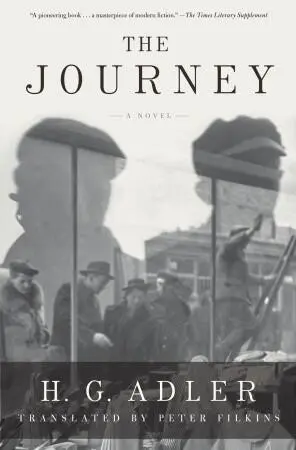
- Название:The Journey
- Автор:
- Издательство:Random House
- Жанр:
- Год:2008
- ISBN:нет данных
- Рейтинг книги:3 / 5. Голосов: 1
-
Избранное:Добавить в избранное
- Отзывы:
-
Ваша оценка:
The Journey: краткое содержание, описание и аннотация
Предлагаем к чтению аннотацию, описание, краткое содержание или предисловие (зависит от того, что написал сам автор книги «The Journey»). Если вы не нашли необходимую информацию о книге — напишите в комментариях, мы постараемся отыскать её.
The story behind the story of
is remarkable in itself: Award-winning translator Peter Filkins discovered an obscure German novel in a Harvard Square bookstore and, reading it, realized that it was a treasure unavailable to English speakers. It was the most powerful book by the late H. G. Adler, a survivor of Theresienstadt and Auschwitz, a writer whose work had been praised by authors from Elias Canetti to Heinrich Böll and yet remained unknown to international audiences.
Written in 1950 after Adler’s emigration to England,
was not released in Germany until 1962. After the war, larger publishing houses stayed away from novels about the Holocaust, feeling that the tragedy could not be fictionalized and that any metaphorical interpretation was obscene. Only a small publisher was in those days willing to take on
.
Yet Filkins found that Adler had depicted the event in a unique, truly modern, and deeply moving way. Avoiding specific mention of country or camps — even of Nazis and Jews—
is a lyrical nightmare of a family’s ordeal and one member’s survival. Led by the doctor patriarch Leopold, the Lustig family finds itself “forbidden” to live, uprooted into a surreal and incomprehensible circumstance of deprivation and death. This cataclysm destroys father, daughter, sister, and wife and leaves only Paul, the son, to live again among those who saved or sacrificed him.
reveals a world beset by an “epidemic of mental illness. . As a result of the epidemic, everyone was crazy, and once they finally recognized what was happening it was too late.”
Linked by its innovative style to the work of James Joyce and Virginia Woolf,
is as much a revelation as other recent discoveries on the subject as the works of W. G. Sebald and Irène Némirovsky’s
. It is a book proving that art can portray the unimaginable and expand people’s perceptions of it, a work anyone interested in recent history and modern literature must read.
The Journey — читать онлайн бесплатно полную книгу (весь текст) целиком
Ниже представлен текст книги, разбитый по страницам. Система сохранения места последней прочитанной страницы, позволяет с удобством читать онлайн бесплатно книгу «The Journey», без необходимости каждый раз заново искать на чём Вы остановились. Поставьте закладку, и сможете в любой момент перейти на страницу, на которой закончили чтение.
Интервал:
Закладка:
“We’ll soon be home, Papa! Do you hear? Home! Everything’s fine. Maybe even next week! Then we’ll have a party with roast goose!”
Leopold’s lips whisper in a monotone. “Roast goose … that will be a triumph.… Little Bunny … he’ll get meat … not bones.…”
The battle with death lasts a long time, through the night and into the next day. The man in the next bed is quite religious. He hardly ever lets his prayer book slip out of his hand. He turns the pages, he hesitantly calls out the holy names and reads aloud many passages in a low voice.
“That helps. The Lord giveth and the Lord taketh away. Praised be the Lord! Forever and ever, amen!”
The color empties from Leopold’s face, the rattle in his throat is quieter and less frequent, his breathing is weaker and more superficial, his breast barely rises and sinks. The fattened fleas creep around and out from under the blanket and gather on the wall like a band of troops. In Ruhenthal that’s a sure sign of the arrival of death. Even a feather hung before a mouth hanging open no longer moves. Everything is still. Only the pious neighbor has sat up in his bed, his lips moving expressively as he prays very quietly and very fast, his head moving softly back and forth. Caroline closes the eyes of the dead. Nurse Dora closes the jaws and binds them. Paul takes off the yellow nightcap that sits crookedly on his father’s head and shoves it into his pants pocket. Zerlina strokes a lifeless pale hand.
“Father is gone. He was the most scrupulous person I ever met. He never understood the ways of the world, but he knew his patients like no other. He was an innocent fool. They murdered him here. They let him starve to death.”
“We certainly did not, Fräulein Lustig! I have constantly portioned out food fairly, and rather than short any patient I’ve even given them some of my own portion.”
“I certainly don’t mean you, Nurse Dora! Don’t you realize the truth? Have you no heart at all?”
Paul and Caroline go back and forth about it.
“No, it wasn’t the nurse, nor anyone in the room, but those above them, the murderers, the violators of all souls!”
A last look at the deceased. Then the nurse pulls the sheet over the head of the corpse. Caroline yearns to see him once more.
“It’s better not to look again. Take from his things what you can use!”
But Caroline doesn’t want anything, nor do Paul and Zerlina. They stand there silent. Then Paul gives a muted sign. Caroline understands and takes Zerlina by the hand. They slowly leave the room, exhausted, anxious, and hungry. The neighbor continues praying incessantly. Then he looks around in earnest, but furtively, and waves toward those left behind as if to assure them that he will follow through with the recommended prayers to the end. Then it’s all over. In the dark street a dreary rain begins to fall. Night has fallen earlier tonight. The passersby whisper intensely and in a muffled manner. Work is done for the day. Life begins. Today there’s nothing happening. A pale blue desk lamp furtively turns on. Feet slog unwillingly through cold puddles. Ruhenthal gasps amid an uneasy slumber. Only the mist from rubbish rises in hidden pits. The chorus is silent. Above the small podium appears the gray beard as it casts a long shadow over the numerous coffins. Then the voice is heard.
“And so we think with gratitude on our dearly departed, because they are a part of us and we are a part of them. All of them who have passed on have fulfilled their responsibilities as fathers and mothers, as sons and daughters. They have all accomplished something imperishable in life and that is more comforting than all the grief we feel. They were all true children of their people and worshipped the eternal. We, however, we who are gathered before these coffins, have the responsibility to humbly bear our loss and to not be swallowed up by our own pain, but rather to think of the example that the departed set through their works, and courageously face the coming days, since from us further accomplishments are expected, from which we may not shrink with a good conscience. If at this moment we do not know by what means to conquer our loss, we must also not despair in saying farewell, but rather let us say as one, remember us, Lord, Thou who created us, of whom it is written, the Lord giveth and the Lord taketh, praised be the Lord.…”
The last oily hymns are poured out. This makes cleaning the streets easier. The dust is knocked down and sealed in. Easily and elegantly the broom glides over the pavement. Tar is poured out. It has been warmed in large pans. Now it flows slowly over the street, coaxed by broad wooden spreaders, a dark syrup, blood gone black, honey of the dead and their inextinguishable memorial, poured out from large drums and pressed into an iced cake. Consecrated hymns of execution turn into a celebration of innocence. Merry hangmen in white robes have imposed the verdict. Farther and farther the pitch flows and is spread by long squeegees that spread it directly onto the low arches of the cobblestones before it sets and hardens forever, now already composed and hardened, no longer answerable to the fire that melted it amid death’s drunken gurgle. The men who have been awarded the honor of this work stand by in dignified manner, because it is good work that they are doing. No day without a good deed. The former professor of theoretical philosophy agrees. To oil the earth is good. The air is clearer, the buildup of mud in bad weather is greatly reduced. Pavement means dryness, peace, security. No one sinks down when walking upon it, because each step is secure only when there is a road that will hold one’s footing. Dangerous roads are closed off and forbidden. Only the workers are granted access. They apply themselves to the strange and transform it into the familiar. To break through to new worlds is the job of the philosophers. Whoever can, does; the good deed is accomplished without complaint.
Fine macadam is spread upon the tar with flat shovels, and then soft wide squeegees evenly distribute it. Once more orderliness has won the day. Now the steamroller effortlessly completes the task by reducing the stone and tar to a uniform smoothness. Proudly and slowly the heavy machine passes back and forth. The motor rattles, levers and wheels move much faster in preparing the way for the dignified entrance of the steamroller. The macadam is tamped down, embedding itself completely in the tar. The path is rescued, the dust banished forever. Out of friendly hoses water is sprayed, now the street is ready for everyone. No one should be forbidden from using it again. The philosopher takes a modest bow: now the job is done.
The dead know nothing of this. They can take no joy in the changes that have indeed occurred. Defenseless and without fuss the corpses allow themselves to be coffined and carried off. The whip snaps, the transport driver sucks harder on his pipe, the horses move forward with a hard jerk. Slowly the funeral train begins to move as it sets off as the last escort. The living like to follow the dead as far as possible. Gratefully the living follow behind as long as the wagon continues to roll along, but when the cargo reaches the barrier they are suddenly prevented from fulfilling their responsibility. A sign informs the funeral train that it has reached its final stop. And so it stands there. It cannot follow along, though it can watch the process that then unfolds. Two policemen look at the wagon that sets off slowly, their eyes asking, You dead, do you have anything to declare? Only their eyes ask this, not a word is spoken. The policemen look on with their dark brown eyes and smile in knowing readiness. The last honor of the dead. They are allowed to leave without a pass, the coffins never once being counted. The barrier lifts high, the wagon pulls ahead, duty-free and as free as a bird. The dead have nothing with them, nor does anyone question that they do. Their death, their honesty is not questioned. No one demands, “Open all your coffins!” The horses pull more vigorously and Ruhenthal’s load of human freight sways across the sand-based macadam and tar. The barrier falls, the farewell is completed. Merrily lurching ahead with sprightly speed, the funeral wagon rumbles along.
Читать дальшеИнтервал:
Закладка:
Похожие книги на «The Journey»
Представляем Вашему вниманию похожие книги на «The Journey» списком для выбора. Мы отобрали схожую по названию и смыслу литературу в надежде предоставить читателям больше вариантов отыскать новые, интересные, ещё непрочитанные произведения.








Обсуждение, отзывы о книге «The Journey» и просто собственные мнения читателей. Оставьте ваши комментарии, напишите, что Вы думаете о произведении, его смысле или главных героях. Укажите что конкретно понравилось, а что нет, и почему Вы так считаете.