Roberto Calasso - Ardor
Здесь есть возможность читать онлайн «Roberto Calasso - Ardor» весь текст электронной книги совершенно бесплатно (целиком полную версию без сокращений). В некоторых случаях можно слушать аудио, скачать через торрент в формате fb2 и присутствует краткое содержание. Год выпуска: 2014, Издательство: Farrar, Straus and Giroux, Жанр: Современная проза, на английском языке. Описание произведения, (предисловие) а так же отзывы посетителей доступны на портале библиотеки ЛибКат.
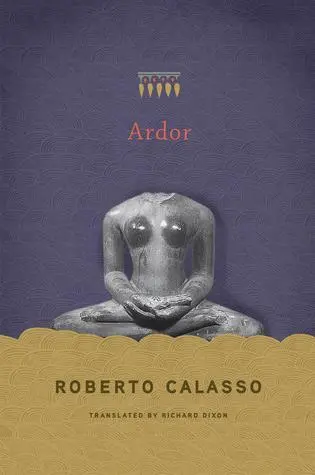
- Название:Ardor
- Автор:
- Издательство:Farrar, Straus and Giroux
- Жанр:
- Год:2014
- ISBN:нет данных
- Рейтинг книги:5 / 5. Голосов: 1
-
Избранное:Добавить в избранное
- Отзывы:
-
Ваша оценка:
Ardor: краткое содержание, описание и аннотация
Предлагаем к чтению аннотацию, описание, краткое содержание или предисловие (зависит от того, что написал сам автор книги «Ardor»). Если вы не нашли необходимую информацию о книге — напишите в комментариях, мы постараемся отыскать её.
has called “a literary institution,” explores the ancient texts known as the Vedas. Little is known about the Vedic people who lived more than three thousand years ago in northern India: they left behind almost no objects, images, or ruins. They created no empires. Even the hallucinogenic plant the
, which appears at the center of some of their rituals, has not been identified with any certainty. Only a “Parthenon of words” remains: verses and formulations suggesting a daring understanding of life.
“If the Vedic people had been asked why they did not build cities,” writes Calasso, “they could have replied: we did not seek power, but rapture.” This is the ardor of the Vedic world, a burning intensity that is always present, both in the mind and in the cosmos.
With his signature erudition and profound sense of the past, Calasso explores the enigmatic web of ritual and myth that defines the Vedas. Often at odds with modern thought, these texts illuminate the nature of consciousness more than today’s neuroscientists have been able to do. Following the “hundred paths” of the
, an impressive exegesis of Vedic ritual,
indicates that it may be possible to reach what is closest by passing through that which is most remote, as “the whole of Vedic India was an attempt to
.”
Ardor — читать онлайн бесплатно полную книгу (весь текст) целиком
Ниже представлен текст книги, разбитый по страницам. Система сохранения места последней прочитанной страницы, позволяет с удобством читать онлайн бесплатно книгу «Ardor», без необходимости каждый раз заново искать на чём Вы остановились. Поставьте закладку, и сможете в любой момент перейти на страницу, на которой закончили чтение.
Интервал:
Закладка:
In that body of Vedic ritual, which is anomalous from every point of view, it is clear that two factors come together that elsewhere tend to remain separate: on the one hand a semantic excess, which leads to a proliferation of possible interpretations and can easily be passed off as an archaic remnant (as if it were a childish world where anything can be said about anything ). On the other, a rigorous formalization that we are used to associating only with far more recent ideas (the very notion of a “formal system” is a twentieth-century acquisition).
If meaning is expunged from the Vedas, as Staal suggests, then at least two other words have to be expunged: religious and sacrifice. Staal, undeterred, does not shrink from the task. And his casualness applies not only to the ancient texts. Even when dealing with modern Indologists, in those rare cases where they are cited with approval, Staal has no qualms about carrying out corrective adjustments that guide the text toward the right theory: quoting an important passage by Renou on the “priority of the mantras and the liturgical forms which they presuppose,” Staal frankly warns us that he is replacing the word religious with the word Vedic. Now, the word Vedic can mean either a vague chronological indication or the connection of something to “knowledge,” veda. But Staal evidently wants to blot out anything religious from this “knowledge,” as if it were a disturbing alien element. More than anywhere else, this is untenable when talking about ancient India, where it is pointless searching for even the tiniest detail that is not intertwined with religion. As Staal himself has noted elsewhere: “There do not exist, for example, any Indian category and words that correspond to the Western notion of religion.” But they do not exist insofar as everything , in a Vedic context, is religious. Even so far as vocabulary is concerned, Staal seeks to intervene, presenting his own suggestions as an appropriate technical adjustment: “I prefer to use the word ritual rather than the word sacrifice , since I reserve this latter for describing the rituals that lead to the killing of an animal.” A neutral tone, as if the matter ought to cause no problems. But that adjustment is enough to cancel out countless passages in the Brāhmaṇas that speak of the rite of the soma as a killing. A killing of a plant and of King Soma, who is a god, welcome on earth. The Brāhmaṇas are tireless in reaffirming that all offerings, including the libation of milk in the fire, the agnihotra , are sacrifices. And here comes the Indologist Frits Staal, three thousand years later, who decides this isn’t so. And above all: that it mustn’t be so. His zeal takes him to the point of correcting Hubert and Mauss’s famous title: quoted by Staal, their Essai sur la nature et la fonction du sacrifice becomes Essay on the Nature and Function of Ritual. It is Western science, in its naïveté and its arrogance, that has decided this (and Staal has indeed entitled one of his books The Science of Ritual) .
* * *
Even back in the times of Keith (1925) it could be suggested with a certain candor that all is possible (and that therefore all is arbitrary ) in the Vedic texts: “If the waters can practice asceticism, it is not surprising that speech can speak standing in the seasons, or that the sacrificial consecration can be pursued by the gods with the aid of the seasons, or that the ascent of the meters to the sky should be visible.” In short, in the Veda anything goes , declared Keith, at almost the same time as the première of the great musical of the same name. What offended a sane Westerner was above all “the notorious ‘identifications’ of the Brāhmaṇas which, since long, had been the laughing stock of occidental scholarship.” This was an “identification technique that establishes links, equivalents, nexuses (or correlations) between, or identity of two entities, things, beings, thoughts, states of mind, etc. Both entities are unrelated, according to our way of thinking.” Examples? “When the text says ‘the muñja grass is strength’ and ‘the udumbara tree is strength,’ or ‘Prajāpati is thought’ and ‘Prajāpati is the sacrifice,’ it will not be clear why some kind of grass (a living being, or dead material) could be the same as ‘strength’ (an abstract idea, or a force experienced); or, in the second case, why and how the god Prajāpati, ‘the lord of creation,’ could be the same as ‘thought/thinking,’ and, at the same time, the idea or act or ritual (‘sacrifice,’ yajña ).” This passage is found in Witzel’s introduction to his edition of the Kaṭha Āraṇyaka (an extremely rare instance of a Vedic text that can properly be described as published in a critical edition). And his intention is clear: to illustrate in a neutral and fair-minded tone why Vedic thought continues to be so disconcerting, but without adopting the usual voice of disapproval, in the manner of Keith or Eggeling or Max Müller. Yet, even in this very recent formulation, there is much that jars. What, indeed, is “our way of thinking” (almost as if the West were a seamless mass of unalloyed good sense)? And are the strange examples of identification that Witzel offers us indeed so inconceivable? Does saying that a certain grass “is strength” really sound any more incomprehensible than Jesus’s words at the Last Supper when he says that a piece of bread is his body and some wine his blood? Is saying “Prajāpati is thought” any stranger than talking about the word made flesh? Is it possible to hold that “our way of thinking” is so barren and desolate that it doesn’t embrace, at least to some extent, thinking in images ?
We still, though, have to understand why the Vedic texts — and above all the Brāhmaṇas — continue to evoke such a feeling of vertigo and obscurity. Not because they involve thinking in images (without which all thought would be inert). But because they use it all the time, with extreme devotion, unperturbed about any implication, indeed putting every implication into action (through gesture). This is the intractable Vedic offense, that triggers so many reactions of rejection and fear. The Western attitude toward imagery wavers between minimization ( x is only a metaphor, and therefore not binding) and the temptation to interpret metaphors literally (a practice leading to various basic psychic pathologies, above all paranoia and schizophrenia).
But in Vedic thought, identifications are not metaphors. As Witzel has rightly said, “the majority of sentences establishing identifications are simple nominal clauses of the type ‘x [is] z’ or ‘x vai z’; they are frequently summed up by a statement ‘x eva z’” (where eva and vai are words roughly corresponding to “indeed,” “in fact”). The cautious and uncompromising way of metaphors is therefore ruled out from the very beginning. The identification (or equivalence) superimposes two entities without any exercise of caution. And here we sense the slight sneer of Western superiority, recalling Musil’s description of the scientists in Diotima’s salon. Once the metaphor is gone, an irresolvable confusion would be created between the two entities whose equivalence is asserted. But it is obvious from a thousand indications that the Vedic ritualists were in no danger of confusing the multiple levels of that which is. Instead, they saw them at every moment and allowed thought to waver continually from one to the other. To cover themselves — and give an ironic nod to the effect that they were well aware of the rules and limitations of the game — they often resorted to the particle iva , “so to speak,” “in a certain way.” Far more subtle than the clumsy “like,” which elsewhere (in the West) announces entry into the realm of the metaphor. Iva is more vague — and lets the unknown and the uncertain become involved at the very moment when a nexus, a bandhu , is established.
Читать дальшеИнтервал:
Закладка:
Похожие книги на «Ardor»
Представляем Вашему вниманию похожие книги на «Ardor» списком для выбора. Мы отобрали схожую по названию и смыслу литературу в надежде предоставить читателям больше вариантов отыскать новые, интересные, ещё непрочитанные произведения.




Обсуждение, отзывы о книге «Ardor» и просто собственные мнения читателей. Оставьте ваши комментарии, напишите, что Вы думаете о произведении, его смысле или главных героях. Укажите что конкретно понравилось, а что нет, и почему Вы так считаете.