Nasser Amjad - Land of No Rain
Здесь есть возможность читать онлайн «Nasser Amjad - Land of No Rain» весь текст электронной книги совершенно бесплатно (целиком полную версию без сокращений). В некоторых случаях можно слушать аудио, скачать через торрент в формате fb2 и присутствует краткое содержание. Год выпуска: 2014, Издательство: Bloomsbury Qatar Foundation Publishing, Жанр: Современная проза, на английском языке. Описание произведения, (предисловие) а так же отзывы посетителей доступны на портале библиотеки ЛибКат.
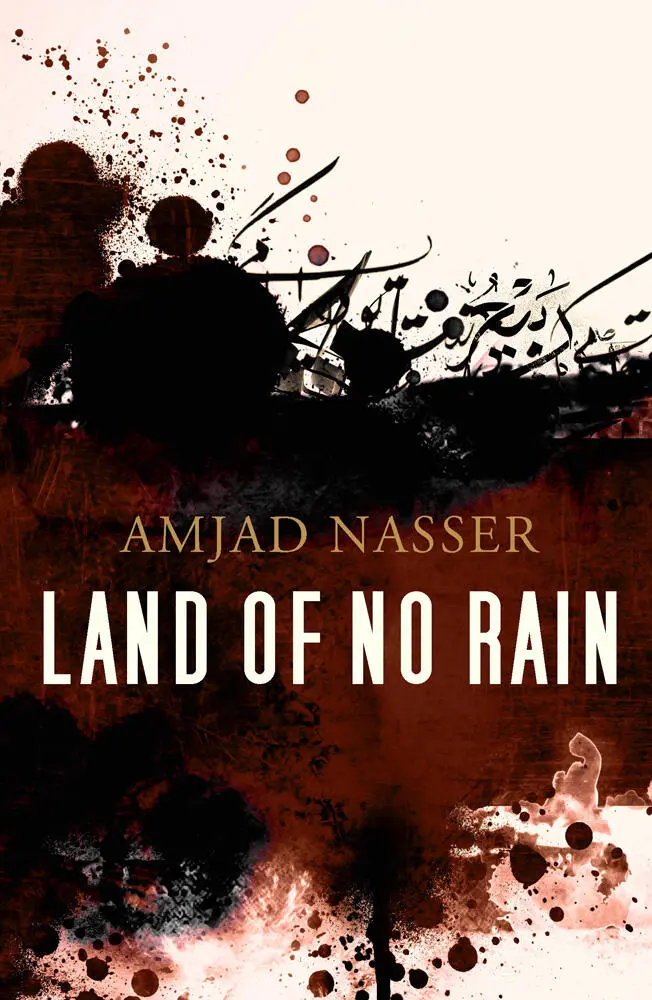
- Название:Land of No Rain
- Автор:
- Издательство:Bloomsbury Qatar Foundation Publishing
- Жанр:
- Год:2014
- ISBN:нет данных
- Рейтинг книги:4 / 5. Голосов: 1
-
Избранное:Добавить в избранное
- Отзывы:
-
Ваша оценка:
Land of No Rain: краткое содержание, описание и аннотация
Предлагаем к чтению аннотацию, описание, краткое содержание или предисловие (зависит от того, что написал сам автор книги «Land of No Rain»). Если вы не нашли необходимую информацию о книге — напишите в комментариях, мы постараемся отыскать её.
Land of No Rain — читать онлайн бесплатно полную книгу (весь текст) целиком
Ниже представлен текст книги, разбитый по страницам. Система сохранения места последней прочитанной страницы, позволяет с удобством читать онлайн бесплатно книгу «Land of No Rain», без необходимости каждый раз заново искать на чём Вы остановились. Поставьте закладку, и сможете в любой момент перейти на страницу, на которой закончили чтение.
Интервал:
Закладка:
* * *
She was in the third year of middle school when you first saw her. Before that, just like other adolescents whose bodies had been shaken by new and unfamiliar impulses, you, Salem and Khalaf used to pursue a local girl, the daughter of the woman who owned the Mothers grocery, a girl who was susceptible to pursuit because her school was conveniently remote. Your heart was liable to throb audibly inside your ribs and you had little control over what went on between your legs. You also especially remember Widad, the girl next door, and the cream nightdress that clung to her body when she was washing the veranda of their house. The girl who smelled of perfumed soap. It almost came back to you now, the same arousal you felt when you saw the roundness of her firm bottom and the way she looked back, half embarrassed and half in collusion, when she saw your mouth agape, looking at her bottom and at the black underwear that showed through the wet nightdress. But until you saw Roula all these pursuits and early arousals had nothing to do with what you had heard and read about love.
You were borrowing a book from the public library when your eyes fell on Roula, the girl to whom you would later say, ‘Your hair is like a flock of goats descending from Mount Gilead’; the girl to whom you would write, loosely inspired by the Song of Solomon, ‘I remember the smell of your mouth better than the taste of wine, your underarm better than the smell of apple,’ even before you had tasted wine and before the sweetness of her mouth had become a memory; the girl who would write to you on pink notepaper after she discovered the source of your pastoral poetry and you began to share its gifts in secret: ‘Sustain me with cakes of raisins, refresh me with apples, for I am lovesick.’ You didn’t know the key to attracting women. You thought it was strength. Acting tough. Combing your hair with a quiff. It didn’t occur to you that words might be more powerful, when allied with inspiration. It was Roula who made you believe that you possessed, in words, a dangerous weapon you would use often after that, sometimes honestly, sometimes dishonestly, sometimes with success, sometimes without. With two of her colleagues, who looked like ladies-in-waiting, Roula was borrowing some reference book from the library. One of Hamiya’s virtues was that it encouraged students to research scientific subjects and the classics and to be competitive, so it provided a large public library for this purpose. You couldn’t keep your eyes off her eyes. She had big dark eyes, very black and very white, that stared perpetually into an unknown the depth of which was hard to gauge. She had two deadly dimples, especially when she smiled or laughed. She had a mouth like the bud of a Persian rose flecked with the dewdrops of a northern dawn, or so you thought, though you had never heard of or seen such a flower. As with the epiphanies of which the Sufis talk, or the inspirations that descend on poets from angels or devils, you knew she was the one your restless soul was seeking. At that moment you surrendered voluntarily to the power of those eyes, the dimples, the hair that trailed down like a flock of goats on Mount Gilead. You left the library before her. You waited an age for her. You didn’t know what you would say, what you would do with your stray hands. On other occasions you had had casual flirtatious words ready in your head and you had control over your hands. This time you succumbed to a state of lightness, weightlessness, imminent flight, and one phrase, or to be precise one feeling, took control of you. When she came out between her two ladies-in-waiting, you looked straight at her, ignoring the presence of the other two, who might as well have disappeared. With your legs trembling, your hands waving aimlessly, your tongue tangled, you said, ‘Excuse me.’ ‘Sorry?’ she replied. ‘Excuse me,’ you repeated. Her dimples played like the eyes of a storm about to break, and she said, ‘Excuse me what?’ ‘I want to have a word with you,’ you said. You can’t remember whether her friends stayed close by or moved away. You can’t remember, because you couldn’t see anything but her. It was she who stepped forward to where you were standing at the entrance to the library. Several steps to the right, where a giant cinchona tree cast a mammoth shadow on the ground. You seemed to be luring her in. You weren’t of course. Perhaps you stepped back because of the simple phrase that imposed itself upon you. Right under the cinchona tree, with the eyes of that storm about to break in her dimples, she stopped. She didn’t show any sign that she knew what you were about to say (or so it seemed to you). ‘Yes?’ she said. ‘I love you,’ you said. ‘What?’ she asked, and the eyes of the storm played again on her cheeks. ‘I love you,’ you said firmly. ‘Are you mad?’ she said. ‘Not always!’ you replied.
You didn’t know who she was. Unlike her. Because she had seen you before. She had heard of what she called your escapades, such as the incident when you stole the exam questions, and then the branding incident, which was fresh at the time and common knowledge among young people. In Hamiya such news didn’t need legs or a megaphone.
Although Hamiya is divided into separate encampments, one for each branch of the armed forces, each with its own housing complex and facilities including schools, there are meeting points that bring people together, such as the traditional central market, the park that is famous for its cinchona trees, the domed library, the sports stadium and the gyms, the art galleries and the cinemas. So people with common interests can meet up. In one of these places Roula had seen you before. After meeting her in the public library, you found out that she was the daughter of the commander of the Grandson’s palace guard. But you weren’t interested in her father’s sensitive position. You were not a complete unknown. You had the makings of a promising poet, as Hamiya’s weekly newspaper put it when it commented on a poem it had published at just that time, and you were also the son of the Calligrapher. In fact these considerations never occurred to you. You were living as though you had wings, living dreams that hovered above the harshness of reality, living life with a boldness that looked like recklessness to many. That’s what mattered to you. That and nothing else. Despite your attempts to be discreet and secretive in your meetings with Roula ‘out of respect’ for her father, as she put it, the story of your love affair soon leaked out and drove her father to complain to your father. Your father, who was in no way held to blame, was furious. His anger had no effect on you. You had been swept far away, on a powerful wave of emotion you had not known before. But Roula started to discover in you things she didn’t like, or things she hoped to avoid so that your love might have a happy ending, such as your tendency to make hasty judgments, the banned books you were reading, your pointed criticism of the Hamiya leadership, your lack of respect for your elders and for convention. ‘Respect for elders’ was the precise expression she used in one of your angry discussions. The traditional ring of it, coming from a girl of sixteen, almost made you crack up laughing. But with a hug, or with one of your surprising turns of phrase, you could make her forget the subject in dispute and set her dimples back to work. She loved your explanation of her name. The second or third time you met, you told her, ‘The Roula are Arabs whose palaces are tents.’ But she didn’t understand. She thought you were making fun of her name. You told her that it came from the first half of a line of poetry that included her name, perhaps the only Arabic reference available for the name. She asked you what the line of poetry meant, and you said it was about some Arabs who bore her name, a tribe that is, whose palaces were tents. But she preferred the other meaning you came up with at another meeting. You had searched through all the encyclopaedias in the Hamiya library, and you came across the theory that the name Roula was a corruption of a Latin word meaning ‘lady of the city’. After that you started calling her ‘lady of the city’. She liked that, especially when you told her about how, when you first saw her, you imagined her companions as ladies-in-waiting to a princess from another world. She tried to defend her friends, saying they were dear friends and not ladies-in-waiting to her or anyone else, but that didn’t prevent a sly narcissistic glitter showing in her eyes. The name ‘lady of the city’ spread among the young people of Hamiya after you had a poem published with that title, a poem that imitated the Song of Solomon because you were enthralled by its pastoral lyricism and its ingenuity in describing love. The local teenagers liked the poem so much that a new boutique selling women’s fashions called itself Lady of the City. But the story of your love, which reached her father, was about to run up against an event that was taking shape in the womb of the unknown, an event that would have repercussions you did not expect.
Читать дальшеИнтервал:
Закладка:
Похожие книги на «Land of No Rain»
Представляем Вашему вниманию похожие книги на «Land of No Rain» списком для выбора. Мы отобрали схожую по названию и смыслу литературу в надежде предоставить читателям больше вариантов отыскать новые, интересные, ещё непрочитанные произведения.






Обсуждение, отзывы о книге «Land of No Rain» и просто собственные мнения читателей. Оставьте ваши комментарии, напишите, что Вы думаете о произведении, его смысле или главных героях. Укажите что конкретно понравилось, а что нет, и почему Вы так считаете.