Nasser Amjad - Land of No Rain
Здесь есть возможность читать онлайн «Nasser Amjad - Land of No Rain» весь текст электронной книги совершенно бесплатно (целиком полную версию без сокращений). В некоторых случаях можно слушать аудио, скачать через торрент в формате fb2 и присутствует краткое содержание. Год выпуска: 2014, Издательство: Bloomsbury Qatar Foundation Publishing, Жанр: Современная проза, на английском языке. Описание произведения, (предисловие) а так же отзывы посетителей доступны на портале библиотеки ЛибКат.
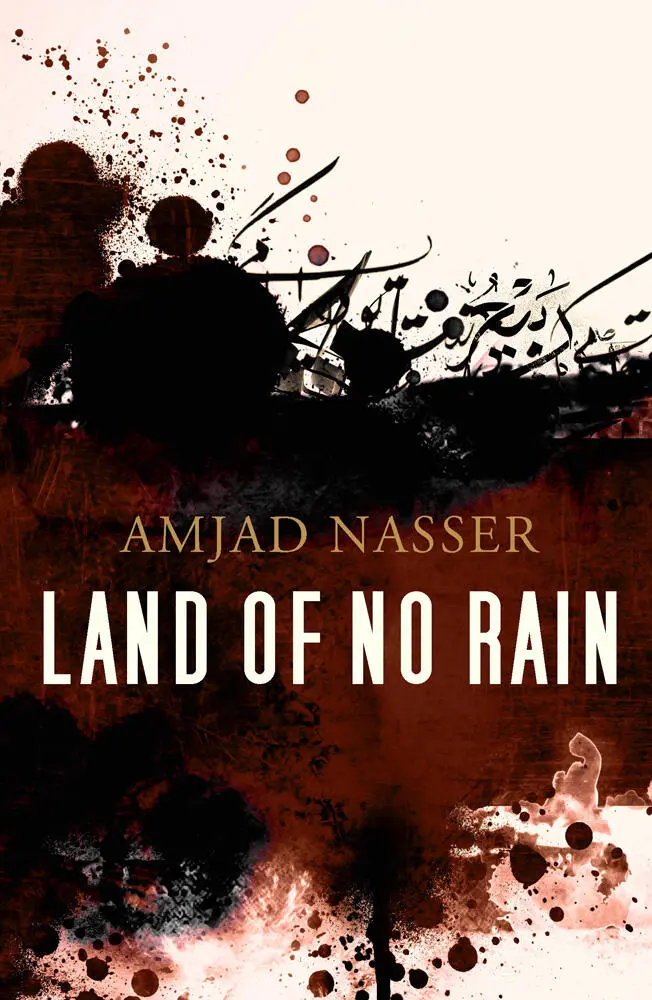
- Название:Land of No Rain
- Автор:
- Издательство:Bloomsbury Qatar Foundation Publishing
- Жанр:
- Год:2014
- ISBN:нет данных
- Рейтинг книги:4 / 5. Голосов: 1
-
Избранное:Добавить в избранное
- Отзывы:
-
Ваша оценка:
Land of No Rain: краткое содержание, описание и аннотация
Предлагаем к чтению аннотацию, описание, краткое содержание или предисловие (зависит от того, что написал сам автор книги «Land of No Rain»). Если вы не нашли необходимую информацию о книге — напишите в комментариях, мы постараемся отыскать её.
Land of No Rain — читать онлайн бесплатно полную книгу (весь текст) целиком
Ниже представлен текст книги, разбитый по страницам. Система сохранения места последней прочитанной страницы, позволяет с удобством читать онлайн бесплатно книгу «Land of No Rain», без необходимости каждый раз заново искать на чём Вы остановились. Поставьте закладку, и сможете в любой момент перейти на страницу, на которой закончили чтение.
Интервал:
Закладка:
While you gazed around at your father’s workshop, at his tools and his relics, young Younis was standing upright, his hands behind his back, in front of a large design in Kufic script in a corner near the entrance to the cellar. It was the same design that could be seen in the photograph hanging in the diwan. Framed in a perfect square, it was severely geometric and appeared to be formed of pixels, as in today’s digital images.
You had seen the design before but hadn’t noticed the maze, in which he had tried out two gradations of turquoise. You thought it was just a geometrical game. Your father, who did not usually play with calligraphy, wanted to play, to try out the surprising possibilities that playing would reveal, or to combine calligraphy and the graphic design for which he faulted your brother Sanad. He was not one of those who used Kufic much, but even when he did it wasn’t in this geometric style that looked as though it were computer-generated. The precision with which your father had executed his Kufic design was amazing. It was in the form of a maze, but a geometric maze based on the uprights and right angles of the letters. Young Younis, who turned towards you when he sensed you standing behind him, knew something you did not know, or had not paid any attention to. With his firm little hand he pointed towards the picture and said, ‘Can you read it?’ His question took you by surprise. Can I in fact read it, you wondered. The way the letters were interlocked, in a starkly geometrical structure, made it difficult if not impossible, and you repeated the same question to him. ‘Can you read it?’ you joked (were you really joking?). ‘I can,’ he said. ‘Very well, read it,’ you said. ‘Lift me up,’ he said. You hesitated a moment. You were just about to have a coughing fit, but you held it back. You brought your father’s chair from behind his desk. Young Younis stood on it. He pointed his little hand to an empty space between two blocks of writing in the upper middle of the design and said, ‘That’s where we go in.’ Then to an empty space on the left-hand side and said, ‘And that’s where we come out.’ ‘Clear enough,’ I told my nephew. ‘That’s the way in and that’s the way out, but you haven’t read what’s written.’ ‘Look,’ he said. ‘Where we go in it’s the word diiq and we come out at faraj , and the longest path between the entrance and the exit is through the word hayra . Do you know what hayra means, Uncle?’ ‘I know,’ I said.
What young Younis said threw light on mysterious aspects of your father’s design. The words and lines emerged from a state of occultation to one of epiphany, as the Sufis say, and what you thought was playing really was playing, but playing by someone who, in an intricate and abstruse manner, was writing the elements of some redemptive talisman. The starting point of the design was the word diiq , ‘anguish’. You managed to work out the interlocking letters after young Younis pronounced them. The end point was the word faraj , ‘relief’. Then the word hayra , ‘uncertainty’. But in the middle was a fourth word that young Younis didn’t say, a word that offered a shorter way out of the maze. You made out the letter sin and then the a at the end of the word. The two dots were next to the a , not on top of it. Then you saw an open rectangle with another identical rectangle right underneath it. It was the letter kaf . Then it was clear to you that the fourth word, which offered a shorter way out of the maze, was sakiina , ‘peace of mind’.
IX
You told your relatives you didn’t want the whole world to know you were back. Your brother Shihab, now the head of the family, objected and said that custom required throwing a party to celebrate your return. You rejected the idea with a vehemence that hurt his feelings. Then you tried to ease the situation by saying you were exhausted from the journey and uneasy after so many years away, and you wanted to rest among them a while before they held the party, to which you would invite those closest to you and your old friends that remained. You calmed things down with this compromise, which postponed the challenge of meeting people you no longer knew and to whom you did not have much to say. But this wish of yours was not entirely honoured. You deduced this from the fact that certain people started passing in front of your house, people who hadn’t passed by very often since you escaped, since your brother Sanad went away and your father died. That’s what young Younis told you, reporting a conversation between his father and mother. So one of them had leaked the news of your return.
Sitting in the diwan, you told your brother Shihab that the news of your arrival was no longer a secret and apparently there were people who had heard. Shihab, who seemed emotionally cold on the outside, said that no such thing had happened. Someone might have seen you and recognised you when you went to visit your parents’ graves. Then he said it didn’t matter because people were no longer as you had known them, and you were mistaken if you thought that the bonds between people here did not break in the same way as anywhere else. But what you heard from young Younis was true, or that’s what the remains of your vanity led you to believe. On the third or fourth day after your return, from the balcony that overlooks Muntazah Street, you saw Roula walking along bolt upright, wearing a black dress that reached to below the knee, with two children beside her and a third jaunting along behind her. Your heart beat so hard you thought they must have heard it throughout the house. In the pit of your lungs you felt a coughing fit coming on. You held it down with the palm of your hand. None of the adults were near by. There was young Younis telling you about his school and his knowledge of foreign literature, while you were watching the sun slowly set on a horizon flecked with red. When Roula was level with your house she looked up at the balcony. She saw you. But you don’t know whether she recognised you because she shielded her eyes with her right hand against the remaining rays of a sun that was still strong. Young Younis was reciting a famous foreign poem that compares life to a stage. You interrupted him and said, ‘Do you see that woman?’ You pointed at her. You told him, ‘Go and call her. Tell her your mother wants to see her urgently.’ Young Younis shot off like an arrow across the large balcony on the third floor and down the side stairs. He disappeared and then reappeared in front of the arched gateway. Then you saw him in the street. He seemed to be calling Roula, because she stopped. Then you saw them talking and young Younis’s hand pointing to the house, not to the balcony where a middle-aged tiger lay in ambush for her with his memories. You went down to the kitchen on the second floor of the house. You called your brother Shihab, who was there with his wife and some of your sisters, smoking almost non-stop, imitating your father in the way he left his cigarette burning in the left corner of his mouth. You took him aside and told him what had happened. You told him, ‘It happened suddenly, so now try to find a solution.’ You went to your room. You changed the pyjamas you were wearing for a shirt and trousers. You stood in front of the mirror. You combed your hair quickly. You put some light cologne on your face, similar to the 555 brand that was popular before you escaped. In front of the mirror your nervousness was obvious. Your face showed signs of two conflicting emotions, each one pulling in a different direction, as though two separate epochs were trying to dictate their terms to you. You didn’t notice that your right eyelash twitched several times. You weren’t aware that your hand, which was still holding the comb, was shaking. You put the comb on the dressing table and it made a sound as if it had fallen from a height. You opened your bag, where most of your clothes remained, not yet hung on hangers. From a plastic container for medicines, you took out a packet. You opened it and swallowed a tablet. You felt the tablet slide slowly down your throat. You went back to the mirror. You stood stock still in front of it. Did you want to make sure you looked right for the occasion? Or to see the map that the years, your travels, trials and tribulations had etched on your face? Whatever the reason, you said to yourself, ‘I’m not the only one who’s changed, whose hair has turned grey, who has wrinkles starting to spread across his face, who has puffy bags under his eyes. I’m not the only one who’s been battered by fate, whose tattered sails have been blown to distant shores by winds and storms. I’m not alone. I’m not alone. She must have changed too, because from the balcony she looked like her picture in the newspaper when she received the Medal of Duty from the Grandson.’ Apparently you hadn’t been standing in front of the mirror for long when young Younis burst into the room, panting.
Читать дальшеИнтервал:
Закладка:
Похожие книги на «Land of No Rain»
Представляем Вашему вниманию похожие книги на «Land of No Rain» списком для выбора. Мы отобрали схожую по названию и смыслу литературу в надежде предоставить читателям больше вариантов отыскать новые, интересные, ещё непрочитанные произведения.






Обсуждение, отзывы о книге «Land of No Rain» и просто собственные мнения читателей. Оставьте ваши комментарии, напишите, что Вы думаете о произведении, его смысле или главных героях. Укажите что конкретно понравилось, а что нет, и почему Вы так считаете.