Richard House - The Kills
Здесь есть возможность читать онлайн «Richard House - The Kills» весь текст электронной книги совершенно бесплатно (целиком полную версию без сокращений). В некоторых случаях можно слушать аудио, скачать через торрент в формате fb2 и присутствует краткое содержание. Год выпуска: 2013, Издательство: Picador, Жанр: Современная проза, на английском языке. Описание произведения, (предисловие) а так же отзывы посетителей доступны на портале библиотеки ЛибКат.
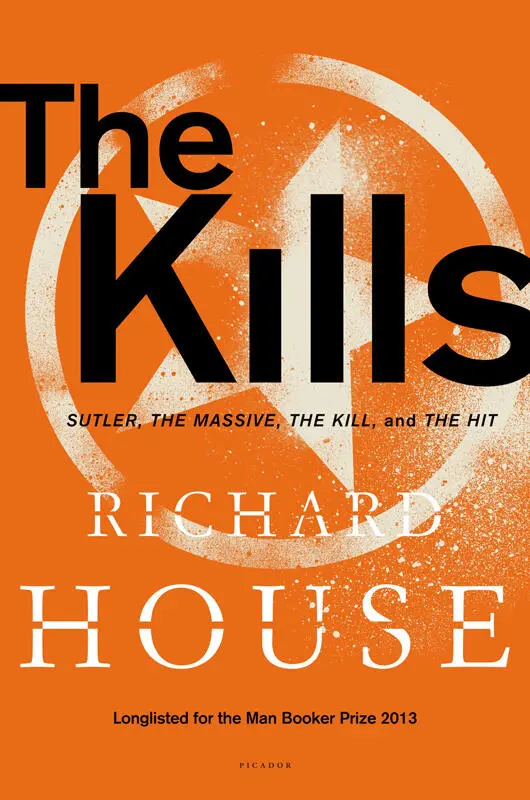
- Название:The Kills
- Автор:
- Издательство:Picador
- Жанр:
- Год:2013
- ISBN:нет данных
- Рейтинг книги:3 / 5. Голосов: 1
-
Избранное:Добавить в избранное
- Отзывы:
-
Ваша оценка:
The Kills: краткое содержание, описание и аннотация
Предлагаем к чтению аннотацию, описание, краткое содержание или предисловие (зависит от того, что написал сам автор книги «The Kills»). Если вы не нашли необходимую информацию о книге — напишите в комментариях, мы постараемся отыскать её.
The Kills — читать онлайн бесплатно полную книгу (весь текст) целиком
Ниже представлен текст книги, разбитый по страницам. Система сохранения места последней прочитанной страницы, позволяет с удобством читать онлайн бесплатно книгу «The Kills», без необходимости каждый раз заново искать на чём Вы остановились. Поставьте закладку, и сможете в любой момент перейти на страницу, на которой закончили чтение.
Интервал:
Закладка:
Rem squinted into the sun, leaned forward to speak, self-conscious and awkward. The camera propped on a car bonnet. He spoke in a fake Mexican accent, a private joke. (They played a game where he, invariably, was subordinate to her, garden-boy, pool-boy, waiter, bus-boy, and these seductions were always brief and hasty. It could happen on drives, at restaurants, at home minutes before guests arrived. Nobody they knew would guess this of them.)
‘So this is home,’ he said. Rough as it was it beat the crap out of Amrah. He’d watched the razing of entire city blocks, and for what? The idea that you could rebuild a city was messy, wrong-headed, and they hadn’t done one thing right.
Rem took off his shirt, ran his hand over his chest. He coughed before he spoke, his expression serious. ‘It makes sense,’ he said, ‘I know you don’t like it, but if I came back there wouldn’t be any work. It’s coming into summer. You know we’d be right back where we started. Anyway.’ He scratched his nose (a habit of his when he wanted to move a conversation off a sticky subject).
‘I picked these people,’ he said. ‘I get to be a manager again. I run my own team.’
Pointing to the desert, Rem said that this wasn’t anything much. It was safe, a little quiet, but definitely secure. The only trouble here would be trouble they brought on themselves through boredom. The camp was a good distance from habitation. Nothing but sand and rock and maybe a few scorpions: nothing until the border.
* * *
Cathy had her own news, wasn’t sure if she had already told him. Cissie had taken Matt back to Kansas. I’m sorry if I’ve already said. Cathy spoke into the phone and couldn’t help but stage her voice, pick and pronounce her words with more than her usual care. The truth is the doctors hadn’t expected him to make it this far, and now he had, they didn’t know what to do with him. They start with one thing and it affects what they do next.
She didn’t like the cadence of her voice, all Southern sing-song that made light of any trouble: every burden being a blessing in disguise. Christ, wasn’t that the word they used? Blessing? This was her family’s doing. How even the worst news came sugar-glazed, every word freighted with blessings. How had she escaped this life? And how was it, even after all these years, that her voice betrayed this last tail of home?
She started up the recording and spoke into the phone. Mike and Jenny have moved. See? Even this sounds happy? Drove by yesterday. They’re gone. Packing cases on the porch which makes it look like they were in a hurry. There were four signs of foreclosures along Ravenswood. That’s four in one block.
She’d seen a dog in the park just like Nut, except he was on a lead and barking. Nut never barked. Far across the park the dog strained against its lead, gave the man a struggle, and while it wasn’t Nut, couldn’t have been, she felt guilty for not making sure.
Cathy ended with the realization that everyone had gone. It’s me, she said, and Maggie. Ten years in this town and I know one person. How can this happen so quickly? We had a full life, didn’t we? Now I know one person.
She paused the recording and then deleted the message, and resolved to start again in the morning.
* * *
The satphone worked only in the late afternoons, communications dropped and stuttered alternately compressing and stretching distance and expectation. Watts sat with Rem beside the water tanks and tried to help Rem send messages back to ACSB, when the news came back that it was closing.
‘You knew this?’ Watts asked.
‘First I’ve heard.’
‘Clark said something when we were leaving.’
‘He knew?’
‘Rumour.’
They looked down the highway.
‘Haven’t seen one vehicle.’
The highway trailed back, an empty spine. Not one thing on it.
* * *
Geezler wanted to know about the map. He’d consulted the maps at HOSCO and none of them had a highway running alongside the Saudi border. Rem asked Watts where the maps had come from.
‘Stores.’ Watts shrugged. ‘The usual.’
Rem asked Kiprowski: if the maps came from Stores, then where did Stores get them?
Kiprowski took the map and looked it over, held the paper close to his face to read, and found printed in the corner a small tagline, S-CIPA. This one came from Southern-CIPA, he said.
Rem managed to send his reply before the lines dropped. Pleased to have a result, he’d forgotten to ask the main question he’d had since they’d arrived: now they were here, exactly what were they supposed to do?
* * *
On the second morning they were woken by the arrival of six yellow garbage trucks. Groots. The same back-loading garbage trucks he’d seen on the streets of Chicago. The convoy arrived early, pre-dawn, and the men duly rose, curious, to greet them. At first sight they thought this funny: dump trucks with the municipal labels and signs stripped from the sides, here, in the middle of Iraq. And yellow? The driver of the first truck, a Ukrainian, Stas, was surprised to find the camp occupied, and when he jumped out of his cab he asked if Rem needed a permit or a manifest now, like at Bravo and SCB Alpha. Rem admitted that he didn’t know, and Stas assured him that there wasn’t too much to it.
‘Here we come with no permits.’
Stas carried about a small towel, which he used to wipe his hands and forehead. He spoke briefly with the other drivers, called Chimeno to him, and asked him to drive the tanker from the Quonset and follow them down to the pits. A line of blocked shapes, dim in the pre-dawn, headlights busy with insects, slowly followed the track downhill, their vibration humming through the night air.
Pit 4, closest to the Beach, was the deepest. Stas explained in broken English how he’d helped excavate the pit.
‘You dug this out?’ Rem couldn’t quite follow. ‘You made this?’
Rem’s question made him laugh. ‘You dig! Yes? You. Every week, maybe.’
The idea horrified Rem. ‘Every week we dig a new pit?’
‘No, you dig the same pit.’
This was the reason for the two diggers parked behind the Quonset.
‘How do you know when?’
‘To dig? You’ll know.’ The pits, Stas indicated, became full, and with a chopping motion he demonstrated how the pits were extended by cutting and in-filling, and by this process they grew at one end and shrank at the other. Continually dug out of the sand they crept, caterpillar-style, into the desert. Now it made sense why they were placed in a star-like configuration, radiating away from one another.
‘How often?’ Rem wanted to make this clear.
‘Depends.’ Stas pinched his nose. ‘Sand will stop the smell. But not so much.’ He wiped the back of his neck then waved the towel in the air. ‘The fire will stop the flies. You have clothes?’
Rem had found a crate of protective suits in the Quonset. Firemen’s bunker gear, rubberized suits with reflective belts and black zippers. He sent Chimeno back to the compound and told him to hurry.
Stas tied the towel over his mouth, bandit-style, and supervised the dumping. The trucks began to unload one at a time at the near end of the pit. The first truck shivered as the pistons struggled to tip the container high enough and the contents slipped out in a dense and mudlike mass.
Pakosta started laughing. ‘That’s disgusting.’ The men watched as the black waste flopped into the pit. ‘Man, that’s graphic.’
The second truck spewed out a muddle of white bags and they watched them roll and slop, getting now a sense of depth and scale.
‘My parents,’ Pakosta shouted above the noise, ‘won a vacation on a game show. A week in Kenya. For five days they saw nothing. Some giraffes. A couple of hyenas. Someone brought them a dead snake. On their last night they stopped at this water hole and saw, like, fifty hippos — and all these hippos did was back up to the water and shit in it for something like half an hour. They made a video.’
Читать дальшеИнтервал:
Закладка:
Похожие книги на «The Kills»
Представляем Вашему вниманию похожие книги на «The Kills» списком для выбора. Мы отобрали схожую по названию и смыслу литературу в надежде предоставить читателям больше вариантов отыскать новые, интересные, ещё непрочитанные произведения.





Обсуждение, отзывы о книге «The Kills» и просто собственные мнения читателей. Оставьте ваши комментарии, напишите, что Вы думаете о произведении, его смысле или главных героях. Укажите что конкретно понравилось, а что нет, и почему Вы так считаете.