Richard House - The Kills
Здесь есть возможность читать онлайн «Richard House - The Kills» весь текст электронной книги совершенно бесплатно (целиком полную версию без сокращений). В некоторых случаях можно слушать аудио, скачать через торрент в формате fb2 и присутствует краткое содержание. Год выпуска: 2013, Издательство: Picador, Жанр: Современная проза, на английском языке. Описание произведения, (предисловие) а так же отзывы посетителей доступны на портале библиотеки ЛибКат.
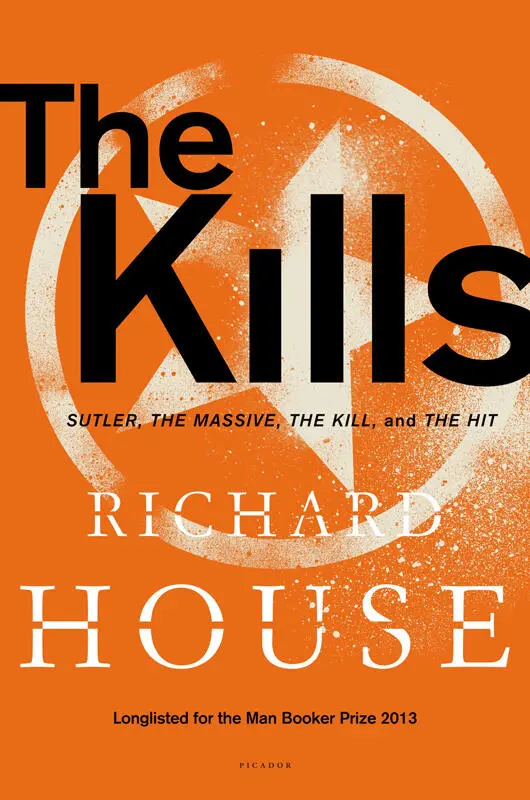
- Название:The Kills
- Автор:
- Издательство:Picador
- Жанр:
- Год:2013
- ISBN:нет данных
- Рейтинг книги:3 / 5. Голосов: 1
-
Избранное:Добавить в избранное
- Отзывы:
-
Ваша оценка:
The Kills: краткое содержание, описание и аннотация
Предлагаем к чтению аннотацию, описание, краткое содержание или предисловие (зависит от того, что написал сам автор книги «The Kills»). Если вы не нашли необходимую информацию о книге — напишите в комментариях, мы постараемся отыскать её.
The Kills — читать онлайн бесплатно полную книгу (весь текст) целиком
Ниже представлен текст книги, разбитый по страницам. Система сохранения места последней прочитанной страницы, позволяет с удобством читать онлайн бесплатно книгу «The Kills», без необходимости каждый раз заново искать на чём Вы остановились. Поставьте закладку, и сможете в любой момент перейти на страницу, на которой закончили чтение.
Интервал:
Закладка:
Pakosta turned the Humvee aggressively about. ‘I have one more property. I think you’ll like what we’ve done here. Honest to god.’
* * *
Pakosta drove first to the Beach. If Rem wanted to get a measure of this vast nothing, then the Beach was the place to start.
‘I was here in February. We had to haul a truck out of one of the pits. We should have just pushed it in.’
The Beach, a long dune, almost as high as the camp, formed a crescent-shaped gulley around an open tip of abandoned vehicles and equipment — most of it stripped of usable parts. The Beach rode up behind as a steep roll of sand.
‘This is where they dump hardware which won’t burn.’ He strode up the dune expecting Rem to follow. Once on the crest he struck a pose and swept out his arms to the north and north-west. ‘Nothing of interest until the border. Belongs to A-rabs, scorpions, camels, and desert rats. Nothing going out, and nothing coming back. If anything did happen to come at us we’d see it several days before it got here. Not so from the other direction.’ Pakosta turned to point south with two fingers, pistol-fashion.
‘Our closest neighbour is Khat. Sometimes the support and supply convoys from Camp Navistar to LSA Anaconda in Baghdad are obliged to take this road: and on occasion the good citizens of Khat choose to stone the vehicles, to slow them down and rob them, because the convoys come from Shuaiba or Camp Arifjan, and bring eggs, milk, bread, flour, you name it. Foodstuffs. Fuel. If we’re smart we’ll have nothing to do with them. Fortunately most of them believe that the pits are used to destroy chemicals and toxic material.’ Pakosta swept his hand to the east. ‘Which brings us to Camp Crapper, the largest and last burn pit in southern I-raq, which, to my knowledge, has never been permanently manned.’ Pakosta spat into the sand then levelled his arms. ‘So, what the fuck are we doing here?’
Rem gave Pakosta an honest answer. ‘Because this is the last job in town. Everywhere else doesn’t look so good right now. Why are you here?’
‘This is my career.’ Pakosta gave a laugh. ‘I’m serious. This country is my future. I’m never going back.’
* * *
Before returning to the cabins they stopped at the burn pits. Five long and shallow trenches, each as broad as a truck. Inside the pits a mess of black glue and scorched semi-recognizable detritus: a freezer unit, gypsum boards, a bicycle frame, half-burned boxes and bags melded together, yet to properly burn, but mostly an uneven field of papery black and grey ash.
* * *
As soon as he shut the cabin door Rem didn’t know what to do with himself. Tired? Certainly. But ready to sleep? He wrote a list of what he wanted to say to Geezler, and outlined their abandonment by the security unit, the highway that stopped in the middle of the desert, the stink of the pits, and how the camp was more remote than he’d imagined. Even so, despite these aggravations, he didn’t doubt that Camp Liberty would be better and safer than Amrah once everything began to settle into place. Rem couldn’t see there being much to report on, day to day. Whatever Geezler wanted from him had already been satisfied. The pits were now manned.
Neither his cellphone nor the satellite phone could pick up a signal. Rem wasn’t sure how to use the satphone: a handset with what looked like a folding hotplate. Tomorrow they’d resolve this. Watts would know. Communications would need to be established with Amrah, no one would be happy if contact home wasn’t possible.
Each of the men secure in a cabin. No wind. No traffic. Rem turned off the flashlight and lay on the bed in utter darkness. Wide awake.
* * *
Part way through the night the lack of sound finally bore into him. A stillness compacted by his heartbeat, the changing pressure in his ears, the random babble in his head, his stomach, his breath, mostly his breath: so that the night slowed down to these small things.
He’d covered himself with mosquito repellent. Thought it better to show caution and hope that the mixed fumes of repellent and sweat would deter anything Clark and Samuels might have missed.
Rem fretted over Cathy. He wanted a little home comfort, a presence, some body warmth. He couldn’t think of Cathy without imagining her falling down. He pictured endless scenarios of Cathy suddenly falling, sometimes heavy: on the El platform, crossing a road, climbing stairs; and sometimes slow, as if asleep: driving, in the street, in the shower, at the stove, the room catching light as she lay on the floor. And on, and on. Cathy tumbling, striking her head, not being found. All of this trouble for a ring and a couple of watches.
A sound grew from outside, the fast mechanical cut and chop of a helicopter, the twin rotors of a Chinook. A helicopter, twin rotors. By the time he’d found his boots and made it outside the drop was completed. Four crates lowered behind the Quonset, dust settling, the helicopter already leaning backward into the sky. Hard spotlights and a lit interior cabin.
He looked down the row and saw Santo smoking outside his hut. The two men waved liked neighbours in any neighbourhood.
* * *
In the news the bombing of four Amrah City markets in the same day, sixty-seven dead in a strip-mall that looked much like the local K-Mart with its parking lot and a broad, stippled concrete hood sheltering the sidewalk. Both the Times and the Post ran photographs of men stumbling over rubble, startled, dusty, hands to their heads. After waiting at the checkout Cathy changed her mind and left the newspapers on the counter. She didn’t need this. Although she’d known his return was indefinitely delayed, it was today that the information sank through and began to hurt. It meant an anniversary alone. It meant reorganizing the payments on their loans. It meant that she would not move apartment until the next summer, and they needed somewhere smaller, cheaper. She’d made and cancelled two appointments at the Howard Street clinic, thinking this can wait, better to go when Rem returned. No more fainting, and no dizziness, instead a lack of appetite, a general exhaustion she carried as a weight, which could be something, but could simply be sadness. This vacation had opened up a world of trouble. She kept newspaper clippings every time she found a report mentioning HOSCO, simply for the habit. In the Tribune she found a report on military wives and infidelity, and wanted to call the paper to complain, to ask what they thought they were doing? Were they really so short of ideas? Cathy took herself to the loading dock, phone in hand, ready to make the call. Not that she could bring herself to make it, because she wasn’t a military wife, just someone in the same position, and she didn’t want to have to justify herself, she just wanted to complain to someone who had to listen. The news of the bombing alarmed her; while she trusted Rem’s word that he was safe, the notion that he could be harmed stuck as a superstition. She could imagine him dead but not wounded, or if wounded not maimed, a scar perhaps, but that alone. Photographs of men lying in streets shocked and scorched made no sense to her: families would look at these images and recognize their sons and husbands.
The arrival of a package with a military frank was a reminder that Rem really was absent. He’d left her to an artificial world, and she lived expecting news from elsewhere. She drove home still dressed in the store uniform that made her itch, a ring on her finger, the Happy Shopper stitched on the breast pocket, and felt owned. Cathy settled her hand on the package. She had her mail delivered to a post-box because packages could not be trusted with her neighbour, Mr Liu.
* * *
Three hours at the library. Stops. Starts. Disconnections. The messages recorded on Rem’s mobile and transferred to their email account. Behind Rem a digital fuzz of flat desert and rising heat broken into shifting tonal zones of spoiled muddy ochre. The image assembled out of crude blocks, bold as thumbprints.
Читать дальшеИнтервал:
Закладка:
Похожие книги на «The Kills»
Представляем Вашему вниманию похожие книги на «The Kills» списком для выбора. Мы отобрали схожую по названию и смыслу литературу в надежде предоставить читателям больше вариантов отыскать новые, интересные, ещё непрочитанные произведения.







Обсуждение, отзывы о книге «The Kills» и просто собственные мнения читателей. Оставьте ваши комментарии, напишите, что Вы думаете о произведении, его смысле или главных героях. Укажите что конкретно понравилось, а что нет, и почему Вы так считаете.