Richard House - The Kills
Здесь есть возможность читать онлайн «Richard House - The Kills» весь текст электронной книги совершенно бесплатно (целиком полную версию без сокращений). В некоторых случаях можно слушать аудио, скачать через торрент в формате fb2 и присутствует краткое содержание. Год выпуска: 2013, Издательство: Picador, Жанр: Современная проза, на английском языке. Описание произведения, (предисловие) а так же отзывы посетителей доступны на портале библиотеки ЛибКат.
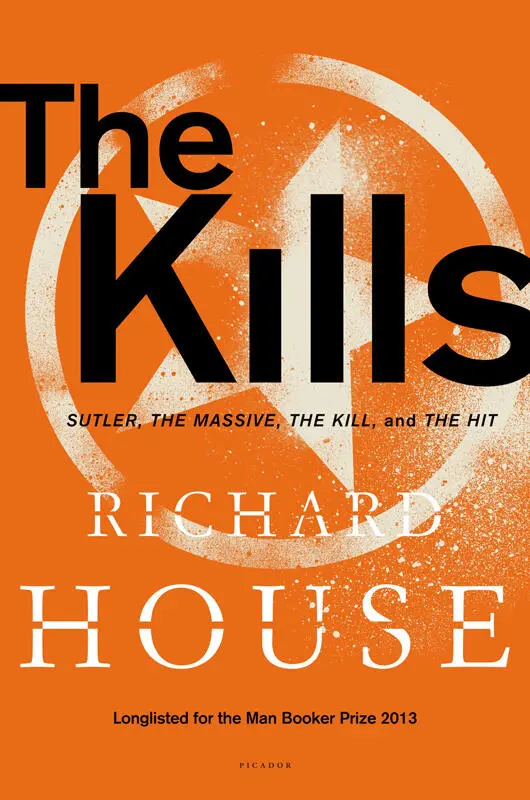
- Название:The Kills
- Автор:
- Издательство:Picador
- Жанр:
- Год:2013
- ISBN:нет данных
- Рейтинг книги:3 / 5. Голосов: 1
-
Избранное:Добавить в избранное
- Отзывы:
-
Ваша оценка:
The Kills: краткое содержание, описание и аннотация
Предлагаем к чтению аннотацию, описание, краткое содержание или предисловие (зависит от того, что написал сам автор книги «The Kills»). Если вы не нашли необходимую информацию о книге — напишите в комментариях, мы постараемся отыскать её.
The Kills — читать онлайн бесплатно полную книгу (весь текст) целиком
Ниже представлен текст книги, разбитый по страницам. Система сохранения места последней прочитанной страницы, позволяет с удобством читать онлайн бесплатно книгу «The Kills», без необходимости каждый раз заново искать на чём Вы остановились. Поставьте закладку, и сможете в любой момент перейти на страницу, на которой закончили чтение.
Интервал:
Закладка:
In his email Rem spoke about assigning cabins to the men, of clearing out bunks. He spoke about a squabble over who would take the cabins closest to the showers — although he couldn’t see the advantage, because the toilets and the showers were stupidly at opposite ends of the camp. He used the word loosely, he said. Camp. In the end they opted to draw straws, but having no straws or anything that would make do, they fell into a game of paper, scissors, stone. Grown men grouped under a temporary canopy playing a child’s game to settle a territorial dispute. He left them to it. Provisions were arriving, but without the proper equipment food would spoil: potable water was shipped in plastic bottles, non-potable water was stored in two large underground tanks set halfway into a hill that relied on gravity to drain into the showers. For the moment they would get by day to day. He didn’t mind, he said, he really didn’t mind, because they had enough vehicles and enough fuel to drive right back to Amrah City if they had to — not that he ever wanted to go back, but if they had to, they could manage themselves out of trouble. The main problem, he confided, was heat, and adjusting the work day so they’d be up before dawn to receive the trucks for the burn pits. All in good time.
* * *
He’d posted the videos to an email account, and she found them accidentally — a stray click on an underlined link.
Once downloaded, the first, smaller message began to play. Rem’s voice broke into the library, until Cathy fumbled the headphone jack into the correct socket.
Rem huddled in a dark room, back to a wall, knees up, the camera close to his chest, his face greased with sweat, his eyes deep, closed at first, compressed. And then: his face sulking, baby-like, mouth rising, brow falling, and sobs, awkward and girlish. Rem cried noisily, he choked in awkward bursts that made this difficult, ugly to watch.
Out on Clark, the few lime trees planted along the sidewalk — always the first to suffer the heat. She took a break, called Maggie, asked ordinary questions, surprised at the control in her voice, how cold she could sound as she asked about the orders, about details, about shifts, the possibility of more work, because money, you know, was always welcome, especially now. When Maggie hesitated she said, ‘Forget it. Forget I asked. I don’t know why I called,’ and Maggie took the insult badly and cut the conversation short.
Cathy returned to the computer, grateful that this was only one room, nothing more than a storefront, but disliked how her private life played out on public computers. She found a different image playing, the second message downloaded and running footage of a stony roadside that fell back to an endless palm grove. The jolt of the vehicle punched the image up to the sky, blinding white then blue, whipped by the feathered tops of palm trees, a rustle of green. Date palms, she knew this, not coconut. And would those be almond trees, or walnut, some kind of fruit? Olive trees broke the rhythm, pleasantly squat and pale, and locked between them the brightest sky, a thin block of air. In breaks between the groves the irrigation channels, the ditches, the dusty roads, and further back more fields and groves, an unfamiliar sight for a country she’d imagined only as stone and desert.
This world looked old by design. She put on the headphones, taken by, but not quite believing, the wearing brightness and the bare sunshine. The waters of a great river brought sparingly to the plains, passed plant to plant through channels and tubes and tight little ditches, and the transformation from flat desert to a continuous roadside oasis struck her as ingenious, hard-earned, and beautiful.
She could distinguish voices under the drone of the engine. Rem, and one, maybe two other men, laughing, discussing how the village wasn’t on the map. How wild is that? Shouldn’t be there. Across the radio, she could just about hear a voice singing and sounding like a taunt.
* * *
The next morning, stopped on Lake Shore Drive, Cathy smoothed the apron over her stomach, and thought again of this oasis: a clear image of water channels, low mud walls, a wild pampas-like grass, but mostly the palm trees, strong leaning trunks, a wild bush of fronds — home to what kinds of bird? What right did Rem have crying, homesick, in some boxy room, when he was free of this monotony?
She wasn’t eating regularly, she’d lost too much weight too quickly, enough to stop her periods. These things happened when she became stressed. Outward, she appeared to manage. Inward, everything became a mess: eating, sleeping, shitting, menstruation, every basic function thrown out of whack.
* * *
Rem could smell the camp before they came across it. A smell, from a distance, of newly turned earth, slightly foetid, not entirely unpleasant. Closer still the stink fastened to the back of his throat, turned penetrative and meaty.
Forty minutes earlier they’d come through palm groves and an ordered grid of dry irrigation channels surrounding an unmarked village, Khat. Now they sat at the head of an incline, a great plate of desert about them, falling on all sides — except to the west where a small bare hill concealed the camp. The tops of two water tanks half buried in the hill, a wire fence, and a cable-wire gate were all that could be seen from the road.
They drove slowly down the track into Camp Liberty. To their right a Quonset hut with a ribbed barrel roof and a long garage door, rosy in the late sun, with two blackened diggers pulled-up behind. To their left an uneven line of HOSCO cabins. This, Rem understood, was the camp, barely enough to justify the journey. The track continued in a wavering line toward the burn pits. Behind them, the highway struck straight, north — south. Further to the west the land lost distinction, the wind drove up a fleshy haze and the horizon faded to flat tones. He couldn’t figure why the camp was based here, nothing established its reason, no commanding feature, water, nothing, except that it lay equidistant between the Kuwaiti border, the Saudi border, and a small town called Khat.
When the vehicles stopped the men stepped out, and one by one looked about, expecting more and failing to find anything. Each one of them took shallow breaths and looked to Rem as if he was the source of the stink. Samuels sloped out last, a spanked dog, all tremors and passing terror, the only one not appalled by the stench.
Rem asked Pakosta if this was it.
‘Just about.’
‘Dead things. It smells of bad meat, animal fat.’ Santo pinched his nose, swatted the flies matting Watts’ back.
The plastic cabins were raised on wood pallets. Their fronts and sides, pitted by the sand, were so badly weathered that grit stuck in them and gave them a soft furred look. Santo gouged out the screws, and when the door opened he jumped back. ‘Something in here!’
The men gathered in a huddle and peered cautiously inside. The floor, black, appeared to move.
‘It’s ash.’ Santo thought this funny, and wafted the door and the ash stirred, disturbed as the surface of a lake.
The bed, a simple cot, at least had a mattress but the room was otherwise bare. Rem had the common sense to make sure the men brought fresh bedding and bed rolls, something more comfortable at least than their accommodation back at Amrah. He charged Samuels and Clark with checking each of the cabins. Fleas, bugs, roaches. Scorpions. Rats. Spiders. He had no idea what was out here.
* * *
Rem asked Pakosta to drive him about the camp. He wanted to see the burn pits as he didn’t yet know how to speak to the men about their work: everything was new and unfamiliar.
A home-made sign outside the Quonset pointed to ‘The Pits / The Beach’.
Читать дальшеИнтервал:
Закладка:
Похожие книги на «The Kills»
Представляем Вашему вниманию похожие книги на «The Kills» списком для выбора. Мы отобрали схожую по названию и смыслу литературу в надежде предоставить читателям больше вариантов отыскать новые, интересные, ещё непрочитанные произведения.






Обсуждение, отзывы о книге «The Kills» и просто собственные мнения читателей. Оставьте ваши комментарии, напишите, что Вы думаете о произведении, его смысле или главных героях. Укажите что конкретно понравилось, а что нет, и почему Вы так считаете.