Richard House - The Kills
Здесь есть возможность читать онлайн «Richard House - The Kills» весь текст электронной книги совершенно бесплатно (целиком полную версию без сокращений). В некоторых случаях можно слушать аудио, скачать через торрент в формате fb2 и присутствует краткое содержание. Год выпуска: 2013, Издательство: Picador, Жанр: Современная проза, на английском языке. Описание произведения, (предисловие) а так же отзывы посетителей доступны на портале библиотеки ЛибКат.
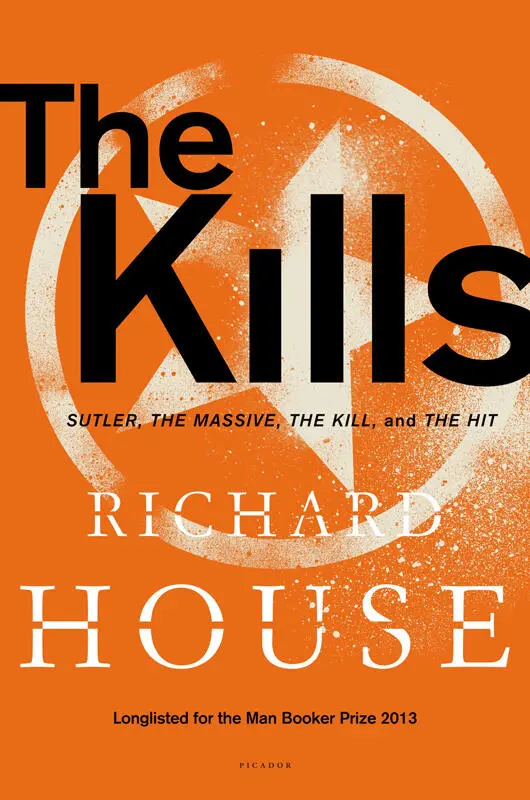
- Название:The Kills
- Автор:
- Издательство:Picador
- Жанр:
- Год:2013
- ISBN:нет данных
- Рейтинг книги:3 / 5. Голосов: 1
-
Избранное:Добавить в избранное
- Отзывы:
-
Ваша оценка:
The Kills: краткое содержание, описание и аннотация
Предлагаем к чтению аннотацию, описание, краткое содержание или предисловие (зависит от того, что написал сам автор книги «The Kills»). Если вы не нашли необходимую информацию о книге — напишите в комментариях, мы постараемся отыскать её.
The Kills — читать онлайн бесплатно полную книгу (весь текст) целиком
Ниже представлен текст книги, разбитый по страницам. Система сохранения места последней прочитанной страницы, позволяет с удобством читать онлайн бесплатно книгу «The Kills», без необходимости каждый раз заново искать на чём Вы остановились. Поставьте закладку, и сможете в любой момент перейти на страницу, на которой закончили чтение.
Интервал:
Закладка:
So anyway, the story: they’re scrambling to establish basic communications, with the mightily reduced aim of refitting a minimal seven out of the seventy-nine exchanges and substations. That’s seven. Count them. Seven. Less than nine per cent of the number they’ve been paid to complete. Alongside this his team is also responsible for the main communications router for the company — that’s HOSCO, remember — so every speck of information, every byte, comes through his small four-man team, and they get to hear everything. Every blip of information the parent company is telling its subsidiaries, and every anxious twitch those subsidiaries are feeding on to their project managers, everything but everything is filtered through this team. And let me tell you, it’s chaos. So, early one morning, HOSCO’s network goes wild. A message from one of the division directors announces that a statement will be made in Washington that very morning and the content of this announcement is to be passed, immediately, to all senior staff. According to this director, the statement they are waiting for is a follow-up to a statement made by the President himself, in which, while touring southern Iraq, he inadvertently blabbed out information on a project that was not intended to be made public. At. This. Point. This statement has slipped out so far ahead of schedule it threatens to kill the project unless they act quickly. You follow? Washington is now obliged to dump a fuckton of money upon said project, and unless HOSCO is ready for this shit-shower of money, they’ll miss out altogether on the mother of all projects. The story, Watts says, is a classic.
* * *
First though comes the story about the trip.
The commander-in-chief’s visit has been scheduled for a long time. The visit is little more than a fly-’n’-stop, a series of parsed hand-waves at relevant outposts along the Iraq — Kuwait border. Things aren’t right in Washington, and what was a planned pre-exit howdy to the remaining teams has become politically toxic.
Picture this: Air Force One, accompanied by small fighter jets prowling wing-tip to wing-tip, wasps cutting through a blue hood of sky toward a copper horizon, a jagged edge of what might be mountains but is in fact the smoke of burning refineries. The mission is important. Everyone agrees that there are few usable photographs of the commander-in-chief alongside his forces because he has the bad habit of looking bored while speaking with people he does not know.
At Camp Navistar the commander-in-chief and team decamp to a fleet of helicopters to be flown direct to the 0–9 at Camp Hope. In readiness the base has long been secured and emptied of all non-nationals, but right at the last minute the media-unfriendly wounding of four Iraqi civilians outside the compound makes the stop at Camp Hope ill-advised. Instead, the commander-in-chief will make his announcement on changes to the Third Iraq Key Strategic Plan at the next nearest manned station, Provision Camp Liberty on Route 567 in South-West District 2 near Amrah City. The change, mid-transit, makes it necessary to gather a great deal of information en route.
Down on the ground, a Colonel Pritzker, is the first to learn that the commander-in-chief has come to Iraq to announce a new development in strategy and now intends to visit Camp Liberty. That day. In fact, within minutes.
Pritzker is suspicious: there are radio shows that do this kind of thing, and he can taste the end of his career. First off, he’s never heard of a provision camp before, and he has no idea who is in residence at Camp Liberty. Camp Liberty, to his memory, is a lowly set of HOSCO cabins, a star-like arrangement of burn pits, and a vacant squatter camp.
The colonel’s advice is passed back to the team, and after some discussion the secretary gets back to Pritzker and says, great, we’re going to run with this. It’s a go. And it finally occurs to Pritzker that this really is the President, and that Air Force One is, as he speaks, winging its way across the Arabian Desert to its imminent arrival at an empty set of burn pits. His final word, the only thing that occurs to him, is to ask the secretary if he knows what a provision camp is. Has he ever heard this term before? The secretary is a little preoccupied because there are other items to concern him now, but the question stops him. No, neither he nor any of the other staffers have heard of a provision camp and presume it is some kind of a place that somehow, you know, provides.
Colonel Pritzker says uh-huh, that’s almost right. A provision camp is certainly a place that provides a service. But Provision Camp Liberty is isolated for good reason, because it is the largest site where chemical, human, and animal waste is brought to be destroyed in the desert. You lose a leg in Iraq, a finger, a toenail, if it can be swept up, it’s coming to Camp Liberty. In fact Provision Camp Liberty stinks so bad that it is known by the TCNs as Camp Crapper. You take several tonnes of human waste, add the insane heat of the Arabian Desert, and you have yourself an intense olfactory experience — but, regardless, whoever is currently in occupation at that site would be mightily proud to meet their commander-in-chief.
Watts imagines the quality of the silence that falls across Colonel Pritzker’s comm-link while the information is relayed back to the team.
Two minutes short of their destination the President’s entourage return to Camp Navistar on the Kuwait border, where, in the hangar, surrounded by his retiring troops, the President himself announces the New Strategic Plan, and here the terrible mistake is made. In an answer to a question about the apparent failure to rebuild Amrah City the commander-in-chief mentions that there is a new scheme under consideration. Somewhere, he says, here, in southern Iraq, in a place he would not identify, the Corps of Engineers are preparing to build a new military outpost, and this outpost will become the largest military staging-post yet built. Once completed, and once its mission is fulfilled, the base will be converted for civilian use and will become the first new city in a peaceful Iraq.
* * *
At this announcement HOSCO goes wild. The lines are crazy. Speculation crosses the globe. One hour after the commander-in-chief’s unguarded statement the Secretary of State back in Washington confirms the details, but adds, with caution, that the intended base is still little more than ‘a good intention’. They’re looking at four sites and are sending point-men to evaluate these sites as we speak. While this, initially, is to be a military ‘advisory’ base, an integral part of the New Strategic Plan. Never again will a foreign power enter Iraq territory and occupy its oil fields (a chuckle from the Press Corps to this one).
In a voice of creamy sincerity the Secretary of State insists that the administration is looking to the future. And then that smile. Everybody loves that smile.
* * *
You know what this means? Watts asks. You know when this happened? This all happened pre-withdrawal plans and pre-basic implementation. Which means that something has to be done about this now. Like, yesterday. Because there’s money attached to the idea, and the period in which that money remains available is near its expiration.
This is how government works. They make decisions, they appoint money to those decisions, and they expect others to bid and take on those projects. There’s a whole complicated structure for this which has government agencies and private businesses at each other neck and neck. It’s in everyone’s interest to have this money used up before it gets sucked back. That’s how everything works around here. At the last minute whole schemes suddenly materialize.
Читать дальшеИнтервал:
Закладка:
Похожие книги на «The Kills»
Представляем Вашему вниманию похожие книги на «The Kills» списком для выбора. Мы отобрали схожую по названию и смыслу литературу в надежде предоставить читателям больше вариантов отыскать новые, интересные, ещё непрочитанные произведения.







Обсуждение, отзывы о книге «The Kills» и просто собственные мнения читателей. Оставьте ваши комментарии, напишите, что Вы думаете о произведении, его смысле или главных героях. Укажите что конкретно понравилось, а что нет, и почему Вы так считаете.