Richard House - The Kills
Здесь есть возможность читать онлайн «Richard House - The Kills» весь текст электронной книги совершенно бесплатно (целиком полную версию без сокращений). В некоторых случаях можно слушать аудио, скачать через торрент в формате fb2 и присутствует краткое содержание. Год выпуска: 2013, Издательство: Picador, Жанр: Современная проза, на английском языке. Описание произведения, (предисловие) а так же отзывы посетителей доступны на портале библиотеки ЛибКат.
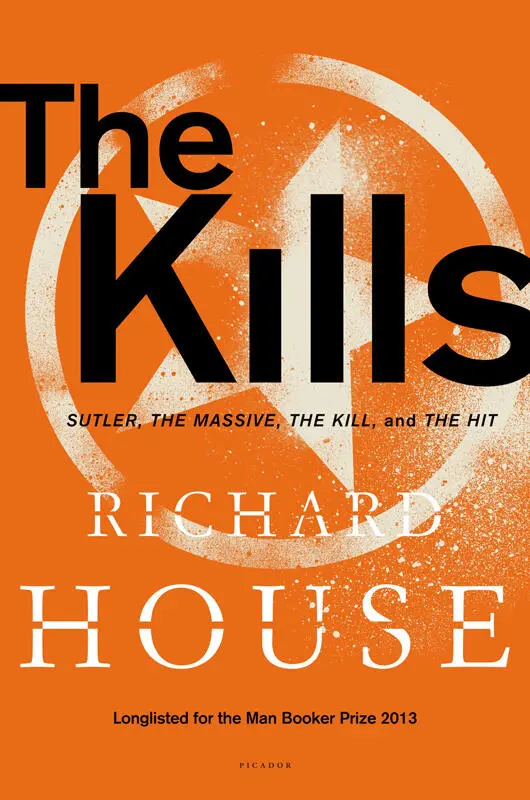
- Название:The Kills
- Автор:
- Издательство:Picador
- Жанр:
- Год:2013
- ISBN:нет данных
- Рейтинг книги:3 / 5. Голосов: 1
-
Избранное:Добавить в избранное
- Отзывы:
-
Ваша оценка:
The Kills: краткое содержание, описание и аннотация
Предлагаем к чтению аннотацию, описание, краткое содержание или предисловие (зависит от того, что написал сам автор книги «The Kills»). Если вы не нашли необходимую информацию о книге — напишите в комментариях, мы постараемся отыскать её.
The Kills — читать онлайн бесплатно полную книгу (весь текст) целиком
Ниже представлен текст книги, разбитый по страницам. Система сохранения места последней прочитанной страницы, позволяет с удобством читать онлайн бесплатно книгу «The Kills», без необходимости каждый раз заново искать на чём Вы остановились. Поставьте закладку, и сможете в любой момент перейти на страницу, на которой закончили чтение.
Интервал:
Закладка:
Kiprowski stood with his hands clasped behind his back, cadet-style.
‘Back in Amrah. I heard you rode alone up Jalla Road?’
Kiprowski smiled and shook his head. ‘I got a ride at the last minute.’
‘But you were going to do it?’
Kiprowski said he didn’t know. He guessed so. Maybe. ‘Seemed as safe as anything else.’
* * *
Rem had no idea who he was speaking with and the temperamental connection didn’t help, neither did an audience. Throughout the discussion he was faced with idiot grins from Chimeno and Clark, teamed up as some redneck glee-club in matching blue T-shirts. (Chimeno: ‘Lock and Load’, with an arrow pointing to his crotch, and Clark: ‘Why Does This Keep Happening?’ The T-shirts had arrived that morning in a care package from Watts’ brother.)
Halfway through the conversation Rem held his hand over the mouthpiece and asked Chimeno and Clark if they could do him a favour. Keen to please, Chimeno leaned forward.
‘Get Santo and find out who Paul Howell is. See if he’s heard of this Markland.’
The two men left and he returned to the conversation. He asked the man his name: Markland. Tom Markland, secretary for Paul Howell — offered as if he should know.
The problem, Markland insisted, was that they couldn’t transport explosives, not in the quantity Rem needed, not by road. Even if he could — just supposing — under the current directive non-combatants weren’t authorized to handle munitions of any kind.
This, Rem pointed out, was madness. The burn pits had been running long before his arrival and they had managed to start fires, with explosives, with fuel, without trouble.
Markland’s voice sank, as if explaining a very easy point to a very simple person. ‘Because the convoys have military escort. They bring their munitions with them. They set the fires by themselves. It’s their business to start the fires. Not yours.’
Rem explained about the Ukrainian, Stas, a driver, and how he’d started the fire on the previous night and how there was no military or security escort.
Markland’s voice sank further and he offered a three-line defence.
1. ‘That’s news to me.’
2. ‘They’re out of my jurisdiction. We have no control over the GST, the CMDN, or over any Ukrainian nationals, only directives on what procedures everyone should follow. If they aren’t following these procedures then you have to report this.’
3. ‘They find their explosives out and about.’
‘There’s plenty out there. There are munitions dumps any place you care to look. How do you think the insurgents arm themselves? Most of what they use is ours. Walk in any direction and you’ll find what you need.’
‘I can’t send someone out to recover explosives that aren’t secure.’
‘I’m not telling you to do that. What I’m saying is you need certification to get what you want.’
‘How do I get certification?’
‘You don’t. It can’t be done, unless the Deputy Administrator gives you special dispensation.’
‘And how do I get permission from the Deputy Administrator?’
‘You talk to me.’
‘ I am talking with you.’
‘You come to Amrah and you make your case to me, and then I make your case to the Deputy Administrator.’
This, to Rem, sounded deeply unsatisfactory.
‘It can take six weeks,’ Markland seemed to crow. ‘And I’m due to leave, so the process might not be completed if you don’t start it soon.’
* * *
In the late afternoon Geezler called Rem directly. ‘The map,’ he wanted to know. ‘You said it came from Southern-CIPA?’
‘As far as we know. Usually we pick them up from Stores or the PX, but this came from one of the convoys, and they get their intel and commands routed through Southern-CIPA.’ Rem said he wasn’t sure who they were, but he’d had dealings with a man called Markland. ‘I need permission to handle explosives so we can start the fires. Otherwise the pits fill up and we live with the stink and the flies. It’s not wholesome. The man I need to see is Paul Howell.’
Geezler said he was listening.
‘From what I know he’s the government man for the sector, handles the money and keeps the locals involved. I’ll ask around.’
He asked how everything else was going.
‘It’s basic. No doubt about that. Supplies are due every other day. It’s pretty much hand-to-mouth right now. We’ve no way of keeping anything cold or fresh, so we’ve moved from A-rations to MREs. I had the feeling that Southern-CIPA didn’t know we were here.’
Geezler advised Rem to come up with a list of what he needed. ‘Go to Southern-CIPA as soon as you can and get this organized. Everything in Amrah is under reorganization. ACSB will shut down within a month. You’ll be busy.’
* * *
After work Cathy returned to Touhy Park, picked up some tacos on her way and sat opposite the fire station and faced the road. She never did this, and wasn’t comfortable with the shift in her day, but stopping in the apartment would mean cooking, opening a rotgut bottle of wine, losing another night to the same routine, and this routine, she’d decided, was holding her down. Besides, she could go to the library and check the internet when she returned, fix something else if she was still hungry. There wasn’t one thing that couldn’t wait.
Done eating she rolled the foil and paper into a wad, looked about for the trash — and saw, across the park, a dog, not unlike Nut, the same dog as before, with the same owner.
Cathy closed her eyes. She had to deal with it. Go, check out that this definitely wasn’t Nut, otherwise she’d have another spoiled night fussing over yet one more thing she’d failed to attend to. From a distance the man looked rough. Dressed in a white tracksuit with a blue trim, a Bulls baseball cap, he walked with a spongy stride — of course he’d have a dog like Nut. It just figured. She decided to walk by, keep it nice and casual, didn’t even have to look at the man, but just wander by and check out the dog.
She cut across the grass, already threadbare, patches spreading out from the path. The dog, as before, lunged and started barking, almost in response to her. Nut never barked. The man yanked the leash and pulled the dog back, other people walked off the path to keep wide of them. As the man tugged the leash the dog chuffed and pulled in resistance.
Despite the barking, the dog became more and more like Nut with each step.
Closer, she realized that the man was not a man at all but a boy, who despite his height could not be older than fifteen. Closer, she realized — no doubt about it — the dog was definitely Nut.
The boy understood what was happening even before she reached him. With the fuss and lunging it became obvious that Cathy was not any person walking toward the dog, but someone who was known. She stopped a little ahead, looked to the boy, and pointed at the dog.
‘I’m sorry but I think that’s our dog.’
Nut tugged and strained and coughed, his backside swung powerfully, front legs pedalled. Cathy settled to her knees and opened her arms. ‘Nut. Nut.’
Unable to hold the dog back, the boy loosened his grip and the dog bounced forward.
‘Where did you find him?’ She cradled Nut, closed her eyes to breathe him in, ran her hands over his back. Nut fell upon her, force of habit, licked her face and neck. She looked up at the boy and repeated her question. The leash, a piece of rope, had chafed Nut’s neck, and rubbed the fur to a sore red line.
She asked a third time where he’d found the dog, and kept her voice even, friendly.
‘He’s my dog.’ The boy’s voice pitched high.
‘I think you found him. Where was he?’
Читать дальшеИнтервал:
Закладка:
Похожие книги на «The Kills»
Представляем Вашему вниманию похожие книги на «The Kills» списком для выбора. Мы отобрали схожую по названию и смыслу литературу в надежде предоставить читателям больше вариантов отыскать новые, интересные, ещё непрочитанные произведения.






Обсуждение, отзывы о книге «The Kills» и просто собственные мнения читателей. Оставьте ваши комментарии, напишите, что Вы думаете о произведении, его смысле или главных героях. Укажите что конкретно понравилось, а что нет, и почему Вы так считаете.