Richard House - The Kills
Здесь есть возможность читать онлайн «Richard House - The Kills» весь текст электронной книги совершенно бесплатно (целиком полную версию без сокращений). В некоторых случаях можно слушать аудио, скачать через торрент в формате fb2 и присутствует краткое содержание. Год выпуска: 2013, Издательство: Picador, Жанр: Современная проза, на английском языке. Описание произведения, (предисловие) а так же отзывы посетителей доступны на портале библиотеки ЛибКат.
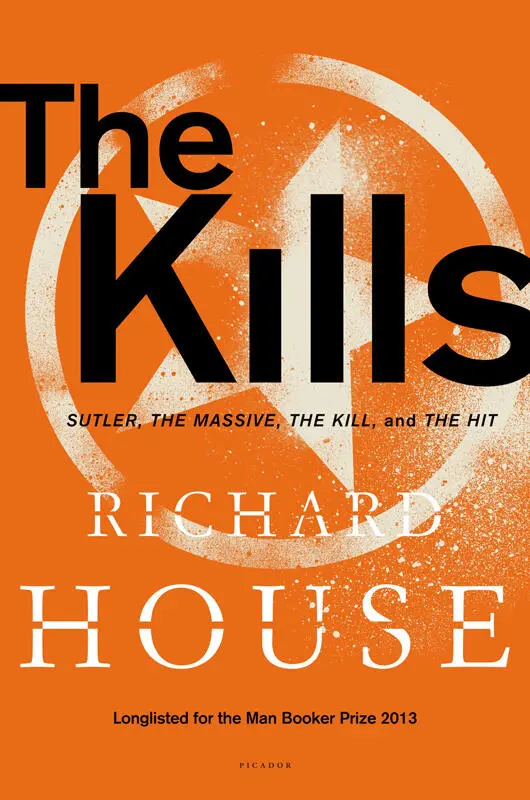
- Название:The Kills
- Автор:
- Издательство:Picador
- Жанр:
- Год:2013
- ISBN:нет данных
- Рейтинг книги:3 / 5. Голосов: 1
-
Избранное:Добавить в избранное
- Отзывы:
-
Ваша оценка:
The Kills: краткое содержание, описание и аннотация
Предлагаем к чтению аннотацию, описание, краткое содержание или предисловие (зависит от того, что написал сам автор книги «The Kills»). Если вы не нашли необходимую информацию о книге — напишите в комментариях, мы постараемся отыскать её.
The Kills — читать онлайн бесплатно полную книгу (весь текст) целиком
Ниже представлен текст книги, разбитый по страницам. Система сохранения места последней прочитанной страницы, позволяет с удобством читать онлайн бесплатно книгу «The Kills», без необходимости каждый раз заново искать на чём Вы остановились. Поставьте закладку, и сможете в любой момент перейти на страницу, на которой закончили чтение.
Интервал:
Закладка:
His room faced the palazzo, and if he stood at his window he could see a broad wine-red wall with regular, deep-set, shuttered windows, on the lower floors the small Juliet balconies, the rooms inside black and unknowable. He divided the view into quadrants to guess occupant by occupant who might have lived there for more than a year (most, he assumed). At street level he could see the entrance, the vast black doors, the tops of heads, the fanned black cobbles of the street. Tucked beside the door a wrapped spray of flowers, dirty and bruised, and behind them other flowers, what might be a candle stub, and beside them a small upturned crate with a cushion.
The landlord came to ask if he was settled, and Finn looked about the room and realized that he was settled, and that, with little more than a writing desk, a handful of pens, some paper, he had everything he needed. He wouldn’t dwell on last night, because most things are replaceable, right? Everything depended on him, on what he wanted to achieve.
The landlord lingered and Finn realized he wasn’t in any hurry to start his work. Tonight, tomorrow. He could write any time, but the opportunity for a discussion would not always be available. So he offered the man a beer and invited him to sit at the window overlooking via Capasso, and gave himself the one constraint — he wouldn’t talk, he’d leave it to the landlord.
Window by window the landlord described the occupants of the building, their occupations first, then their foibles: pharmacist, speech therapist, accountant, the two brothers who ran the alimentari, a lawyer, at the door the supervisor, in the street the magistrate’s driver who seemed to be there at all hours. Outside the Fazzini there would be prostitutes, and while you can’t see the bar, you can see the women, loitering among the scooters, talking, loud, calling one to the other.
‘The two Frenchmen, the brothers — not Salvatore, not Massimiliano.’ The man pointed at the palazzo with his beer, he’d seen them himself. Only one time, but he’d seen them, they weren’t fiction. Few people believed that Krawiec was guilty, except the police. ‘There isn’t much,’ the man admitted, ‘that happens here that doesn’t get noticed.’
Finn asked him to be clear. ‘You saw them?’
‘I saw the brothers. Plenty of people saw them. They came at night, they never stayed long. Many people saw them, except the driver.’ The man nodded down to the street. ‘He’s there most days, but he says he never saw them. It might be a question of keeping his job.’
Finn took a long look and realized it would be hard for anything to happen here, night or day, without someone seeing or hearing. A figure in the palazzo, faced into the room unaware that he could be seen, practised voice exercises: ‘peh-peh-peh-peh’.
As soon as he was alone he set the table in front of the window. He tore pages from the notepad and labelled the days: A, B, C, D … wrote a list of the occupants as he could remember them: the doctor, the supervisor, then added the participants: Marek Krawiec and his wife/g-friend, the Second Man, the American Student, Mizuki Katsura, Niccolò Scafuti. Then a list of places: Ercolano, field and paint-factory. Via Capasso. The Language School. The Circumvesuviana station.
MONDAY
Finn called Carolyn and told her he was staying, not just for the summer, but for as long as it took, which might mean deferring his final year. It’s different this time, he explained. He was considering Krawiec’s story, and taking it seriously; no one had bothered to do this. For Finn this meant going right back to the root, which wasn’t, as you’d expect, the Spanish novel. He asked his sister if she knew how he’d first heard about the killing. Not the novel, but the actual killing? It happened through a chance meeting, in a hostel in Portland, Oregon, on a mid-term break, and in one long evening, after they’d exhausted the usual conversations about the weirdness of campgrounds, fears of bears and deer-ticks, the hassle of travelling by Greyhound, he was told a story by someone who’d spent the previous summer in Italy. Naples, Italy. This man — there’s no point even trying to remember his name — said he’d sat opposite two women on a train, and one of them had started talking about how she was the only witness in a murder case. There wasn’t much to it. She’d stepped off the train to see a boy at the station with two bags — a shoulder-bag and a duffel bag. Key to this was the fact that he was wearing a green T-shirt with the design of a star set in a circle on his back. There wasn’t anything else to it. She saw this boy at the station. Nothing more.
Then one day, on the train again, with everyone reading the newspaper with a picture of the dark T-shirt with the star design, she’d caught a headline saying that the person who was wearing the clothes had, more likely than not, been killed.
It took her a while to figure out what to do, but eventually, she decided to have a word with the police.
Next time she was in town she went to the Questura, and she spoke with the people at the front desk and was immediately taken to the top man. She told him what she knew, and he asked her to describe the clothes, and then he took her to a room where he showed her the actual clothes. At first she thought they couldn’t possibly be the same. They didn’t even look like clothes. The T-shirt was cut, stained, so wasn’t even the same colour. The shorts were rust-coloured, this weird brown, and she realized that this was blood. Except for the blood, the stains, the cuts, the clothes were exactly the same. She was positive. The only thing was, she couldn’t exactly remember what the boy looked like because it wasn’t like she’d really noticed him, she’d just walked past him. And this is where the police did something really smart. This investigator had the man who did the photo-fit pictures walk her through one of the offices and ask her to look at the men in the office. As they walked he asked her if the youth she’d seen looked anything like this man, or that man. And the woman, who’s really uncertain, started to give answers like: he wasn’t so tall, his hair was shorter, his nose was this way or that way, and this gave the photo-fit guy a really good idea of what they were looking for. Clever, no?
At the end, once she was done, they made up a picture of this guy composed from different faces, and with a little work they managed to figure out exactly what he looked like — not just his face, but they managed to get a good idea about his height and weight, just from walking through the offices and her answering questions. I mean, that’s really something. That’s clever.
* * *
Finn told his sister what he was writing, in great detail: three thousand words on Saturday, seven thousand words on Sunday, and today, a day of revision — and then a description of the content. He read passages to her, but nothing too involved. His desk overlooked the palazzo entrance, the doors were right in his eye-line, he could look sideways from his paper and see it, and had quickly learned about the habits of those who lived inside and those who visited. It wasn’t unusual for people to come to the entrance and just stand there. People came all the time to loiter in front of the doors, and it was hard to tell exactly what they were doing. Some took photos. But a good number just gawped in a way that could be boredom or grief and left flowers, candles, notes and tokens, and while the supervisor cleaned everything away almost immediately, she was too superstitious to remove the candles and tokens, and they become dustier and greyer by the day. It’s the kind of thing that causes more pain over time, he said. Sometimes the Italian sense of melodrama took over: on Saturday three black sedans pulled up just short of the entrance, highly polished and dressed with fine strings of white flowers, and in the middle car sat the bride, who would be married, he guessed, within the hour. The doors either side of the bride were open and a woman attended to her, arranged and fussed over her dress. Beside the car, smoking, the bride’s father in a new suit, visibly more anxious than his daughter. The girl’s mouth was drawn into a pout and what details Finn couldn’t see he imagined: the pearlescent lipstick, the nails impossibly long and polished the same colour as her lips, her black hair carried back in long ringlets and covered with a mass of toile, delicately edged with petals that needed to be plucked away from her face. The girl’s face was undeniably round, he could see this, hamster-like sulking jowls, and when she talked she tended to set her mouth in a broody scowl, her neck and arms also were plump, child-like — but when she smiled she became exceptionally pretty, in a girlish way that made Finn suddenly sentimental. It was lucky, he thought, to see a bride among all this bustle, poised before her wedding, it improved his mood to see her in her last independent moment, cosseted and fussed. But it wasn’t an accidental pause. The bride’s father threw away his cigarette, took the bouquet from behind the bride and laid it at the foot of the entrance. No prayers, no pause, which surprised Finn. The bouquet was placed with care, leant in the corner so that it would not get kicked and would not be in the way, another man handed him a football shirt, Napoli blue, with Maradona’s number, No. 10, which the man folded, number showing, and laid beside the flowers. Once the man had set the flowers and shirt in place he returned to the car and settled without a word beside his daughter, and within a moment the three cars continued slowly down the hill toward the bay.
Читать дальшеИнтервал:
Закладка:
Похожие книги на «The Kills»
Представляем Вашему вниманию похожие книги на «The Kills» списком для выбора. Мы отобрали схожую по названию и смыслу литературу в надежде предоставить читателям больше вариантов отыскать новые, интересные, ещё непрочитанные произведения.





Обсуждение, отзывы о книге «The Kills» и просто собственные мнения читателей. Оставьте ваши комментарии, напишите, что Вы думаете о произведении, его смысле или главных героях. Укажите что конкретно понравилось, а что нет, и почему Вы так считаете.