Richard House - The Kills
Здесь есть возможность читать онлайн «Richard House - The Kills» весь текст электронной книги совершенно бесплатно (целиком полную версию без сокращений). В некоторых случаях можно слушать аудио, скачать через торрент в формате fb2 и присутствует краткое содержание. Год выпуска: 2013, Издательство: Picador, Жанр: Современная проза, на английском языке. Описание произведения, (предисловие) а так же отзывы посетителей доступны на портале библиотеки ЛибКат.
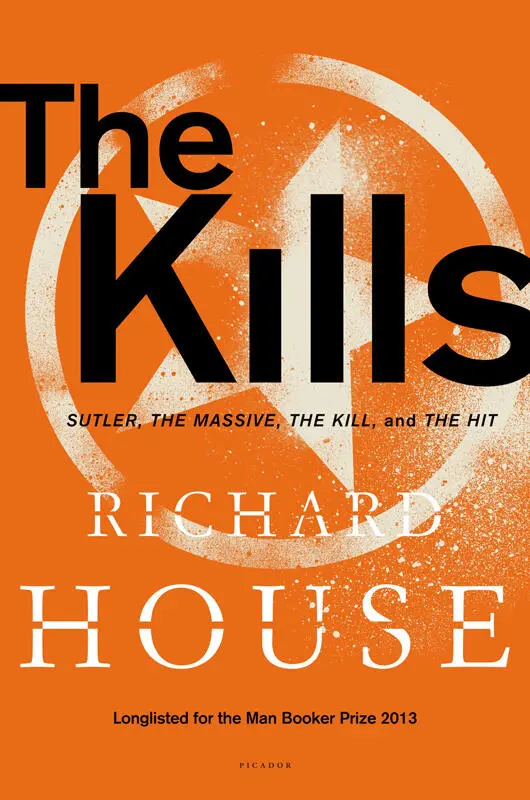
- Название:The Kills
- Автор:
- Издательство:Picador
- Жанр:
- Год:2013
- ISBN:нет данных
- Рейтинг книги:3 / 5. Голосов: 1
-
Избранное:Добавить в избранное
- Отзывы:
-
Ваша оценка:
The Kills: краткое содержание, описание и аннотация
Предлагаем к чтению аннотацию, описание, краткое содержание или предисловие (зависит от того, что написал сам автор книги «The Kills»). Если вы не нашли необходимую информацию о книге — напишите в комментариях, мы постараемся отыскать её.
The Kills — читать онлайн бесплатно полную книгу (весь текст) целиком
Ниже представлен текст книги, разбитый по страницам. Система сохранения места последней прочитанной страницы, позволяет с удобством читать онлайн бесплатно книгу «The Kills», без необходимости каждый раз заново искать на чём Вы остановились. Поставьте закладку, и сможете в любой момент перейти на страницу, на которой закончили чтение.
Интервал:
Закладка:
* * *
Finn decided to return to the hotel, but wanted first to check himself. He could have been stabbed. You heard about this happening all the time: people in shock who don’t know that they’ve lost an arm, a kidney, half of their spine ripped out, who walked up the street like la-di-dah, to collapse from blood-loss, shock, inattention. Finn found a side alley behind the Questura and stripped down to his boxers and checked himself, and saw in the dull yellow light only a slight graze on his elbow, a round imprint on his right hip that would surely blossom to a bruise. The man had shoved him, knocked him down — the whole thing was immature, barely man-to-man. There wasn’t any blood, and once he’d reassured himself that he hadn’t been stabbed, he checked his body for broken bones. Pressure? Wasn’t that it? You check for pressure points? See what aches or hurts, or is just outright unbearable.
Everything checked out, nothing really wrong here (but how close was that?), no blood loss, punctured organs, broken bones. But seriously — how stupid was that? Why had he even answered the phone? His watch had hit the wall and it grieved him to see the face cracked, but nothing else was damaged.
He walked quickly, limping at first, one side seeming a little larger, the bump to his hip limiting his stride, and elbow aching as a hint of how serious this could have been. He became angry as he walked and couldn’t console himself with the idea that this was all experience, all useful, all material for the book. The kind of story he could tell in an interview. Oh the kidnapping. Yeah. Well, Naples — beautiful by the way — nice place, but troubled, very complicated … let me tell you …
Finn took via Umberto back to via Duomo, to via Capasso. He walked fast to walk out the ache.
The Fazzini, as before, bright and busy, with a younger noisier crowd. The bar ran along the back wall, a broad wood counter stacked with glasses, and blocked with people, quite a crowd. But no Rino. No thugs. No kidnappers. No hit-and-run scooter-rider.
He half-ran, half-hopped back to the hotel.
Lights on in the lobby, the door unlocked (at three in the morning) and no night security: bad signs. Unwilling to wait for the elevator he hobbled up the stairs, four floors, to find the door to his room open, as he expected, the lights on, the room in disarray looking something like a film set with the bed pulled away from the wall, the cupboard open, his clothes thrown out of the drawers and scattered, paper torn from the blank notebooks littered the bed and the floor. Everything gone.
Someone must have given them a list. Just written out exactly where he’d hidden his laptop. His portable hard-drive. His sister’s camera. His phone. The two USB sticks. His remaining traveller’s cheques. And not one, but every single notebook from the trip. Even his copy of The Kill.
This was no simple theft, but a complete strategic wipeout — erasing every piece of research he’d collected on the murders. In taking the computers and the notebooks they’d stolen every draft and every scrap of information he’d collected, along with the correspondence. Some of this stuff he couldn’t begin to consider replacing. Finn buckled over at the doorway. An instant stab of grief at all the detail and experience now lost to him: all of his careful and particular notes that could not now be recreated. He’d sat with Lemi Krawiec for six long hours while the man repeated endlessly that his brother was innocent, and how he didn’t know the facts because he didn’t need the facts. He was innocent. All the while Finn had taken notes, he’d written about the kind of airlessness trapped in that room, the space between these protestations, the protestations themselves and how by their insistence they held a kind of dogma, that the more times they were repeated the more it could be believed, and the more likely it was that this would be true: until nothing else could be considered except that single fact: Marek Krawiec is innocent. And this was gone. The precise description of the decor along a mantelpiece, Krawiec’s mother’s house, the petiteness of it, sullen and ordinary, of Lvov at night, how capsule-like the city seemed, of the people seated facing the windows at the respite home in Lvov, the women on buses, the silent trains and trams. Everything lost: the airport and how coming into it the aircraft pitched through a layer of fog — fog so you knew you were in the heart of Eastern Europe, right on the edge of another period entirely — how this worked as an image of what he would and would not find — coming through fog. OK, not great, but apt. The petrochemical works, the roadways, the fields and fields shaved of produce, and the intensity of it all, that one man could come from this flat monochrome to a city so bumpy and opposite and butcher two people. Just how, exactly, is such a notion seeded in someone, so that it becomes essential to act on? He’d formed some sense of Krawiec — not so much from his brother, but from experiencing the same spaces — of how casually cruel the man would become, of how the landscape predicted this, made it so. He was close to understanding how such a crime comes out of a limited number of options, so that it seems both possible and inevitable, something to do; he understood a connection between flat landscapes and wet fields and industrial parks and chemical plants and how an impulse drives an idea to become an inevitable action. He’d come that close to understanding.
On the door handle, a last touch from the thief or thieves: the housekeeping sign saying ‘Thank You For Your Stay: Gratuities.’
* * *
He checked the dumpsters outside the hotel, went through the trash, dawn now and his side beginning to ache, and found nothing. The hope, at least, that the notebooks would be scattered somewhere because they were of no earthly use to anyone else. As he bent over the dumpster, moved cardboard around, he remembered a description in one of the newspapers about the discovery of the clothes in Ercolano — and didn’t like the idea that there could be more in the dumpster than trash or stolen goods.
WEDNESDAY
He packed his rucksack in the morning. Without his papers and notebooks and equipment he didn’t have enough to fill the soft hold-all. He hadn’t slept, and through the night plans were made and disassembled, ideas on how he would return home because he had less than nothing, and how he’d have to undo the publishing deal because he didn’t have the material any more, or even the heart to start over. He hadn’t slept, and he had to go back to the Questura, chase up his report, because the police who’d come had told him there wasn’t anything to do until the morning because this crime didn’t register to them as being something worthy of any kind of attention. He couldn’t even call Rino because all of his numbers were on his phone, his email was on his laptop, and nowhere would yet be open.
* * *
After the police, Finn checked in his bag at the Stazione Central. His head rang with humiliation; they’d laughed at him, asked him to describe with particular precision exactly where he’d hidden his valuables. So you hid the money on top of the what? Exactly where? He couldn’t expect any sympathy back home, because this whole thing, he had to admit, was kind of shameful. He’d set himself up: bragged about his summer, his contract, rubbed it hard into other people’s faces, and in one night he’d managed to wreck it all. The police had contacted Rino, who said he had no idea about any kidnapping, assault, or robbery. Last night was the same as any other, he ate at about eight o’clock, watched TV, argued with his wife, and was incredulous, as was his wife, about this entire idea, and Finn understood that words were said between the police and Rino that undermined him, although he did not know exactly what.
Читать дальшеИнтервал:
Закладка:
Похожие книги на «The Kills»
Представляем Вашему вниманию похожие книги на «The Kills» списком для выбора. Мы отобрали схожую по названию и смыслу литературу в надежде предоставить читателям больше вариантов отыскать новые, интересные, ещё непрочитанные произведения.



Обсуждение, отзывы о книге «The Kills» и просто собственные мнения читателей. Оставьте ваши комментарии, напишите, что Вы думаете о произведении, его смысле или главных героях. Укажите что конкретно понравилось, а что нет, и почему Вы так считаете.