Richard House - The Kills
Здесь есть возможность читать онлайн «Richard House - The Kills» весь текст электронной книги совершенно бесплатно (целиком полную версию без сокращений). В некоторых случаях можно слушать аудио, скачать через торрент в формате fb2 и присутствует краткое содержание. Год выпуска: 2013, Издательство: Picador, Жанр: Современная проза, на английском языке. Описание произведения, (предисловие) а так же отзывы посетителей доступны на портале библиотеки ЛибКат.
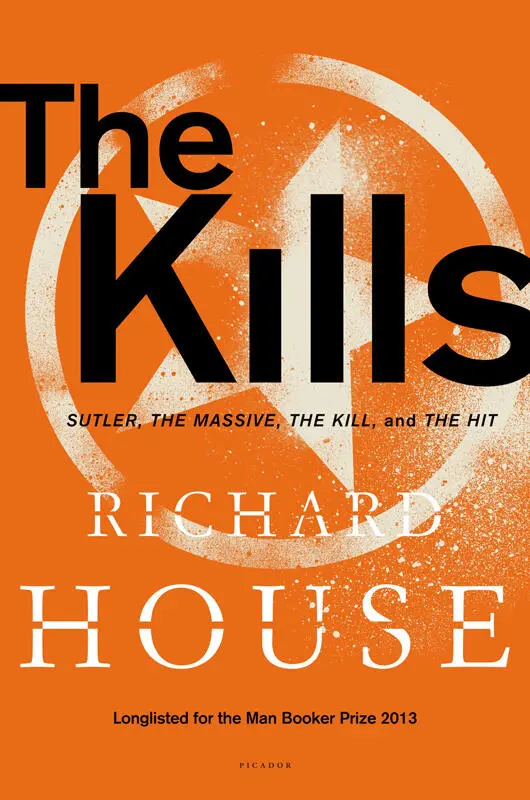
- Название:The Kills
- Автор:
- Издательство:Picador
- Жанр:
- Год:2013
- ISBN:нет данных
- Рейтинг книги:3 / 5. Голосов: 1
-
Избранное:Добавить в избранное
- Отзывы:
-
Ваша оценка:
The Kills: краткое содержание, описание и аннотация
Предлагаем к чтению аннотацию, описание, краткое содержание или предисловие (зависит от того, что написал сам автор книги «The Kills»). Если вы не нашли необходимую информацию о книге — напишите в комментариях, мы постараемся отыскать её.
The Kills — читать онлайн бесплатно полную книгу (весь текст) целиком
Ниже представлен текст книги, разбитый по страницам. Система сохранения места последней прочитанной страницы, позволяет с удобством читать онлайн бесплатно книгу «The Kills», без необходимости каждый раз заново искать на чём Вы остановились. Поставьте закладку, и сможете в любой момент перейти на страницу, на которой закончили чтение.
Интервал:
Закладка:
My mother worked for charities and good causes, and before the war she avoided the city proper and worked in the local towns. Coming from the south we were used to working on the land, and while we lived in the city, we looked outward and worked the trades and activities that we understood in the neighbouring fields. Similarly, my mother worked at foundling nurseries and in the hospitals, she cleaned, learned to administer basic care. A skinny woman, she walked bent, peasant-like, head down. Prideful enough to henna her hair, she wore it high and drawn back tight. The pair of them, my parents, made little sense, one constantly robbed, the other constantly burdened as if grieving — and in the evenings they would bring each other to tears, and so, as I have said, they were largely useless.
Was I loved? I suppose so. They bragged over our achievements, small as they were, celebrated their children to others, held us up, but in such a limp way they always seemed on the edge of an apology. My younger brother sang in church, at fetes and fairs, travelled for a while with my mother and then with a band of penitents, and my parents talked about him as you might talk about a man who slurs or stutters, or a man who drinks, with a little shame, as if this were also a small failing, as if he could not help himself, knew no better than to sing in the way he did — and underlying this, always, a warning to my brother that this would not last, or that his ability to sing more beautifully than other boys was also a cause of pride which was to be monitored and kept in check.
The truth is that my sister and brothers gave my parents so few opportunities to celebrate that they were unused to it, and as a consequence did not know what to make out of the small pickings we offered them. A joke in the palazzo that my parents were related, brother and sister, which is patently untrue, helped to explain their simple pleasures, their inability to soundly reason, their love for the church, how they were able to dutifully abide the pressures of the times when others wilted under it. If I’m giving the impression they were attentive: they were not. Our education was a scattered affair. We were taught, sporadically, at the local school by a fraternity of monks, who delighted in my older brother and my younger brother (too stupid on one hand, too naive on the other), but whose interest I managed to escape. We shared the same tutors, the same amount of schooling, each of us managed the rudiments of reading and writing, and the most basic arithmetic, but we were needed in the fields in the spring to plant, train and prune, in the late summer for harvesting, in the autumn for storing — whatever influence the holy fathers had over our young bodies and minds, remained, at best, minimal. Our education came in the fields through practical labour: first we understood the length of the day, our own energies, we quickly trained in agriculture, assisted in making cheese, wine, and then we understood the currency of our bodies, that our labour, four children, was not enough to sustain the family, the fact our combined labours were worth less than the work of one man meant that we were obliged to pilfer food.’
* * *
(page 15) ‘My younger brother’s birth came alongside the first suggestion of war. I should impress on you that once the country was overtaken by war, life became a wholly different matter. First there was the skin, the day-to-day fact of it, and second there was the under-layer, the continuation of regular life: births, deaths (unassociated with the war); people continued to marry, breed, labour, sicken — and in this regard we existed almost as we had before.
My mother, a thin woman, took on a translucent quality when she was pregnant. Her skin became unnaturally pale, as if something fed on her and threatened her life. As her belly grew she became increasingly fragile — and looked, very much, like a fish, a sprat, with some bubo attached, so that she appeared infected. Our neighbours, all farmhands and labourers, bred hard — so little else to do — and as these women grew they took on an unsuppressed vitality and health, of which my mother appeared to be the exact opposite.
My brother’s birth came in February. I watched her in the courtyard, cranking the mangle and managing sheets through the rollers, then all of a sudden doubled-up, hand to her belly, and brought to her knees. Secured in her room she bled heavily, and we waited for news, we sat in the kitchen as the midwife boiled towels, brought out spoiled sheets and bedclothes. Her yelps lasted through the night and were accompanied by deep guttural blows that sounded like wind on a roof, a rising storm that came in answer to my mother’s cries, a kind of call and response of two animals. As she howled, the sky bellowed — and so my brother was brought into the world. These booms, this noise was neither thunder nor wind, but the artillery of the 112th sounding from the mountains. Already in view of the town, too far to effect damage, they made their guns sing to us little songs of threat, a boom, a drumbeat, an unrealized threat.
One detail. We needed a doctor. Three lived in the palazzo, so my brother and I were sent first to one, and then to the other, and finally, begging (as it looked as if both the child and mother would perish) to the last. While these good men were home, one assured us that he was called out elsewhere, another that he was sick himself, and the third that he would attend (he did not), and that we should return to my mother.
(…) On this first assault the Americans were repelled. Perhaps if they had not announced themselves they would have surprised the city, and if the city had fallen then, the region, and maybe the country would have slid quicker into their hands — but no, they told us where they were and were repelled. (…) Four years later they would not repeat their mistake. The 112th returned with fresh battalions and with the British in tow (somewhere, dallying behind, paddling up the beaches, moving in like hyenas after the kill). The Americans dropped their troops in the mountains from great aircraft and a great height, scattered them like dandelion drifts along the farther crests, speckled the ledges with paratroopers, and so they silently took the heights ringing the city, and from this vantage they prepared to kill, maim, starve, and punish. The lights of the city can be seen across the plain at night as a condensed and distant sparkle. Intensely signifying the kind of life, the plenteousness of the city, which they must have looked upon with hate: planning, night after night, how they would reduce it.
But this, this is four years ahead still, four years away from the night of my brother’s birth.’
* * *
(page 19) ‘I cannot talk about the American army without mentioning my sister — who I should have more properly introduced. E—, named after my mother’s German grandmother, had her own mischief and needed watching. She could be still, as sound and static as a tree, and then gone. If you did not keep your eye on her you would miss her. But I cannot think of her right now. Not at this moment.’
* * *
(page 20) ‘Against expectation, A— (they gave him a Spanish name) was not a fat baby. The first time I saw him he appeared greasy and paler even than my mother, run through with fine capillaries, as if made of goose-fat and red thread, infinitely vulnerable. So frail and vague he was not expected to live. Announced by the Americans boom, boom, boom, A— brought into the house a new and focused anxiety as we expected him to expire at any moment. As a consequence we lived those moments and felt them dearly, and sustained him second to second, minute to minute. For this period I remember being happy, and my devotion toward A— grew.
Читать дальшеИнтервал:
Закладка:
Похожие книги на «The Kills»
Представляем Вашему вниманию похожие книги на «The Kills» списком для выбора. Мы отобрали схожую по названию и смыслу литературу в надежде предоставить читателям больше вариантов отыскать новые, интересные, ещё непрочитанные произведения.


Обсуждение, отзывы о книге «The Kills» и просто собственные мнения читателей. Оставьте ваши комментарии, напишите, что Вы думаете о произведении, его смысле или главных героях. Укажите что конкретно понравилось, а что нет, и почему Вы так считаете.