Richard House - The Kills
Здесь есть возможность читать онлайн «Richard House - The Kills» весь текст электронной книги совершенно бесплатно (целиком полную версию без сокращений). В некоторых случаях можно слушать аудио, скачать через торрент в формате fb2 и присутствует краткое содержание. Год выпуска: 2013, Издательство: Picador, Жанр: Современная проза, на английском языке. Описание произведения, (предисловие) а так же отзывы посетителей доступны на портале библиотеки ЛибКат.
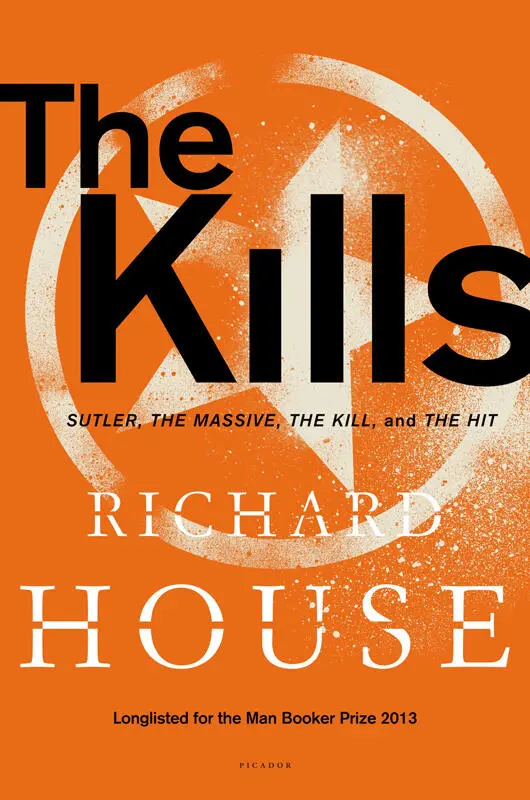
- Название:The Kills
- Автор:
- Издательство:Picador
- Жанр:
- Год:2013
- ISBN:нет данных
- Рейтинг книги:3 / 5. Голосов: 1
-
Избранное:Добавить в избранное
- Отзывы:
-
Ваша оценка:
The Kills: краткое содержание, описание и аннотация
Предлагаем к чтению аннотацию, описание, краткое содержание или предисловие (зависит от того, что написал сам автор книги «The Kills»). Если вы не нашли необходимую информацию о книге — напишите в комментариях, мы постараемся отыскать её.
The Kills — читать онлайн бесплатно полную книгу (весь текст) целиком
Ниже представлен текст книги, разбитый по страницам. Система сохранения места последней прочитанной страницы, позволяет с удобством читать онлайн бесплатно книгу «The Kills», без необходимости каждый раз заново искать на чём Вы остановились. Поставьте закладку, и сможете в любой момент перейти на страницу, на которой закончили чтение.
Интервал:
Закладка:
The very next week we lined the streets and performed the exact same welcome for the British.
This was not the end of war. Although we believed that it was.’
* * *
(page 9) ‘I am allowed to read, and have been given histories and accounts both of the war and of the city prior to the war. And while these versions of what happened are not incorrect, they largely miss the point. Remember: your arrival was our defeat. For twenty-two years we happily supported the government and way of life knowing that hard choices needed to be made — unpopular decisions for the benefit of all. The government didn’t arrive by accident, and while they disappeared overnight, taken to courts and tribunals, some summarily shot, remember — this was our choice because it worked. Full employment. Acceptable housing. Food. And future hopes — not only for ourselves. And our inclination to that government, our allegiance to those ideas, did not disappear as quickly as their bodies.
(…)
The city thrived, ten years before my birth. Everything new: stations, trains, trainlines, trams, roads, the first motorways, an opera house, public gardens, cinemas, a grand post office, municipal buildings and swimming pools. We asked for homes and they built us homes. We lived on the edge of the city, in new houses. At that time ground hadn’t yet been broken and the city hadn’t overtaken the neighbouring villages, spread out to take over the farmland.
You can’t imagine the countryside and how it was. The wine and olives from this region were famous, as was the oil with its curative properties — all of which sounds like Spain, and while there is a strong Spanish community here, it is not Spain. It is, or was, handsome; we enjoy a fair climate and moderate weather. The countryside is, or was, pretty in every season: the vines held the winter mists, spring was brief, the sunflowers followed a full summer sun, and autumn, the longest, truest season, when the twilight is unnaturally long, was the time best spent here — the basic structures remain: there are rivers (now channelled), a close curve of mountains, a bed-like cultivated plain leaning into a broad-curved gulf where the city tumbles to the sea, and while it is not Spain, you might believe that you were in Spain. Now that the city has become so vast these seasonal subtleties pass unremarked: it either rains or suffers an oppressive heat. The winters are wet. The summers are hot. The periods of transition are almost unnoticeable. Outside the city, away from the concrete the climate is more temperate. All this is before the Americans. Before their tanks and progress, their factories, their processing plants, all, now, abandoned.’
* * *
(page 12) ‘Shortly after the relief of the city, I witnessed, close-hand, a death in the vineyards, a young workman, cut in the thigh with a pruning knife, bled into the dirt, arterial, beyond help. He knew this, self-wounded, and I felt the weakening pulse at his thigh; held my hand close above his mouth until his breath expired. I looked into his eyes for a long time and fancied that I witnessed something, although I am certain now that this was only a naive desire; in any case I found it hard to leave — more out of science than sentiment — and having witnessed the process of his expiration, having watched a great quantity of blood leave him and saturate the ground, I became curious about the other processes now riding his body and in learning what other kinds of collapse were happening inside him: I wanted to know what was occurring deep under his skin. I inspected the cut but left the body otherwise undisturbed, (…) there is little point withholding the fact that this man was my brother.
(…)
The three-room apartment in which we lived does not deserve attention, situated on the first floor in a building seven storeys high, it housed at any given time no fewer than four, and no more than six of us. We shared mismatched chairs, a table, and little else. Four children, we shared one room and two beds. The boys bundled chaotically into one bed, a habit so ingrained that I still dislike sleeping alone. One apartment among many, our home was no different and no more decrepit than our immediate neighbours on either side. One mystery occurs to me now, which has not occurred to me before. At the start of the war, upon its declaration, the city lost about one third of its inhabitants, who took with them what they could manage and headed for the mountains or the sea and abandoned their homes. We did not take over these empty properties, then or later. Even at the start of the bombardment, when war came to our doorstep, we remained, as did the others, in the places allotted to us. Even in their absence we afforded respect to people who had abandoned us.
It is possible that the building dictated this. There would have been little use us occupying the other apartments. The professors, lawyers, doctors, clerks, the city officials and shop owners had their own entrances, their own stairwells. The tradesmen and labourers, along with those who could not find work, entered through the stairwells opening onto the inner courtyards. So that the building, as with many of the buildings in the city — and I think, in other cities, although I have not travelled much — folded about a core courtyard and kept separate the wealthy and the poor. In other countries these palazzi are known by their more proper names as tenements or slums, although, I believe, in other countries, they do not house the same variety of people. Opposite these apartments, as I have said, on the other side of the road, and therefore in the country, lay a vineyard, and more immediately a line of stone sheds, a place first for animals or produce, for olives and walnuts, for the safe storage of harvest, some of which were later adapted into workshops in which the goods brought from the fields were prepared. During the worst of the bombardment we temporarily fled the palazzi — taller, and easier targets for the mortars and bombs — and hid in the farm sheds. Although I spent much of my childhood in these buildings, either hiding or playing, I remember very little about the place, except how the musk of animals permanently coloured the air. The city, at this time, took on its own smell, of cooked and rotten meat, of the flesh of the dead.
What of the farm, which is now long gone? The owner, whose father had built the property, was killed early in the war, at the docks during an air-raid. On his death his family managed to buy their way out, and left all of the business (the managing of the land and farms, the harvesting and selling of its produce) to unscrupulous managers. But so productive were these holdings, and so rich the land, that even in the thick of war there was produce available — until, naturally, the final year, when the outmost fields abutting the river and mountains became the front line and the harvest was left to rot.
I have less useful information about my parents than I have about the place in which we lived. Both were sentimental, suffered at every slight grief or injustice, and easily took on others’ troubles as their own. Before the war my father worked as a handyman whenever and wherever he could and was periodically busy and absent, or without work and constantly at home. When he was busy he lacked the wherewithal to collect what was owed to him — as this seemed to pain him, and people quickly learned of this weakness and took advantage, delaying and sometimes denying payment whenever possible. Unskilled, he dug graves, trenches, irrigation ditches, and never received his proper wage. He laboured at the harvest, repaired walls, drains and roofs, and was always, in every instance, short-changed. I remember him in dirty, worn clothes, hands stained by labour, the skin on his face, hands and arms commonly rough and dark from the sun, the rest of him remained whiter than a plucked chicken.
Читать дальшеИнтервал:
Закладка:
Похожие книги на «The Kills»
Представляем Вашему вниманию похожие книги на «The Kills» списком для выбора. Мы отобрали схожую по названию и смыслу литературу в надежде предоставить читателям больше вариантов отыскать новые, интересные, ещё непрочитанные произведения.





Обсуждение, отзывы о книге «The Kills» и просто собственные мнения читателей. Оставьте ваши комментарии, напишите, что Вы думаете о произведении, его смысле или главных героях. Укажите что конкретно понравилось, а что нет, и почему Вы так считаете.