Richard House - The Kills
Здесь есть возможность читать онлайн «Richard House - The Kills» весь текст электронной книги совершенно бесплатно (целиком полную версию без сокращений). В некоторых случаях можно слушать аудио, скачать через торрент в формате fb2 и присутствует краткое содержание. Год выпуска: 2013, Издательство: Picador, Жанр: Современная проза, на английском языке. Описание произведения, (предисловие) а так же отзывы посетителей доступны на портале библиотеки ЛибКат.
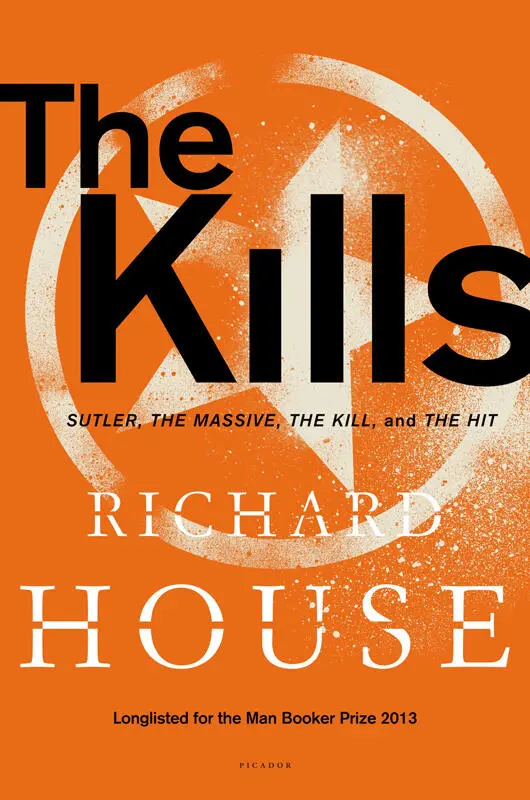
- Название:The Kills
- Автор:
- Издательство:Picador
- Жанр:
- Год:2013
- ISBN:нет данных
- Рейтинг книги:3 / 5. Голосов: 1
-
Избранное:Добавить в избранное
- Отзывы:
-
Ваша оценка:
The Kills: краткое содержание, описание и аннотация
Предлагаем к чтению аннотацию, описание, краткое содержание или предисловие (зависит от того, что написал сам автор книги «The Kills»). Если вы не нашли необходимую информацию о книге — напишите в комментариях, мы постараемся отыскать её.
The Kills — читать онлайн бесплатно полную книгу (весь текст) целиком
Ниже представлен текст книги, разбитый по страницам. Система сохранения места последней прочитанной страницы, позволяет с удобством читать онлайн бесплатно книгу «The Kills», без необходимости каждый раз заново искать на чём Вы остановились. Поставьте закладку, и сможете в любой момент перейти на страницу, на которой закончили чтение.
Интервал:
Закладка:
He wanted to use his time efficiently because he only had the summer. He needed to be effective. In less than eighty days he would be a student again, one of a number, pushing a student loan, a coffee habit and unsociable hours; but during the summer he was a writer with a project. A writer with a project and a publishing contract. A sophomore (soon to be final-year) student with an agent and a contract, about to hold a discussion about a notorious and unsolved murder with a respected anti-Mafia magistrate. Hard to believe how the year was working out. In travelling Finn had focused his luggage down to two items: a small backpack; a soft hold-all. Both could be slung over his shoulder, and he fostered this image of himself, as someone mobile, focused, unburdened but connected. The contents of his luggage reflected this ambition: in both bags he’d carefully wrapped a wealth of goods, a laptop (new), a portable hard-drive, two USB memory sticks, a DV camera (borrowed at the last minute from his sister), a phone, and less convenient, the assorted cables and plugs because they’ve yet to figure out the proper portability of these items. Along with this were his notebooks. These books were precious, seven already filled with his tiny writing, a compact concentration of notes from interviews, his own impressions, research from the sites, scraps of papers, tickets, receipts, things discovered while out and about, and he’d been smart enough to choose small books and marked each one with his mobile and home number, email addresses, and a note on the first page suggesting a reward might be paid if they were found and returned.
Finn wanted to test-drive a way of life — this is how he’d phrased it to his sister — see for himself if he was cut out for writing. While he loved college — what wasn’t there to like? — he was working it hard and didn’t see the point in waiting around, holding on for blind luck and good fortune while amounting debt. The whole point about ambition is making sure it happens (name one other sophomore to secure a publishing contract). Carolyn agreed, besides, he was older than the other students, and that five years made a difference. They talked this over, endlessly refining, because beyond choosing a smart college and a sensible course with professors whose references would really matter, nobody really considers the bigger picture, not really, and just because his family were loaded didn’t mean he could ignore these things. No one really figures this through. Most people just let things happen to them, like they’re lucky. Not that Finn wasn’t lucky. Moderately good-looking, modestly intelligent, white, and with parents who didn’t mind bankrolling the project while he waited for the advance, just so they could brag that their not-yet-graduated son had a publishing deal and was writing in Naples, Italy for the entire summer (and your kid has an internship, er, where exactly?). From Finn’s perspective everybody gains something this summer: the parents, the college, the publisher, and certainly (not least of all), Finn himself.
Finn ordered coffee, spoke Italian well enough to feel part of the general rush, although Spanish was the language he swam in. The value of the magistrate would come in the form of names, not anecdotes (which Finn already knew), and through inflection — the weight he placed on certain events, and the sequence in which he ordered them. Aside from this, a senior magistrate who wasn’t willing to go on public record but still had something to say (unofficially) would make an excellent introduction to his book, not to mention the boost it gave the project: people were still interested. Finn couldn’t imagine a better situation. He didn’t expect to uncover anything new, not after a year, but he did expect to find new people and new perspectives — much the better if they wanted to remain anonymous.
As a figure, the magistrate didn’t disappoint — reassuringly familiar (as if cast into the role) — tall and thin, slightly wild grey hair, a hint of stubble, a man both preoccupied and focused. Distinctive, Finn thought, an air of instinct about the man, an intelligence and concentration he’d like to describe. As expected the information was less than revelatory: the magistrate ran through what he knew to be happening.
1. Since his release from custody, Niccolò Scafuti had returned to his apartment at the Rione Ini estate on the outskirts of Ercolano, where he now lived a solitary life. If the magistrate had any personal regrets, it was the involvement of Scafuti in the investigation and he wished that the man had not taken the walk that night and discovered the American’s clothes and brown bag. But he didn’t think, a) given the circumstances, b) Scafuti’s unwise decisions, and c) what they knew at the time, that anything could have played out any differently. Scafuti had destroyed evidence, it was unfortunate, a criminal offence which had caused great damage. Who knows what might have happened if they’d read the notebook?
2. Marek Krawiec. Now here was an entirely different situation, and the magistrate remained clear and absolute about the fact that Krawiec could not be interviewed, and neither would he be coaxed into any kind of acknowledgement of where Krawiec was being held (most likely Rome). The case was under judicial review. On this the magistrate remained firm. Marek Krawiec could not be interviewed. He could say, though, that investigators were hopeful about finding the missing bodies. Krawiec was still emphatic about his innocence.
3. The palazzo, of course, was indeed the palazzo at via Capasso 29 close to the Duomo and the tourist district — everybody knew this and it had featured in many news reports over the year. This didn’t stop a rumour that this palazzo was not the actual site of the murders — that there was some kind of cover-up because somebody important lived in the building where the killing had actually occurred. This was plainly untrue.
4. Evidence. There were many other rumours which were not true: the evidence taken from the basement room on via Capasso and discovered on the shoreline at Ercolano was not destroyed or lost, and was not mishandled or contaminated as many reports had speculated. Much of the blood evidence was destroyed by the sea, but even so, there was plenty of other evidence to confirm Krawiec’s presence in the room (which, interestingly enough, he never denied).
5. The missing student, otherwise known as ‘The American’, ‘The Student’, or less frequently as ‘The First Victim’, seen once and only once at the Circumvesuviana station dressed in the hunter-green T-shirt with the five-point star design, had not yet been identified, and no other remains had been discovered. The DNA from the shirt, shorts, undershorts, matched the blood evidence on the plastic taken from the room and recovered from the shoreline, and these were assumed, until new evidence or Krawiec told them otherwise, to belong to the American. The American was picked up probably before he had a chance to check into a hotel. The only blood evidence belonged to the American.
6. The man known as ‘The Second Man’ (the body discovered in the abandoned paint factory in Ercolano) had never been mistaken for the missing student — ‘The American’, or ‘The Student’. This death, the autopsy demonstrated, could be attributed to a combination of factors: a blow to the head, the resulting haemorrhage, and drowning after he was dumped in the storage tank. Because of evidence found in the tank with the Second Man — the novel, a wallet, a digital player — assumed to be items taken from the student — this ‘victim’ had always been looked upon as a co-conspirator, although they were unable to establish his identity.
Читать дальшеИнтервал:
Закладка:
Похожие книги на «The Kills»
Представляем Вашему вниманию похожие книги на «The Kills» списком для выбора. Мы отобрали схожую по названию и смыслу литературу в надежде предоставить читателям больше вариантов отыскать новые, интересные, ещё непрочитанные произведения.




Обсуждение, отзывы о книге «The Kills» и просто собственные мнения читателей. Оставьте ваши комментарии, напишите, что Вы думаете о произведении, его смысле или главных героях. Укажите что конкретно понравилось, а что нет, и почему Вы так считаете.