Richard House - The Kills
Здесь есть возможность читать онлайн «Richard House - The Kills» весь текст электронной книги совершенно бесплатно (целиком полную версию без сокращений). В некоторых случаях можно слушать аудио, скачать через торрент в формате fb2 и присутствует краткое содержание. Год выпуска: 2013, Издательство: Picador, Жанр: Современная проза, на английском языке. Описание произведения, (предисловие) а так же отзывы посетителей доступны на портале библиотеки ЛибКат.
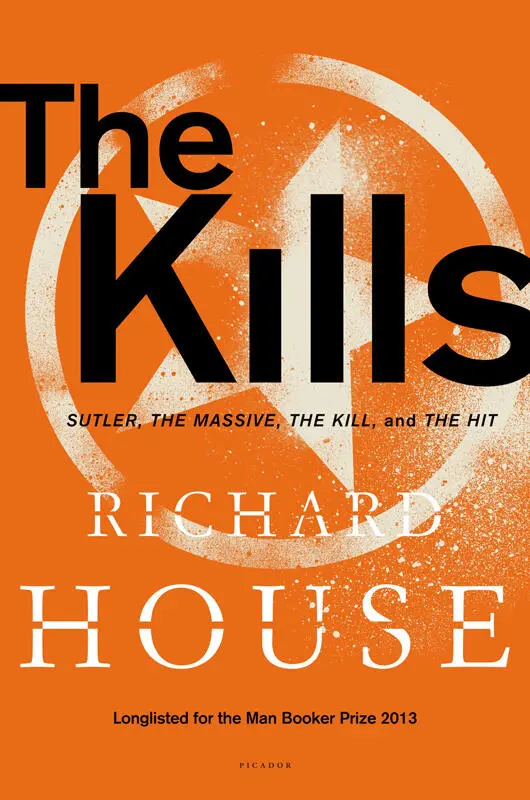
- Название:The Kills
- Автор:
- Издательство:Picador
- Жанр:
- Год:2013
- ISBN:нет данных
- Рейтинг книги:3 / 5. Голосов: 1
-
Избранное:Добавить в избранное
- Отзывы:
-
Ваша оценка:
The Kills: краткое содержание, описание и аннотация
Предлагаем к чтению аннотацию, описание, краткое содержание или предисловие (зависит от того, что написал сам автор книги «The Kills»). Если вы не нашли необходимую информацию о книге — напишите в комментариях, мы постараемся отыскать её.
The Kills — читать онлайн бесплатно полную книгу (весь текст) целиком
Ниже представлен текст книги, разбитый по страницам. Система сохранения места последней прочитанной страницы, позволяет с удобством читать онлайн бесплатно книгу «The Kills», без необходимости каждый раз заново искать на чём Вы остановились. Поставьте закладку, и сможете в любой момент перейти на страницу, на которой закончили чтение.
Интервал:
Закладка:
As Finn walked the magistrate to his car, the man’s driver straightened up and opened the door. Finn’s last questions involved Mizuki Katsura.
‘Nothing was found in Tokyo. I even hired someone and they found nothing.’ Mizuki Katsura did not exist. Had the magistrate ever considered this?
The magistrate paused before ducking into the car. ‘We don’t have her name. But that doesn’t mean she didn’t exist. Clearly someone under this name attended classes at the language school, and someone under this name has disappeared. In Europe we should be especially careful of such an idea. Many people who fall victim to crime are undocumented, or have chosen or have no choice but to exist in ways which remain officially off the record.’
‘So you believe that there were two victims.’
‘There are three, remember. The man at the paint factory is a victim as well as a culprit.’
Finn nodded in agreement.
The magistrate lowered himself slowly into the car, then fixed Finn with a gaze, cold eyes, grey, white-rimmed and a little clouded. ‘I will give you the ending of your book,’ he said, with just an edge of a wry small smile. ‘Consider how smoothly this was achieved. I do not believe that this is the work of a novice. It is possible that Marek Krawiec and the man found at the paint factory had a criminal career which involved the disappearance of considerably more than two people. Krawiec also might have had experience prior to his arrival here. What better place to disguise himself? What you must write about, if there is any need for clarity, is the history of Niccolò Scafuti, and the damage done to the city.’
Finn watched the car draw away then looked with satisfaction at the boutiques along via Crispi. A profitable meeting, which provided both a beginning and the end. As soon as he was on the metro Finn checked his mini-recorder. Nothing you could broadcast, not in terms of quality, but still useable.
* * *
Hotel Grimaldi — between Corso Umberto and via Nuova Marina — was close to the palazzo on via Capasso, and cheap (Finn wasn’t being irresponsible with his money, and didn’t want to make the mistake of being too remote from his subject, just comfortable enough for a good, critical distance). The room held a wardrobe, a dresser, a bed, a sink; the shutters for the window could not be folded back as they hit the side of the bed. Finn left a voicemail for his sister, and then typed. They have beds here like school beds. And thought as the message slowly fed its way through, a dial turning on the screen, that this was the beginning of her day, the end of his. She wouldn’t yet be in New York, the message would arrive before her. Out in the bay a ferry rounded the jetty, the sea soaked blue.
While he unpacked he began to consider the month ahead. He would find his meals close by, eat during the day with Rino. He would write for four hours in the morning, arrange his interviews and site visits in the afternoon, write late into the night. There would be no evenings out, no time wasted. With twenty thousand words already written — the first three chapters had secured the contract — he had a foundation for the project; although he already guessed this would need to be refigured. Unlike his fellow students, Finn had discipline. He could organize himself, and he could focus. By the end of the month he would transform the notes and the research into a complete and serviceable draft: something in the region of seventy to eighty thousand words. Which meant three thousand words a day. Not a problem. He could achieve this. Having secured a book, Finn had his mind on a larger target, film, and while his mother could advise on publishing and help with contacts, with filmmaking he was completely on his own.
Finn, still busy unpacking when Rino arrived, asked the clerk to let him up. He’d advertised for a researcher at two universities, and picked Rino Carrafiglio, a Ph.D. student at the Orientale. He’d formed an idea of the man from their correspondence, and thought of him as someone in his early twenties with whom he would have easy and intense conversations. He’d pictured himself in bars, cafés, trattorias, which only Rino with his detailed understanding of the city would know, either planning or unpacking their interviews, tapping into the core of the crime and the city itself, stripping back, in long and late discussions, the artifice and the deceptions to discover what was really happening. In reality Rino looked like a taxi driver, end-of-shift bags under his eyes, unshaven, and miserable, with thinning hair, short stature, and a wrinkled shirt; he looked like a dirty old basset-hound. A few hairs stuck over the back of his collar. He could be twenty-something, thirty, late forties even, Finn couldn’t tell. Finn did little to hide his disappointment, and regretted sending money in advance to secure assistance (money he could have used on a ticket to Amsterdam, London, or his return to Boston). He had a certain expectation of Italians — which the magistrate had not disappointed. The magistrate looked the part: a long grey face, thin and graceful, a man who appeared cultured, whose knowledge seemed to be reflected in his owlish and groomed manner. Where the magistrate held authority, Rino, on the other hand, just looked worn and sad. It didn’t seem right after all of the work he’d committed to the project — two weeks in Naples, two weeks in Rome, two (crushingly disappointing) weeks in Struga, Poland, chasing up a mother who was dead, and a brother who could repeat one phrase in English (‘He didn’t do it’), visits obsessively described in little black notebooks. He’d already over-sold Rino’s abilities to his agent and editor, and determined now that he would take no photographs which included the man.
Finn took a while to hide his valuables while Rino waited. The cash on top of the wardrobe. The traveller’s cheques in their envelope under blankets inside the dresser. His passport under the mattress. The laptop inside its soft case slid under the wardrobe. The portable hard-drive in the bottom drawer of the dresser, among dirty laundry. The spare USB sticks which contained copies of all of the drafts of the book and correspondence were easily concealed, one in his wash-bag alongside the shaving cream and toothpaste, the other in the interior side pocket of his soft hold-all. He’d also bought a bottle of rye and he placed that beside the bed.
Rino stood by the door with his hands in his pockets and licked his lips.
* * *
On that first evening, for a small additional fee, Rino brought Finn to the Bar Fazzini. As they passed the palazzo on via Capasso, Rino pointed out the carriage doors but didn’t say until they were inside the bar that this was the place, you know, that’s where it all happened.
Immediately into the bar Rino picked two men and told Finn to keep an eye on them. ‘Here,’ he’d said, ‘are the people you need to speak with.’ Finn couldn’t guess why he’d singled them out. The men, evidently brothers, had dressed for the meeting; both wore suit trousers and long-sleeve shirts, both combed their hair straight back, and both were clean-shaven with light skin and small wet black eyes. The younger brother, slight, reed-thin, pinched his forefinger and thumb at his crotch as he spoke. The older brother, larger and more solid, was the man to do business with and Rino paid him all of his attention. With broad shoulders and massive hands, the man looked like a chef and was a chef. He looked out of proportion, as if he had built himself, choosing a thick body out of mismatched parts.
‘Salvatore and Massimiliano.’ Rino grandly swept out his hand. These, he said, were the brothers Marek Krawiec had based his alibi on. From these two men he had invented the French brothers. Massimiliano worked at the alimentari, the small kitchen and food shop under the palazzo on via Capasso. His brother Salvatore worked as an accountant but was often at the store.
Читать дальшеИнтервал:
Закладка:
Похожие книги на «The Kills»
Представляем Вашему вниманию похожие книги на «The Kills» списком для выбора. Мы отобрали схожую по названию и смыслу литературу в надежде предоставить читателям больше вариантов отыскать новые, интересные, ещё непрочитанные произведения.



Обсуждение, отзывы о книге «The Kills» и просто собственные мнения читателей. Оставьте ваши комментарии, напишите, что Вы думаете о произведении, его смысле или главных героях. Укажите что конкретно понравилось, а что нет, и почему Вы так считаете.