Richard House - The Kills
Здесь есть возможность читать онлайн «Richard House - The Kills» весь текст электронной книги совершенно бесплатно (целиком полную версию без сокращений). В некоторых случаях можно слушать аудио, скачать через торрент в формате fb2 и присутствует краткое содержание. Год выпуска: 2013, Издательство: Picador, Жанр: Современная проза, на английском языке. Описание произведения, (предисловие) а так же отзывы посетителей доступны на портале библиотеки ЛибКат.
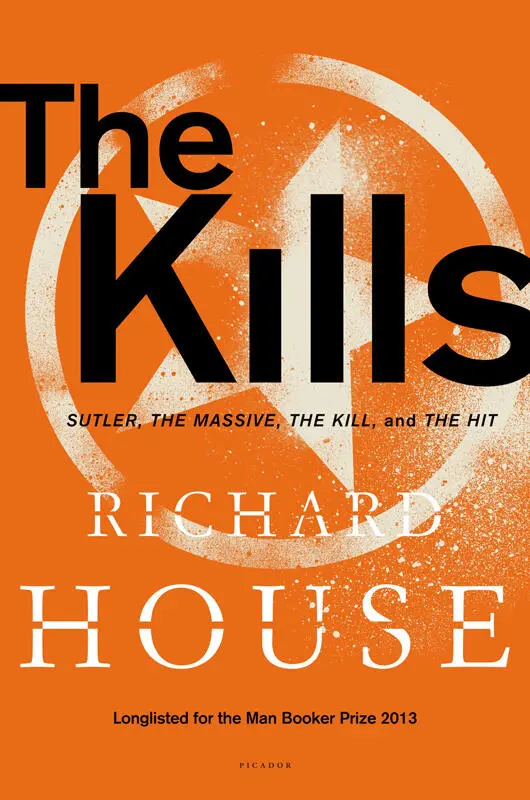
- Название:The Kills
- Автор:
- Издательство:Picador
- Жанр:
- Год:2013
- ISBN:нет данных
- Рейтинг книги:3 / 5. Голосов: 1
-
Избранное:Добавить в избранное
- Отзывы:
-
Ваша оценка:
The Kills: краткое содержание, описание и аннотация
Предлагаем к чтению аннотацию, описание, краткое содержание или предисловие (зависит от того, что написал сам автор книги «The Kills»). Если вы не нашли необходимую информацию о книге — напишите в комментариях, мы постараемся отыскать её.
The Kills — читать онлайн бесплатно полную книгу (весь текст) целиком
Ниже представлен текст книги, разбитый по страницам. Система сохранения места последней прочитанной страницы, позволяет с удобством читать онлайн бесплатно книгу «The Kills», без необходимости каждый раз заново искать на чём Вы остановились. Поставьте закладку, и сможете в любой момент перейти на страницу, на которой закончили чтение.
Интервал:
Закладка:
Sparrows squabbled in the dirt.
* * *
Once they were gone Niccolò attempted to settle into work. Taking out Fede’s books he spread them across the desk, then adjusted the seat, raising it so he could sit comfortably and face the view.
Little happened for the first hour. The plant was located on the outskirts of the town and the road led directly to the factory. Lovers searching for discreet roads and parks would make their slow way up the hill, but few stopped long. From the cubicle he could see the edge of Naples, a vast yellow spill slipping into a solid blue sky. Aircraft coming in and out of the airport slid slowly beside the hill, gaining height over the bay.
Disturbed by his discussion with Fede, Niccolò could not settle. He spread out the newspaper and kept the notebook underneath. Throughout the morning he considered what he should do, and the problem bore into him. He should take the notebook to the police, he decided. He could say that he’d found it on the wasteland after the search, that there was an area close to the houses where everyone parked their cars. It would be better to be rid of it.
* * *
Fede returned in the early afternoon and asked directly, coldly, if Niccolò had gone to the police. Irked by the question, Niccolò shrugged him off. He’d come all the way back to ask him that? Fede stepped into the office and asked immediately, ‘What’s that smell?’ He saw ash on the ring burner, saw how the wall was scorched, and turned in disbelief to Niccolò. Niccolò, as usual, was due to take the report forms and ledger to the central security office, and he used this as an excuse to leave Fede. When he returned from the main building he was pleased that Fede had gone. He sorted through the newspapers stacked under the desk, and looked quickly through them to see if there were any reports he might have overlooked before he threw them away. The day was bright; a soft wind came off the bay directly onto the mountain, and with it came a sweet smell, and again the faint brittle stink of fire.
Livia had wanted to talk that morning. Her in-laws wanted to visit again on Sunday afternoon, there was progress she said, real progress this time, and if her father-in-law was as rude to Niccolò as he had been on the previous night, she wanted him to say something. Niccolò could not remember what the man had said. The man wore glasses with thick black rims and thicker lenses so that his eyes appeared glassy and wet, he was short, and his teeth were yellow from smoking. Niccolò could not see why Livia was so intimidated by him.
At four o’clock Niccolò was called to his supervisor’s office.
The supervisor’s office was in the central administration building, a set of concrete oblongs abutted one to another; the windows zipped in a long black line across the entire complex. The dye-production plants were glass boxes with slanted glass roofs, surrounded by concrete offices. It was only his second time in the office, the first when he picked up his employment papers and the Chief of Security who had seen him came out to shake his hand, and from that one gesture Niccolò had always thought well of the man.
Niccolò had seen the chief a number of times, talking at meetings and holding discussions. The man habitually spoke in an unbroken monotone so that he could not be interrupted.
Now, on his second visit, Niccolò walked quickly wondering what this could be; the reviews were completed for the year, and in his report he had done neither well nor badly, which his manager assured him was a good sign given the length of his employment.
As soon as he entered the office Niccolò could see that his guesses were entirely wrong. Three senior officials stood about a desk: his manager, the section manager, and a police officer. The police officer asked directly for the notebook, and Niccolò, in honesty, said that there was no book. After speaking with Federico he had set the book on top of the stove and burned it.
The three men appeared surprised. The officer invited Niccolò to sit down.
‘You’ve destroyed evidence? Do you understand what you are saying, what you are admitting to?’
Niccolò shook his head. He locked eyes with the police officer. Pinpoints of light vibrated on the tabletop, the floor, the tawny walls and doorway shifted in relation to each other. The pure complexity of the moment he found himself in. Unlike other absences this one shuddered down on him, and Niccolò fell heavily, his cheek on the floor, his shoulder hammering his chin as he quickly seeped away. Light first, voices after; the officer calling for attention.
FRIDAY: DAY Q
In the late morning Niccolò returned to the abandoned paint factory with the police, and it was a shock to leave the confines of the cell and return to Ercolano.
That morning two magistrates had come to question him. They wanted to hear again about the factory in Ercolano.
Was there anything Niccolò wanted to add to the list of evidence he had thrown into the tank?
Niccolò shook his head. It was hard to be exact, he had thought through the night, trying to remember, but nothing else had occurred to him. Cats, he said. Mostly cats.
Was there anything particular about the factory, anything he could describe?
Niccolò apologized. No. Nothing occurred to him.
The chief magistrate said that it was of no issue if he could not remember, and Niccolò said that he was thinking, but it was difficult to describe an empty room. He had only ever gone into the first room. He didn’t much like the building, and didn’t feel safe going in there, as there was only one entrance and no windows.
The men waited in silence.
Could he describe the factory?
Niccolò nodded, and looked to the chief magistrate as he answered. There was only one that you could get inside, because the commune had recently sealed the others. And this factory was on the opposite side of the road to the wasteland and the market gardens. A path ran down from the wasteland across the estate and eventually brought you to the road and the factory. The other factories, as he had said, were fenced off.
Could he remember what was inside the room?
Again, he shook his head. There was nothing in the room. Nothing at all, and he hadn’t looked into any of the other rooms. As he’d said it was entirely empty except for a tank, in the first room. A tank set into the floor. Is that what they wanted to know?
There was nothing else to remember about the place? The tank. What shape was it? Was it square or round?
The hole into it was round, but the tank itself might be square. The water was about three metres down from the hole. It probably wasn’t that deep. It was filthy, the water was black and it stank.
The magistrate asked if Niccolò could draw a map, and could he show where the building was in relation to where he lived. Niccolò said that he could, it would not be as hard as trying to describe the place. Even though he’d seen it a good number of times, he couldn’t remember anything distinctive. There was graffiti. Writing on the walls.
As the magistrates left, Niccolò rose in his seat, and raising his voice a little, began to repeat what he had said. It was easy to know which building it was because all of the other buildings had been sealed by the commune. Some of them had been bricked up, but for one reason or another they hadn’t sealed this one. He didn’t know why. The others were all secured, and there was no way into them.
Leaving the room the chief magistrate quietly thanked him, and Niccolò thought that there was sadness in his voice.
Читать дальшеИнтервал:
Закладка:
Похожие книги на «The Kills»
Представляем Вашему вниманию похожие книги на «The Kills» списком для выбора. Мы отобрали схожую по названию и смыслу литературу в надежде предоставить читателям больше вариантов отыскать новые, интересные, ещё непрочитанные произведения.




Обсуждение, отзывы о книге «The Kills» и просто собственные мнения читателей. Оставьте ваши комментарии, напишите, что Вы думаете о произведении, его смысле или главных героях. Укажите что конкретно понравилось, а что нет, и почему Вы так считаете.