Richard House - The Kills
Здесь есть возможность читать онлайн «Richard House - The Kills» весь текст электронной книги совершенно бесплатно (целиком полную версию без сокращений). В некоторых случаях можно слушать аудио, скачать через торрент в формате fb2 и присутствует краткое содержание. Год выпуска: 2013, Издательство: Picador, Жанр: Современная проза, на английском языке. Описание произведения, (предисловие) а так же отзывы посетителей доступны на портале библиотеки ЛибКат.
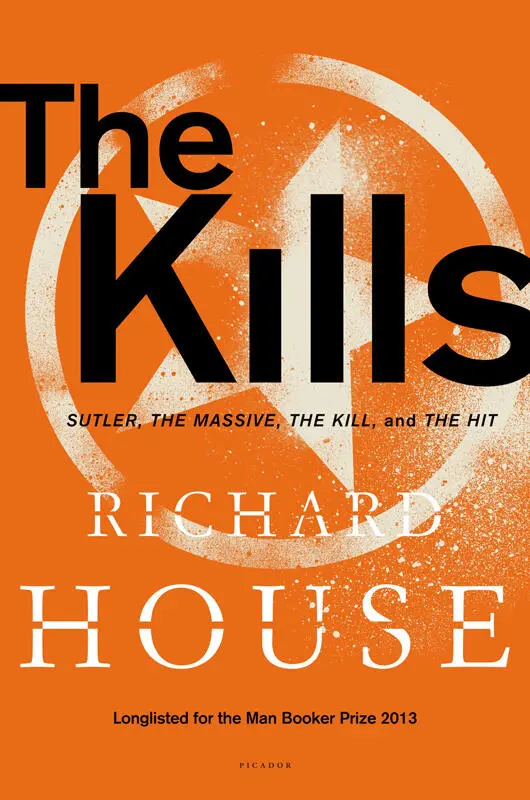
- Название:The Kills
- Автор:
- Издательство:Picador
- Жанр:
- Год:2013
- ISBN:нет данных
- Рейтинг книги:3 / 5. Голосов: 1
-
Избранное:Добавить в избранное
- Отзывы:
-
Ваша оценка:
The Kills: краткое содержание, описание и аннотация
Предлагаем к чтению аннотацию, описание, краткое содержание или предисловие (зависит от того, что написал сам автор книги «The Kills»). Если вы не нашли необходимую информацию о книге — напишите в комментариях, мы постараемся отыскать её.
The Kills — читать онлайн бесплатно полную книгу (весь текст) целиком
Ниже представлен текст книги, разбитый по страницам. Система сохранения места последней прочитанной страницы, позволяет с удобством читать онлайн бесплатно книгу «The Kills», без необходимости каждый раз заново искать на чём Вы остановились. Поставьте закладку, и сможете в любой момент перейти на страницу, на которой закончили чтение.
Интервал:
Закладка:
Stopped on the piazza with only a general notion of his location, he decided to return to the station. Once on via Carbonara his thoughts now ran on other subjects. When he stopped at via Capasso to wait for a break in the traffic, he looked down the small street directly at a red tin sign of a star in a circle mounted under a porch.
The dimensions, colour and design of the star were identical to the star on the missing student’s T-shirt, the sign duplicated in Fede’s newspaper and this morning’s Mezzogiorno. The discovery astounded him. He walked to the entrance and found the small portal-door open. Niccolò peered into the courtyard to smell fresh bread and see what looked like apartments rising above the central courtyard. On the brass plaque beside the doorbells he read the names of the businesses: a language school, a furniture ‘fabricator’, a lawyer, a seminary. It took a while for the information to sink in and seemed oddly coincidental, so odd that it might not be a coincidence at all, but some deliberate design.
Niccolò stopped at the entrance perturbed, unsure of his discovery. The longer he looked at the tin sign, the more significant it seemed.
* * *
He waited two hours, standing first immediately outside the door, so that every time it was opened he could see into the courtyard and understand a little better what was inside. He thought it best to wait, to stay open to the coincidence and see what might develop. Contented with the discovery he was happy to allow whatever might happen to unfold without prompting. At eleven o’clock he heard voices echoing as they came to the door, and a whole group of people came out of the courtyard. They came out in threes and fours, Americans, French, German, busy with chatter. The students from the language school held the door open for each other, they ducked as they came out, and Niccolò waited with his back to the wall, close enough to see each individual, and some, noticing him, nodded politely. The students, mostly women and girls, spoke English, although he heard German, and a little tentative Italian. Two boys, Japanese, ducked out through the doorway, and Niccolò waited, not sure if this also meant something. When the door closed behind them the students walked on and the street became silent.
After twenty minutes with few people coming in and out Niccolò began to consider moving on, and just as he debated the idea the door opened, and out stepped a young girl dressed in a short skirt with black skin-tight leggings.
The woman crossed directly in front of him. Short, with black hair cropped in a boyish cut, she hurried, half-running, through the shade of the street out into the sunlight, and headed to the broader piazza where she joined a small group of students and followed after them into an alimentari. Niccolò, with nothing else to do, came cautiously to the shop. Looking through the long windows he couldn’t distinguish her from the other students. Finally she emerged from the shop alone with a blue bag tucked under her arm. As she walked the strap slipped from her shoulder and she occasionally corrected it.
The student crossed directly in front of him. Niccolò automatically shied away, when he looked up again she was heading through the market and the tight streets of the Centro Storico, stepping aside for the cars and motorbikes and making her way to the open parade of via Cavour. Turning once the street opened out she hurried toward the metro, and came directly down the subway steps, walking so purposefully that he was sure she was taking him somewhere he needed to see.
Niccolò followed the student down to the platform, and stood close enough that he could have touched her shoulder without having to stretch. Niccolò seldom came into the city, he disliked the forced proximity of strangers, the crush and chaos; through the rush of the morning he had found no time to consider where he was, but now, deep under the city, he felt at ease. He fidgeted with the student’s notebook in his pocket. His fingers slipped over the plastic sheath.
Nothing particular singled out the student, she was a plain girl, thin, possibly haughty, a little masculine. There were other women on the platform and girls dressed in shorts or short skirts shouting as they came to the platform, heading to the northern beaches. One talked to a friend and lazily looked him up and down.
He stood beside the student on the train, turned three-quarters away from her, and refused a man asking for cigarettes. The girl appeared not to notice as the man spoke to her. Coming through to Campi Flegrei the train broke to the surface. Looking directly out of the window he watched the hotels and apartments on the broad cliff surrounding the back lots. He waited for her reflection when the train hit shade to show in the window.
Alighting at Campi Flegrei, he let her walk ahead, and followed via a bridge over the platform down to the street, it was clear that she was familiar with this route. The avenue was broader than the tight city streets. Ahead, running behind apartment blocks was the steep sweeping rim of a crater, the crest edged with finer houses and palm trees.
He followed her through a car park to the doors of an apartment and stopped at the steps as she paused at the doors and checked through her shoulder-bag for her keys. As she leant over the counter she looked back, and for the moment, before she turned and walked into the building he was certain that she had seen him. She seemed, he thought, to be looking for someone.
A group of four men playing cards inside the entrance looked back at him, and he thought that he should leave.
He returned directly to the train station.
* * *
Finding Niccolò just out of the shower Livia asked why his work clothes were laid out on the bed.
‘You need to help put things away. They’re going to be here at any minute. Why are you taking a shower now? You do this deliberately.’
In an attempt to broker reconciliation, Livia’s husband’s parents had invited themselves for the evening. They were passing through, they said, nothing more. Livia begged Niccolò to stay. ‘Do this one thing,’ she begged. ‘For me. I ask very little of you. They are checking on me. They don’t like that I came here, and they are suspicious.’
Niccolò knew how critical her father-in-law was and was well acquainted with her mother-in-law’s particular fussiness. The evening would be soured by the couple’s disappointment in Livia.
‘I’ve bought cold meats, cheese, and bread. Do you think that’s enough? They said they wouldn’t eat.’ Livia stood in the bathroom and watched Niccolò dry himself. ‘Don’t,’ she asked, ‘please, please, don’t mention the clothes. Say nothing of the clothes. I’m begging you. They are going to be here soon. You need to hurry up.’
Niccolò stood naked in front of the mirror. He parted his hair in the same way he had parted his hair that morning. He refused to be hurried.
‘So? Why are your clothes on the bed?’ She didn’t understand. ‘And why is your hair different? You didn’t go to work?’
Niccolò shrugged and said the police had called and asked him to come into the city.
Livia immediately appeared alarmed.
‘You went to Naples?’
‘I took the train.’
‘I don’t understand why they would want to speak with you? What else do they need to hear?’
Niccolò said he didn’t know.
‘What did they say?’
‘I didn’t see them.’
‘You didn’t see them? They called you in and then they didn’t speak with you?’ She shook her head, immediately angry. ‘Do you have a name? Who was this?’
Читать дальшеИнтервал:
Закладка:
Похожие книги на «The Kills»
Представляем Вашему вниманию похожие книги на «The Kills» списком для выбора. Мы отобрали схожую по названию и смыслу литературу в надежде предоставить читателям больше вариантов отыскать новые, интересные, ещё непрочитанные произведения.





Обсуждение, отзывы о книге «The Kills» и просто собственные мнения читателей. Оставьте ваши комментарии, напишите, что Вы думаете о произведении, его смысле или главных героях. Укажите что конкретно понравилось, а что нет, и почему Вы так считаете.