Richard House - The Kills
Здесь есть возможность читать онлайн «Richard House - The Kills» весь текст электронной книги совершенно бесплатно (целиком полную версию без сокращений). В некоторых случаях можно слушать аудио, скачать через торрент в формате fb2 и присутствует краткое содержание. Год выпуска: 2013, Издательство: Picador, Жанр: Современная проза, на английском языке. Описание произведения, (предисловие) а так же отзывы посетителей доступны на портале библиотеки ЛибКат.
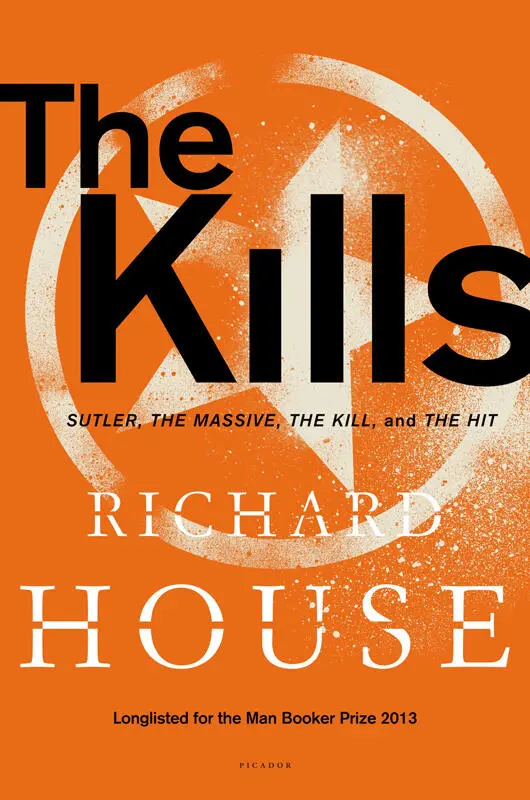
- Название:The Kills
- Автор:
- Издательство:Picador
- Жанр:
- Год:2013
- ISBN:нет данных
- Рейтинг книги:3 / 5. Голосов: 1
-
Избранное:Добавить в избранное
- Отзывы:
-
Ваша оценка:
The Kills: краткое содержание, описание и аннотация
Предлагаем к чтению аннотацию, описание, краткое содержание или предисловие (зависит от того, что написал сам автор книги «The Kills»). Если вы не нашли необходимую информацию о книге — напишите в комментариях, мы постараемся отыскать её.
The Kills — читать онлайн бесплатно полную книгу (весь текст) целиком
Ниже представлен текст книги, разбитый по страницам. Система сохранения места последней прочитанной страницы, позволяет с удобством читать онлайн бесплатно книгу «The Kills», без необходимости каждый раз заново искать на чём Вы остановились. Поставьте закладку, и сможете в любой момент перейти на страницу, на которой закончили чтение.
Интервал:
Закладка:
* * *
Marek rose early. He walked about the house in his shorts, prepared breakfast for Paola and laid a place ready at the table, and considered what he needed and what he didn’t. For example: he didn’t need Paola on his case, organizing him, making plans. She would bother him with schemes and details. Finding him work would become her project. He didn’t need this bother and he didn’t need his brother calling or sending messages. He needed his mother to stop her midnight walks. He needed less advice and more money.
His first idea was to visit Nenella. A fattuchiera, a woman from Pagani reputed to have second sight. Pagani was Paola’s village, and Paola had known Nenella as a girl. Nenella, she swore, could call out the bad fate of the most cursed. Often Paola would say that such a situation, or such a hope, such a notion could be divined by Nenella. The woman was able to advise, solicit, or intervene in any situation. Marek had no such faith, and ridiculed Paola whenever she expressed this belief, but today he thought he would see her.
A slow trickle came out of the pipes, not enough to shave and not enough to wash. He remembered the workmen and how the drilling continued intermittently for three hours, driving sleep out of the neighbourhood. He leaned over the balcony and looked for the pit the men had dug, but there was no sign of water, only a dry hole surrounded by bollards, nothing he could see, and no signs that explained the drilling. It was typical. They came in the middle of the night to disrupt his sleep and after all that noise they had achieved nothing. Further up the street he could see the magistrate’s car and his driver leaning casually against the side. As he looked down he thought he saw the man look up. Glancing back at Paola it occurred to him that the magistrate’s driver spent a great deal of time outside the apartment.
With what little water he could draw from the tap he made a coffee. As he waited for the coffee to boil he checked the wastebasket in the bathroom. Marek brought a small cup to Paola, and waking her set his hand on her stomach, and thought perhaps that he felt her flinch. Light bloomed between the shutters and Paola blinked, slowly wakening. Marek ran his hand softly over the curve of her hips as an overture, but remembering the discarded contraceptives decided against it: a child conceived today, out of duty, out of surrender, would be an unlucky child.
‘Speak with Tony.’ Paola hugged her pillow. ‘See what he has. He promised he’d find something.’
Already. Not yet up and she’s making plans. He told her about the water, happy to annoy her.
* * *
Marek hid in the café beside the tabaccaio. He watched Peña sweep the pavement, Lanzetti leave for work. The youth, Cecco, hung around the tabaccaio during the day and the Bar Fazzini at night, and seemed, oddly, to be friendly with Stefania, who otherwise sat at the counter and stitched all day without much of a word for anyone. For the boy she ordered coffee, Coke, limonata allowed him to sit with her and run errands on occasion.
At eight o’clock Paola sent Marek a message asking what he was doing. When he answered, Speaking with Tony, she responded immediately, IMPOSSIBLE!!!! I just spoke w. him. Moments later a third message: He has a car for you. Then a fourth. Can you pick up more shirts? I need them this afternoon?
I’ll ask Tony.
As long as it happens.
He watched the palazzo. The supervisor, Peña, sat on an upturned crate in the long shadow beside the entrance. She looked like a doll, not only because she was small, but because of her high forehead, thin hair, tiny mouth and hands, and the way she sat with her legs stuck out. When she moved the action appeared mechanized. Unlike everyone else on the street she seldom spoke and he felt something in common with her because of this.
As Marek came out of the café Peña shuffled forward to slip off the crate. She waved to him, straightened her clothes, and signalled that she wanted a quick word.
Peña spoke formally but not coldly. ‘You are a driver? Yes? I’m looking for a driver.’
‘For how long?’
Peña didn’t know. She’d ask Salvatore. Two men had rented a room from her. Two brothers. She believed they were French. They weren’t from the city, and had an idea that they wanted to hire someone to drive them. She offered Marek a card with a handwritten number and asked him to copy it down. She also needed a room painted if he knew anyone who could manage this.
Marek said he’d see what he could do.
* * *
He found English Tony at the garage with Little Tony and Antonio. The three men discussed two cars raised on the loading bay; another car, a cream and grey old-style Citroën, sat on the sidewalk. English Tony broke away to speak with Marek.
‘Use this one.’ He signalled the Citroën. ‘There’s a pick-up in Bagnoli. Bring it straight back.’ Tony looked him over with sympathy, and said he wouldn’t know the extent of the damage to the coach until he’d taken a proper look. At an uninformed guess, worse scenario, the frame could be shunted back. If this was the case it would take a while to fix. Marek wondered what story Paola had told him, why he sounded calm about the matter, and why he would loan him the Citroën — a man who lost his temper at any provocation, and had once thrown a hammer at his son, Little Tony. Tony also did some dealing, nothing more serious than dope and maybe some light recreational blow for his American friends, and Marek clumsily implied that he could help, you know, deliver, you know, but English Tony didn’t take up the invitation.
‘Can I use the car this afternoon?’
Tony gave an expression Marek couldn’t read.
‘Paola needs some packages for her work. Some shirts.’
‘Sure. Take it. But when you’re done you bring it back.’ English Tony gave a half-hearted wave, then added as an after-thought. ‘But no accidents. OK? No damage. There’s just one thing. Fuel. Don’t go by the gauge. Sometimes she just dies.’
* * *
Marek drove to the lungomare at Mergelina and called Peña’s number, and at first, because what was being said didn’t exactly make sense, he thought that he was speaking to an answering machine — then realized that the phone had been answered by accident.
‘If it’s not in,’ the voice said, ‘we don’t do it.’
After a rustle the call cut out.
Marek called a second time, and the answer came as a curt pronto. He spoke carefully, in Italian, and explained that he was a driver, and that he understood that they were looking for a driver. So … The call cut out a second time. Marek waited a moment before calling back. This time he spoke quickly and apologized for not having a name and said that he was a driver. The supervisor at the palazzo on via Capasso had given him the number. He understood that they needed a driver.
He felt that he had the man’s attention.
‘You need a driver?’
In the background he could hear another voice, in French, a man demanding to be given the phone.
‘Hello. You are a driver? You know the city? Can you come at four this afternoon? We can discuss rates when you come. Room 312. Hotel Grand.’
The man gave an address in Castellammare di Stabia. Did he get that? ‘It’s on the hill,’ he said. ‘On the mountain. Looking at Napoli. The big white hotel. You will find us, yes? Room 312.’
Marek said yes, and once the call was cancelled he realized that he had not taken a name, just a room number.
Читать дальшеИнтервал:
Закладка:
Похожие книги на «The Kills»
Представляем Вашему вниманию похожие книги на «The Kills» списком для выбора. Мы отобрали схожую по названию и смыслу литературу в надежде предоставить читателям больше вариантов отыскать новые, интересные, ещё непрочитанные произведения.







Обсуждение, отзывы о книге «The Kills» и просто собственные мнения читателей. Оставьте ваши комментарии, напишите, что Вы думаете о произведении, его смысле или главных героях. Укажите что конкретно понравилось, а что нет, и почему Вы так считаете.