Richard House - The Kills
Здесь есть возможность читать онлайн «Richard House - The Kills» весь текст электронной книги совершенно бесплатно (целиком полную версию без сокращений). В некоторых случаях можно слушать аудио, скачать через торрент в формате fb2 и присутствует краткое содержание. Год выпуска: 2013, Издательство: Picador, Жанр: Современная проза, на английском языке. Описание произведения, (предисловие) а так же отзывы посетителей доступны на портале библиотеки ЛибКат.
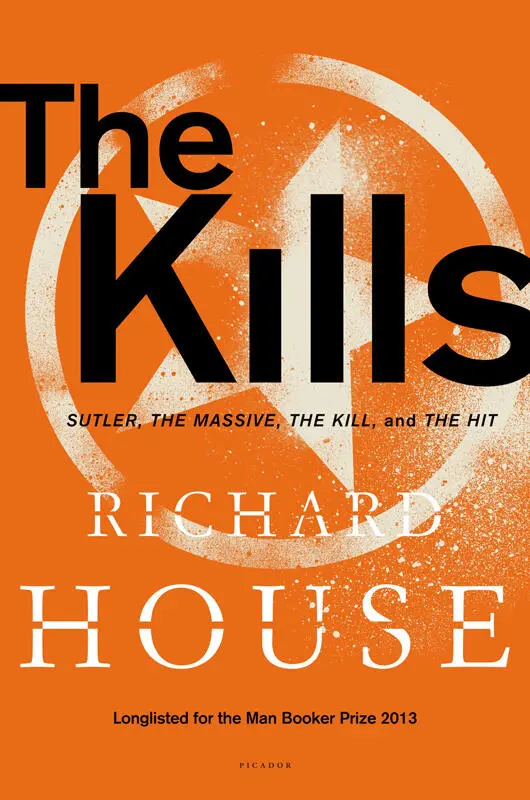
- Название:The Kills
- Автор:
- Издательство:Picador
- Жанр:
- Год:2013
- ISBN:нет данных
- Рейтинг книги:3 / 5. Голосов: 1
-
Избранное:Добавить в избранное
- Отзывы:
-
Ваша оценка:
The Kills: краткое содержание, описание и аннотация
Предлагаем к чтению аннотацию, описание, краткое содержание или предисловие (зависит от того, что написал сам автор книги «The Kills»). Если вы не нашли необходимую информацию о книге — напишите в комментариях, мы постараемся отыскать её.
The Kills — читать онлайн бесплатно полную книгу (весь текст) целиком
Ниже представлен текст книги, разбитый по страницам. Система сохранения места последней прочитанной страницы, позволяет с удобством читать онлайн бесплатно книгу «The Kills», без необходимости каждый раз заново искать на чём Вы остановились. Поставьте закладку, и сможете в любой момент перейти на страницу, на которой закончили чтение.
Интервал:
Закладка:
With the purse in hand Marek missed the lights and failed to pull into the intersection. Horns sounded behind him, a taxi cut directly across his path — so close he automatically braced — the shock of this barely registered when the cab was struck by a city bus, punched sideways and shunted into Marek’s coach.
Marek dropped to his side as the airbags pillowed over him, as the windscreen blew out, and found himself straddling the gearbox on his hands and knees. The impact itself seemed to come later, after its effect, as a mighty shove, something divine, out of scale.
The accident left a buzz in Marek’s ears and dampened all other noise. He’d hit his head, not hard, but a knock nevertheless. Scattered birds came soundlessly down, and a kind of wonderment spread through him: if he hadn’t been preoccupied with the red purse he would be dead, he would have driven directly into the path of the taxi, of this he was certain; being caught on the rebound was nothing, nothing at all. Glass in his hair, a shirt ripped in the seam, but no real damage, except to the coach.
Passengers stepped off the city bus and walked in a disconnected stumble to the kerb. To Marek’s right a woman with bags tipped at her feet, groceries spilling into the road, pointed at the traffic lights and shouted, red red, in disbelief.
* * *
The instant it was over a bevy of car horns sounded along Corso Garibaldi and Corso Umberto. The first pneumatic punch brought people onto the balconies overlooking the intersection. Others hurried from the market stalls to catch sight of a crushed car and coach, a city bus stopped at an acute angle to the sidewalk. From under the cab rose a thin, violet quiff of smoke.
Marek studied the car in front of him, astonished that this — how many tonnes of steel? — had spun out of nowhere, as if the car had landed smack-bang out of the sky, as if the people stumbling from the bus were drunk. As if the men — the passenger slumped across the seat, his head resting on the driver’s haunch, the driver lolling over a battered door, shirt rucked to his shoulders, arms flung out so he appeared to be reaching or pointing — were some soft part of the car.
A man in a doctor’s coat, skinny and bald, hurried to the taxi. He leaned deep into the cab and as he drew out he sorrowfully shook his head, nothing could be done — an intimate gesture, Marek thought, which implied kinship: as if they knew each other.
Traffic locked the length of Corso Garibaldi and Corso Umberto, and in a slow outward spread the smaller side streets began to seize up. Marek could smell oil and rubber and the sun’s heat rebounding on the smooth black cobbles. He looked hard at the taxi and the dead men and resisted the urge to lie across the seat and see how long it would take for someone to come to him. He didn’t know what to do with himself. His job, he knew, was over. Without the coach Tony would not be able to hire him. The vehicle, too damaged to repair, would not be replaced. Without a vehicle there would be no work. Paola would need to be told.
Security guards from the Banco di Napoli escorted passengers from the bus; as the bus driver passed by he looked hard at Marek, his expression still and blank, one of shock, and Marek felt pity for him. The man in the doctor’s coat helped passengers to the kerb and looked at Marek as if he knew him, and Marek realized the man was his neighbour, Lanzetti, Dr Arturo Lanzetti, the pharmacist who lived on the fifth floor with his wife and his son. He knew his son, knew of him, heard him almost every day.
The first police arrived on motorbikes and rode the pavement alongside the piazza. The corso sang with their alarm. Firemen trapped in the traffic abandoned their trucks and clambered between the cars to the intersection, and everyone stopped to look at the taxi, the two dead men, then Marek and the coach, and shook their heads at his undeserved good luck.
Lanzetti came to the coach and opened the passenger door. He brushed the glass from the seat with slow sweeps then sat down, uninvited.
‘This will take a while.’ He offered Marek a bottle of water and told him to drink. ‘Will you let me?’ He signalled Marek’s head by tapping his own. ‘You have a cut.’
‘It’s nothing.’ Marek leaned toward his neighbour. Lanzetti looked and nodded, it was nothing to worry over. The pharmacist could give no information; a passenger on the bus needed to be taken to the hospital and although they had managed to get an ambulance to the intersection, it would be another matter getting it out. The medics were already in control.
The police slowly re-established order: the gathering crowd kept to the pavement, and drivers ordered back to their cars.
Marek leaned away from the sun and waited for the police to come to him. He showed the purse to Lanzetti and explained how it had delayed him, how otherwise, without the purse, matters would be very different. Lanzetti nodded as he listened, a slow gesture, one of comfort, as if he understood how the smallest coincidences of place and time could be of such startling importance. The difference between what did happen and what had nearly happened — which didn’t particularly require discussion, but needed to be acknowledged.
The road was hosed down before the roof was cut from the car and both men watched, silent and respectful. A ring of firemen held up blankets to block the crowd’s view and to prevent the curious from taking photographs. As the bodies were lifted from the squat wreckage Marek finally gave his details to the police and Lanzetti slipped quietly out of the cab.
The sight of the young men being laid carefully on stretchers and then covered with blankets struck Marek deeply; he looked hard, expecting some break in their stillness.
* * *
And what was their argument about? Money, sure, because every argument is about money. But this one started with a discussion about children, about how they could not afford, as a couple, to have a child, when really, the simple fact was that Paola did not want his child, and he wanted her to admit this truth. We have enough to look after, she said, with me and you. We have enough. Their arguments concertinaed, one to another, and while Marek remembered the insult he lost the particular words and phrases; Paola, however, recalled intricate points and details so that nothing was properly resolved. They each had their triggers: the uselessness of their work, their mismatched schedules, how lonely it was to go to bed alone or wake alone, how weekends when they finally spent them together were listless, empty, and how they both felt unattractive. Beneath this ran their own dissatisfactions (for Marek: his recent weight gain, his thinning hair, how easily these days he started to sweat. For Paola: the veins thickening on the backs of her calves, how tired she was and lately forgetful). Some of their disagreements grew out of their daily routine. Paola resented cooking, and Marek resented the half-efforts she would make, and how much food was spoiled through lack of care. How could someone prepare so carefully for sex (the gel, the foam, the condom slick with spermicide), and not have the wherewithal to make a simple meal? How could an Italian woman not cook? How could this be possible? And then there was the issue they usually avoided, the heart of every disagreement: Paola did not want his children. Who would want the children of a man who had no work?
* * *
When Marek returned he found Paola in the kitchen, deliberately positioned at a bare table with nothing about her, no cigarettes, no drink, so that her waiting would be obvious.
Tony had called. She’d heard everything from him, about the accident, about the coach, about his job. She stood up and walked to Marek and held him tightly.
Читать дальшеИнтервал:
Закладка:
Похожие книги на «The Kills»
Представляем Вашему вниманию похожие книги на «The Kills» списком для выбора. Мы отобрали схожую по названию и смыслу литературу в надежде предоставить читателям больше вариантов отыскать новые, интересные, ещё непрочитанные произведения.





Обсуждение, отзывы о книге «The Kills» и просто собственные мнения читателей. Оставьте ваши комментарии, напишите, что Вы думаете о произведении, его смысле или главных героях. Укажите что конкретно понравилось, а что нет, и почему Вы так считаете.