Richard House - The Kills
Здесь есть возможность читать онлайн «Richard House - The Kills» весь текст электронной книги совершенно бесплатно (целиком полную версию без сокращений). В некоторых случаях можно слушать аудио, скачать через торрент в формате fb2 и присутствует краткое содержание. Год выпуска: 2013, Издательство: Picador, Жанр: Современная проза, на английском языке. Описание произведения, (предисловие) а так же отзывы посетителей доступны на портале библиотеки ЛибКат.
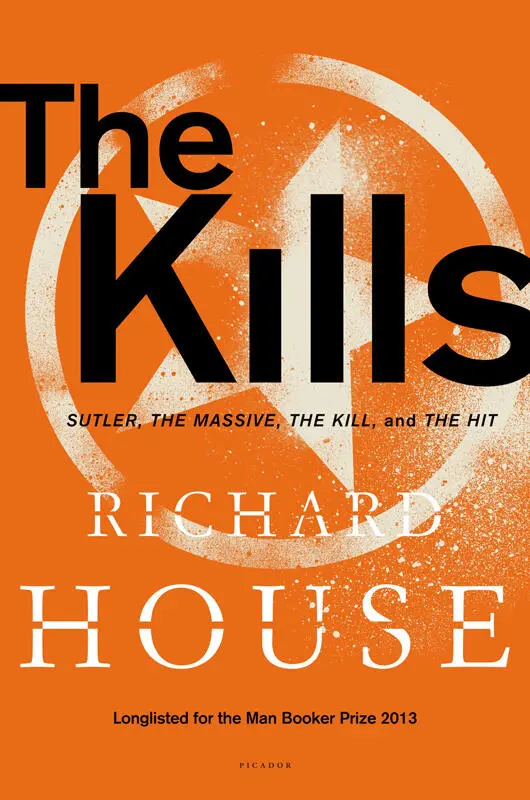
- Название:The Kills
- Автор:
- Издательство:Picador
- Жанр:
- Год:2013
- ISBN:нет данных
- Рейтинг книги:3 / 5. Голосов: 1
-
Избранное:Добавить в избранное
- Отзывы:
-
Ваша оценка:
The Kills: краткое содержание, описание и аннотация
Предлагаем к чтению аннотацию, описание, краткое содержание или предисловие (зависит от того, что написал сам автор книги «The Kills»). Если вы не нашли необходимую информацию о книге — напишите в комментариях, мы постараемся отыскать её.
The Kills — читать онлайн бесплатно полную книгу (весь текст) целиком
Ниже представлен текст книги, разбитый по страницам. Система сохранения места последней прочитанной страницы, позволяет с удобством читать онлайн бесплатно книгу «The Kills», без необходимости каждый раз заново искать на чём Вы остановились. Поставьте закладку, и сможете в любой момент перейти на страницу, на которой закончили чтение.
Интервал:
Закладка:
As she listened Peña took her medication. She laid the pills along the smooth walnut side-table and took a sip of water, a tablet, another sip. The boy dropped toys into the courtyard and she retrieved them: the small soldiers, crayons, pens, a racing car, a diver with the yellow aqualung. She listened to him read. The boy’s pronouncements outlined a chaotic world. The tumble of an aircraft into open water; a fire erasing an entire city block; a mudslide sweeping houses, cars, caravans into a widening canyon, events which described nothing godly or divine, but simple laws of opportunity, matters Peña understood to her core. There was nothing, she considered, not one thing, which could truly surprise her. After reading the headlines Sami turned to the local section to read stories of disagreements, strikes and train stoppages, contracts for uncollected trash. After this he read the sports, although this was news they already knew.
A sip of water. A tablet. A sip of water.
Propped forward with pillows, Peña sat upright and motionless, her eyes fixed on a length of sunlight vibrating into the room. Her medication amplified her waywardness, a potential to slip away. Tiny things tumbled down the side of the building. A steady rain of falling toys: a cowboy, a diver, a mule, a racing car, a lipstick, a robot that was also a car, a troll or what she took to be a troll, a key-ring, a mobile phone, a face cut out of a magazine flickering down, a hawk — wings open, a number of pigeon eggs, one by one, a series of keys, an open can of paint, a boy who could swim through air.
* * *
At night Sami hitched himself onto the window ledge and pushed open the shutters. Too short to see into the courtyard, the boy shuffled on his forearms like some kind of creature, Peña thought. Dust stirred and sparked in the void between them. Peña stepped back from her window. It troubled her not to remember things. Names mostly. Places. But sometimes plain words.
It took some moments for her eyes to adjust; she watched as Sami edged himself forward, one hand set in a fist. With his chin on the stone lintel he stared into the courtyard. Small sounds skidded beneath them: televisions in separate rooms, honks and voices, the settling rattle of air-conditioners and the steady clap of water on stone, the less attributable snaps and tremors that came from deeper sources — the entire building contracting in the cooler night air.
There was something in the boy’s hand, and he took time to stand this object right at the edge. Another toy soldier, Peña guessed by the size, another trophy.
About an hour after Sami had set the toy on the ledge Peña heard the clack of the lock on the small portal door, then a muffled conversation as two men came from via Capasso into the courtyard. Sami came to the window then quickly ducked away — and although she could not see him she guessed that he was standing in the dark away from view.
The voices were soft, too quiet to properly understand, and when a soft chuckle rode up the side of the building the boy cautiously returned to the window ledge. They were speaking to him in whispers, words she couldn’t quite catch. Come on, they seemed to say. Come on.
The men continued talking while they smoked, the rising whiff of tobacco, their voices becoming a little less discreet. One of the men became boisterous and shouted through the courtyard, ‘Hey,’ for attention, and then softened into laughter. Peña slipped back into her room. The boy slid himself forward to watch.
In the kitchen, unaware, Anna Soccorsi stood over a kettle with her arms folded, wearing nothing more than a man’s T-shirt.
* * *
Peña slept in her armchair. She woke once and heard the voices again, men whispering to the boy words she could not hear.
* * *
Arturo Lanzetti did not always live with his family. He stopped two months in Naples, sometimes less, but two months was his median stay, then he would be gone, leaving Anna with the child, or Anna alone. The period before his departure would be plagued with silences and bitter argument so that Peña could tell even before he was gone that he was going. While Lanzetti was away the phone rang late at night, and Peña became used to Anna’s thin and unpersuasive voice sounding always like a complaint. Anna sometimes wore a ring and sometimes did not, and as was common she kept her own last name so there was no clear indication of their status. For Peña the mystery of their relationship was solved at different times to a different result.
TUESDAY: DAY C
As the train drew slowly toward the station in one long curve, Mizuki, by habit, stepped up to the door and watched the reflection, phone in hand. The towers of the business district, superimposed on the glass, slipped over the long grey container park that faced the bay. On this day she remembered a story about a woman who’d lost a bracelet, and again she couldn’t remember the title: she found the lapse funny, because wasn’t this also the subject of the story? In learning a new language she was forfeiting memories, or maybe she was simply tired? For two nights now her sleep had been broken. Nothing particularly troubled her, and neither was she hankering for something — the usual causes of unrest. She simply couldn’t sleep. Both nights she’d lain awake with the notion of a river suspended above her, a current flowing through the room that would occasionally descend and engulf her (and she would sleep), then rise (and she would wake). The water looked nothing like water: black and slick and infinite as volcanic glass. The sensation was not unpleasant, but it left her unable to concentrate. A memory of the dream stuck as an insistent ache in her arms and a pressure in her chest as if she had wrestled a strong current.
Mizuki did not purposefully look for the brothers, but was pleased to recognize one of them as she stepped off the train. Which brother is this, she asked herself, the older or the younger? Once again the man appeared to be waiting, a little less present than the previous day, perhaps even bored. This time he leaned back, puppet-like, with one shoulder bent to the grey pillar and his hands dug into his pocket, so that his body turned — loose-looking, something set aside. When she passed by she hoped to catch his eye and paused to make sure that this would happen: when he finally looked at her he registered nothing. This, then, was the younger brother.
On the upper concourse she spied the older brother at the station threshold, beside him the newspaper vendor, magazines pegged in a line, others stacked in bundles, and drinks, water, cola, wrapped in packs. She stood beside the man as she bought a bottle of water, felt her pulse quicken. If she leaned to her right her shoulder would touch his upper arm. She paid, turned about, passed directly in front of the man — and noticed how he turned his head to watch her with the same intensity as the day before. Today the men were not wearing similar clothes and she could easily distinguish one from the other. French, she decided. Definitely French. She had an eye for this. The clothes (a summer suit jacket with new jeans, expensive shoes when sandals would do), but best of all a studied casual air, a kind of self-possession she had to admit she found attractive even while she found it arrogant. Generalities, sure, but she was usually right. And was he wearing perfume, some fresh aftershave or shaving balm? Or was it just the sight of him, so clean, a man in a pressed shirt, a man in a suit jacket, European, that made her expect this?
Today the corso was clear and Mizuki reached the school before the start of the lesson, and realized, again, that she had failed to take a photograph. At the large wooden doors to the courtyard she tucked her hands into her sleeves, pulled back her hair, and turned up her collar to protect her neck, readying herself to run from the wasps.
Читать дальшеИнтервал:
Закладка:
Похожие книги на «The Kills»
Представляем Вашему вниманию похожие книги на «The Kills» списком для выбора. Мы отобрали схожую по названию и смыслу литературу в надежде предоставить читателям больше вариантов отыскать новые, интересные, ещё непрочитанные произведения.








Обсуждение, отзывы о книге «The Kills» и просто собственные мнения читателей. Оставьте ваши комментарии, напишите, что Вы думаете о произведении, его смысле или главных героях. Укажите что конкретно понравилось, а что нет, и почему Вы так считаете.