Richard House - The Kills
Здесь есть возможность читать онлайн «Richard House - The Kills» весь текст электронной книги совершенно бесплатно (целиком полную версию без сокращений). В некоторых случаях можно слушать аудио, скачать через торрент в формате fb2 и присутствует краткое содержание. Год выпуска: 2013, Издательство: Picador, Жанр: Современная проза, на английском языке. Описание произведения, (предисловие) а так же отзывы посетителей доступны на портале библиотеки ЛибКат.
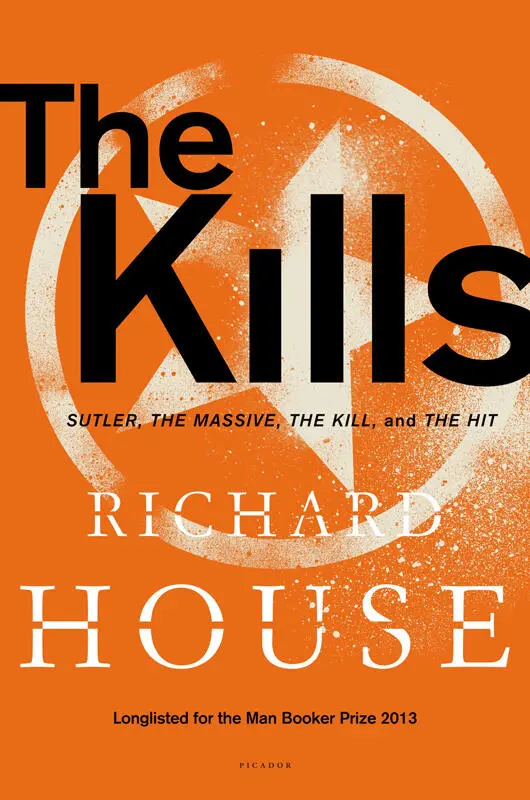
- Название:The Kills
- Автор:
- Издательство:Picador
- Жанр:
- Год:2013
- ISBN:нет данных
- Рейтинг книги:3 / 5. Голосов: 1
-
Избранное:Добавить в избранное
- Отзывы:
-
Ваша оценка:
The Kills: краткое содержание, описание и аннотация
Предлагаем к чтению аннотацию, описание, краткое содержание или предисловие (зависит от того, что написал сам автор книги «The Kills»). Если вы не нашли необходимую информацию о книге — напишите в комментариях, мы постараемся отыскать её.
The Kills — читать онлайн бесплатно полную книгу (весь текст) целиком
Ниже представлен текст книги, разбитый по страницам. Система сохранения места последней прочитанной страницы, позволяет с удобством читать онлайн бесплатно книгу «The Kills», без необходимости каждый раз заново искать на чём Вы остановились. Поставьте закладку, и сможете в любой момент перейти на страницу, на которой закончили чтение.
Интервал:
Закладка:
They found Rafí at the bar, shirt unbuttoned to a grey T-shirt, sleeves rolled up, Cecco beside him with his elbows on the counter looking more boyish than usual. Rafí signalled out the man he wanted Lila and Arianna to meet.
‘You know him?’ Rafí asked. ‘He’s here all the time. His name is Salvatore, goes by Graffa. He lives in the palazzo opposite.’
Reed-thin, static, heron-grey and bald, the man wore workmen’s trousers and a workman’s shirt. Lila found his bird-like sharpness a little sickening and thought the man didn’t belong in the bar. If such a man wanted company he’d pick up women along the marina. Such a man, being fifty-five, maybe sixty, would be married or separated, and almost certainly would prefer young girls.
By the time Lila and Arianna reached the counter, Rafí was already at the man’s side. He rested his hand on the man’s arm and whispered to him. Cecco, watching, appeared bereft.
Lila watched Cecco as Cecco watched Rafí.
Rafí bought the man a drink. Salvatore, he said, persuasive, overusing the name, Sal. Graffa then followed him outside when he wanted to smoke and stood so close that when the man exhaled he blew smoke over Rafí’s shoulder. Arianna leaned close to Lila and said they should be going, her voice now hoarse. Although the bar was busy there would be no business, and she didn’t like the way things were going with Rafí. The man, this Salvatore, wasn’t interested — anyone could see. Lila shouldn’t encourage Rafí. Tomorrow she’d have a word and find out exactly what was going on with their money. They shouldn’t depend on him.
‘Have you heard him talk?’ She nodded toward the street. ‘These stories?’
When they tried to leave Rafí stepped up to the entrance, sly and pleased with himself.
‘It’s good,’ he said, his head turned so the man couldn’t see him. ‘He’s interested.’
‘In what? What have you told him?’ Arianna steered Lila toward the street, and there, on a low stone wall, with the dark furred shafts of palm trees behind him, Salvatore sat waiting, expectant. Music from other bars slipped through the night air. Lila could smell jasmine, and looking up she saw a rusted sign of a star and realized that what she could taste in the air wasn’t jasmine but scorched sugar and vanilla from a bakery. From the windows came the hum of fans and extractors.
Rafí whispered into Arianna’s ear then stepped back. ‘It’s agreed. Right? You agree?’
Arianna looked to Lila then nodded. ‘We do this, then we go.’
* * *
For a reasonable fee Rafí took the women to a car parked in the alley behind the bar.
Rafí shone a flashlight along the cobbles and spun the light over the sunken bags and newspaper packets bunkered into the doorways. Lila held her breath against the sweet boozy stink. Arianna became argumentative. A flashlight? A car? What was this exactly?
Salvatore turned his back to the group and spoke on his phone. When he was done he clicked his fingers to draw Rafí’s attention. He nodded at Lila. ‘Seriously. How old?’
‘I told you. Fifteen.’
The man sucked on his teeth and shook his head, certain. ‘She’s not fifteen.’
Rafí gave a small confirming nod and called to Lila. ‘Tell him. Fifteen?’
Lila nodded. Fifteen it was.
They kept their voices low, aware that above and about them were open windows to kitchens and bedrooms, the warren-like pockets of apartments dug side by side into sheer unornamented walls.
Salvatore repeated the information into the phone, one hand to his ear. ‘Is she clean?’
Rafí held out his hands, palms up, as if insulted.
‘Where’s she from?’
‘Originally?’ Rafí blew out his cheeks, and slowly, indifferently, spun a story about how Lila was Sicilian, how her dark complexion came from Arab blood, but being too live a firecracker her family had packed her off to Mostra to the sweaty attentions of a retarded uncle and cretinous second-cousins. He’d found her in the Veneto, he said, picked her up on an autostrada, or some such flat un-sunny hinterland. Lila was a naive unfortunate who surrendered her ass night after night to every male member of her family, who might be imbecilic but knew enough about business to save that other temple for a paying stranger. So, in a sense, she was untouched, and yes, definitely clean. Unschooled but not uneducated. Dumped at the side of the road by her uncle after a final refusal she was making her way back home. This story played better than the earlier version where Rafí claimed that the women were sisters, who slept cat-like, entwined on a single bed in a small stone hut in some dumb coastal village. Driven by misfortune to the mainland to sell themselves, Lila and Arianna delivered nightly shows on hollow mattresses in dry, dirty basements right across the peninsula. In their primitive understanding there wasn’t even a word for what they were, Arianna being a weird boy/girl hybrid so you couldn’t actually call what they did lesbian. Any story played better than the truth, which, in Lila’s case was nothing but bland. Lila came from Modena, and before that Skopje, the entire family uprooted when she was less than two years old, although she had no memory of this. End of story. Her father was a mechanic, as were her brothers. Her mother, gone too long for her to remember, had worked as a domestic. Now, Arianna, half-Spanish, was a more interesting bundle and told stories about her brothers who threatened her with knives, locked her in a room for an entire week the first time they saw her dressed as Arianna. The second she fled they told the neighbours she was dead. Rafí discovered her at a gas station ten kilometres outside of Pavia, where, he explained, she’d learned to suck the small change from a vending machine.
Salvatore listened without interest and repeated the information into the phone, and this time Lila could hear him repeating himself, as if the person he was speaking to could not follow the discussion. While the man listened he looked hard at Lila. ‘Is what he says true?’
Lila shrugged.
Rafí pinched his tongue between his teeth and nodded.
Salvatore cleared his throat. ‘What about the other one?’
Lila for her part was starting to tire; she couldn’t see why they were waiting, or why they were doing business outside and on the phone. She hoped these men weren’t Italian. Italian men talked everything to death, explained themselves and their sorry situations in endless preparation, each one of them secure in the notion that buggering a prostitute wasn’t hard-line adultery. As soon as they were done Lila didn’t exist, and this disregard seeded a real and terrible shame.
Rafí stepped away and shone the flashlight on Arianna, who stood with her arms folded, clearly unimpressed.
‘And she has a—’ The man whistled through his teeth and waggled his little finger. ‘This one, she has a cock? Yes? A pistol?’ He translated into the phone and then, speaking to Rafí, said that he needed to see for himself before they could decide.
Rafí turned the flashlight through the window to the back seat of the car. ‘Just to look,’ he cut his arm in a flat cross-swipe, ‘anything different and you pay more.’
Arianna shot Lila a glance as she ducked into the car. She signalled Rafí to come close and whispered to him, the streetlight stroking his jet-black hair and greasing Arianna’s forehead.
Inside the car Arianna sprawled across the back seat in an attempt to find a comfortable position. She raised her knees, struck up her feet and shimmied her hips lower and lower until her shoulders jammed against the door. Salvatore let her settle then took the flashlight and hunched through the front passenger door, folding himself inside as a man undertaking an unpleasant task.
Читать дальшеИнтервал:
Закладка:
Похожие книги на «The Kills»
Представляем Вашему вниманию похожие книги на «The Kills» списком для выбора. Мы отобрали схожую по названию и смыслу литературу в надежде предоставить читателям больше вариантов отыскать новые, интересные, ещё непрочитанные произведения.




Обсуждение, отзывы о книге «The Kills» и просто собственные мнения читателей. Оставьте ваши комментарии, напишите, что Вы думаете о произведении, его смысле или главных героях. Укажите что конкретно понравилось, а что нет, и почему Вы так считаете.