Richard House - The Kills
Здесь есть возможность читать онлайн «Richard House - The Kills» весь текст электронной книги совершенно бесплатно (целиком полную версию без сокращений). В некоторых случаях можно слушать аудио, скачать через торрент в формате fb2 и присутствует краткое содержание. Год выпуска: 2013, Издательство: Picador, Жанр: Современная проза, на английском языке. Описание произведения, (предисловие) а так же отзывы посетителей доступны на портале библиотеки ЛибКат.
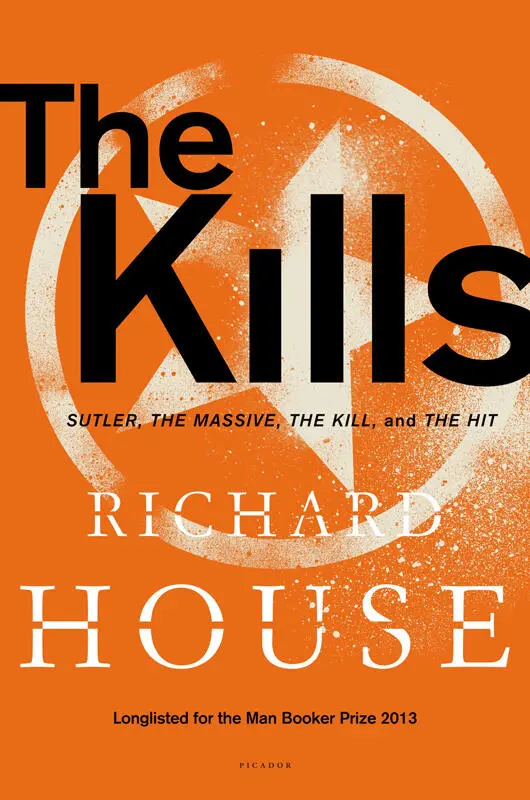
- Название:The Kills
- Автор:
- Издательство:Picador
- Жанр:
- Год:2013
- ISBN:нет данных
- Рейтинг книги:3 / 5. Голосов: 1
-
Избранное:Добавить в избранное
- Отзывы:
-
Ваша оценка:
The Kills: краткое содержание, описание и аннотация
Предлагаем к чтению аннотацию, описание, краткое содержание или предисловие (зависит от того, что написал сам автор книги «The Kills»). Если вы не нашли необходимую информацию о книге — напишите в комментариях, мы постараемся отыскать её.
The Kills — читать онлайн бесплатно полную книгу (весь текст) целиком
Ниже представлен текст книги, разбитый по страницам. Система сохранения места последней прочитанной страницы, позволяет с удобством читать онлайн бесплатно книгу «The Kills», без необходимости каждый раз заново искать на чём Вы остановились. Поставьте закладку, и сможете в любой момент перейти на страницу, на которой закончили чтение.
Интервал:
Закладка:
She raised her hands, let the toy settle into them, looked up as she drew the thread away from the wall. In the open window four flights up, she could clearly see a boy leaning over the edge, holding the other end of the thread and a torch. The boy flashed the light, twice, and Lila signalled back with two blinks. She directed her beam at the window and was surprised to see how young the boy was, his face all moonish, round, a little startled. Torchlight from the window strafed the paving, settled on her face. Lila smiled up and raised her hands so he could see the toy.
Salvatore shoved her out of the light so hard that she fell backward, and without thinking she punched, open hand, heel first, and blunted the man in the face, struck his nose — then scuttled to the doorway, and further, to the street, so fast that she didn’t stop until Rafí and Arianna grabbed hold of her. What was she playing at? What was she doing? Arianna pulled her upright, drew her quickly into the streetlight toward the noise of the Fazzini while Rafí reasoned with Salvatore, salvaged what he could, saying: ‘Calm. Calm. Let’s all keep calm.’
Lila didn’t understand the problem. Arianna stroked her face and said she shouldn’t worry, ‘but these men, they don’t want to be seen. It’s not so good to draw attention to yourself. You shouldn’t have hit him.’
* * *
Arianna hectored Lila on the walk back.
‘He was laughing at us,’ she complained. ‘What was he saying? How much we weigh?’ She waited for Lila to catch up. ‘The price of what, of meat? Who were these brothers? Who talks like this?’
Lila wanted to find something to eat. Michele’s would be open, they could pick up pizza, Pepsi, frittura, but Arianna walked ahead without a word. She walked wide of the doorways and the shuttered booths, suspicious of every man they passed.
* * *
Back at the Hotel Stromboli, Lila settled against Arianna. Arianna complained about the dog, her long body stretched out, head turned to the window, straw-coloured hair loose about her face. Bark, bark, bark, she complained, every time they come back. No end of trouble. She spoke slowly, lazily, as if the words were too weighty to heft out, her arm hung over the side of the mattress. On the floor between them, mismatched shoes, a scrap of foil, three lighters — all spent — an envelope with two remaining pills, egg blue on one side and white on the other. Lila pressed her head back into Arianna’s thigh.
‘Did it hurt?’ Lila asked. She could feel her voice vibrate through her collarbone. There had to be some science behind this, the way that people intuit sound, how some people sense danger, or how animals, dogs for example, or birds, know that trouble is coming, or feel threat in their bones, a coming earthquake, a lightning strike, a wall of water. The dog’s barks also passed through her.
‘Did it what?’
‘Hurt. When you were in hospital?’
Another pulse ran through Lila’s shoulders. She could smell Rafí’s aftershave, a metal tang to it, old and sour.
Arianna crawled out from under her and sat upright. ‘We need to think. We need to plan what we’re going to do when he comes back. If he had to give back all that money…’ She rested her hand on Lila’s head and apologized. ‘I should have been watching you.’
* * *
In the late afternoon Peña swept the courtyard and kept an eye open for Sami’s toys but found nothing. When Dr Lanzetti returned to the palazzo he passed by Peña and continued to the stairs without a word. A man who walks with his head down, his hands in his pockets, a man who used to show politeness, who passes now without the time of day, is a man in trouble.
* * *
That night Peña waited until Arturo Lanzetti and Anna Soccorsi were in bed. Neither of them had spoken much through the evening; Anna’s mood infected the air. Again the palazzo settled into its own subterranean sounds, the tiny clicks of cooling tiles, the snap of contracting wood, of pipes tightening.
Sami appeared at the window some time after midnight, awake and ready. With his shoes over his hands he slowly pushed open his shutters. The boy must be standing on a chair, or a box, something to raise him level to the window so that he didn’t need to scramble up.
This confidence made Peña anxious. The boy was becoming bolder and she worried that with any misstep he would fall, but he stood, framed by the window, the room a black hollow behind him. After half an hour she could not help herself and drifted into sleep.
The first disturbance of the night came as a scuffle, a woman’s shouts and a confusion of voices, how many men how many women she couldn’t tell, although one of the voices, she was certain, was Salvatore’s. By the time she made it to the window the fuss was over, the entrance door shut, the courtyard silent. The boy’s window and blinds now closed.
The second disturbance came several hours later when Peña was woken once again by a soft call, men’s voices rising though the hollow. She looked out and saw the boy standing on the window ledge, one hand timidly touching the shutter, his toes tipped to the lintel. Four floors up and the boy stood at the lip of his window, knees slightly bent, while from the courtyard voices seemed to coax him forward with a baritone coo. Unsure of what she should do Peña picked up her water glass. Terrified that she might startle him and cause him to fall. She thought to drop the glass, but instead simply struck it lightly, a spoon against a glass — a slight sound, clear and distinct. The boy looked up. He stepped back, and Peña moved forward so that he could see her. The boy slipped further back from the edge, clambered down, then closed the shutters. With the shutters closed, the voices stopped, and she thought that she had imagined this. A startling image, a boy in a window, so high above the courtyard.
* * *
The third disturbance came at four in the morning. A shout from the boy’s room, cries, the clatter of shutters thrown open: light cast directly across the courtyard to brighten her room.
A scene of unity, the three together in the boy’s room, Lanzetti holding the child, the mother bent beside him, insisting that she look at his hand, prising it open, and the boy twisted away, stuck to his father crying slow ow-ow-ow’s.
Anna came to the window, looked down into the courtyard and then shouted across to Peña. ‘Who did this? You saw. You must have seen.’
Peña shook her head.
‘It’s impossible. You must have seen who did this. You see everything.’ Anna leaned further over the ledge, fierce and unwavering.
Peña again shook her head.
Anna left the boy’s bedroom. Lanzetti followed after — the boy fast to his side — asking where she was going.
‘I’m going to talk to her,’ Peña heard her say. ‘I’ll make her tell me who did this,’ she said, ‘that shrunken little bitch.’
Peña stood at her door and opened it knowing that the woman would shout at her, that there would be no containment, no reserve. Anna Soccorsi came across the landing with a toy held in her hand, a small metal car, the front end blackened.
‘They heated this. Do you see? He burned his hand. It was deliberate. Do you understand? This is assault, and you saw who did it.’ Now warmed up, she looked over Peña’s shoulder and caught sight of Sami’s toys laid out across Peña’s kitchen table. Her voice immediately slipped gear, became incredulous, alarmed. ‘What is this?’ She turned to Peña. ‘Those are my son’s toys. Look,’ she shouted to Lanzetti and pointed, ‘look, she has his toys. It was you? It was you! I’m calling the police.’ One hand covering her mouth, Anna turned and ran back to her apartment.
Читать дальшеИнтервал:
Закладка:
Похожие книги на «The Kills»
Представляем Вашему вниманию похожие книги на «The Kills» списком для выбора. Мы отобрали схожую по названию и смыслу литературу в надежде предоставить читателям больше вариантов отыскать новые, интересные, ещё непрочитанные произведения.



Обсуждение, отзывы о книге «The Kills» и просто собственные мнения читателей. Оставьте ваши комментарии, напишите, что Вы думаете о произведении, его смысле или главных героях. Укажите что конкретно понравилось, а что нет, и почему Вы так считаете.