J. Powers - Morte D'Urban
Здесь есть возможность читать онлайн «J. Powers - Morte D'Urban» весь текст электронной книги совершенно бесплатно (целиком полную версию без сокращений). В некоторых случаях можно слушать аудио, скачать через торрент в формате fb2 и присутствует краткое содержание. Год выпуска: 2000, Издательство: NYRB Classics, Жанр: Современная проза, на английском языке. Описание произведения, (предисловие) а так же отзывы посетителей доступны на портале библиотеки ЛибКат.
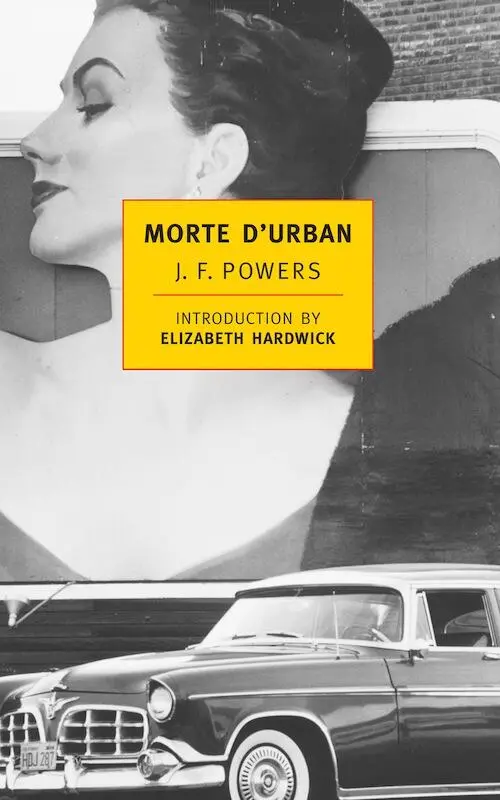
- Название:Morte D'Urban
- Автор:
- Издательство:NYRB Classics
- Жанр:
- Год:2000
- ISBN:нет данных
- Рейтинг книги:5 / 5. Голосов: 1
-
Избранное:Добавить в избранное
- Отзывы:
-
Ваша оценка:
Morte D'Urban: краткое содержание, описание и аннотация
Предлагаем к чтению аннотацию, описание, краткое содержание или предисловие (зависит от того, что написал сам автор книги «Morte D'Urban»). Если вы не нашли необходимую информацию о книге — напишите в комментариях, мы постараемся отыскать её.
The hero of J.F. Powers's comic masterpiece is Father Urban, a man of the cloth who is also a man of the world. Charming, with an expansive vision of the spiritual life and a high tolerance for moral ambiguity, Urban enjoys a national reputation as a speaker on the religious circuit and has big plans for the future. But then the provincial head of his dowdy religious order banishes him to a retreat house in the Minnesota hinterlands. Father Urban soon bounces back, carrying God's word with undaunted enthusiasm through the golf courses, fishing lodges, and backyard barbecues of his new turf. Yet even as he triumphs his tribulations mount, and in the end his greatest success proves a setback from which he cannot recover.
First published in 1962,
has been praised by writers as various as Gore Vidal, William Gass, Mary Gordon, and Philip Roth. This beautifully observed, often hilarious tale of a most unlikely Knight of Faith is among the finest achievements of an author whose singular vision assures him a permanent place in American literature.
Morte D'Urban — читать онлайн бесплатно полную книгу (весь текст) целиком
Ниже представлен текст книги, разбитый по страницам. Система сохранения места последней прочитанной страницы, позволяет с удобством читать онлайн бесплатно книгу «Morte D'Urban», без необходимости каждый раз заново искать на чём Вы остановились. Поставьте закладку, и сможете в любой момент перейти на страницу, на которой закончили чтение.
Интервал:
Закладка:
“Just hold it there,” Wilf said.
Father Urban held the hoe to the frozen ground. He had been chopping away in a lifelike manner because he didn’t want to be accused of posing. Earlier that morning, in the chapel, Wilf had fired away at him all during Mass — except at the elevation. “You were posing then,” Wilf had told him at breakfast. Well, wasn’t he posing now? Wasn’t Wilf—“Now you take your Life magazine”—being inconsistent?
“No,” Wilf said, shaking his head. He wanted the hoe.
Father Urban held the camera and watched Wilf. Why so sad? Loved the good earth, was that it?
“That’s more what I’m after,” Wilf said.
Father Urban took the hoe again. He was cold, miscast, and his tailored cassock was all wrong, too. “Just trying to keep warm,” he muttered, hacking at the ground. Wilf was warm in his devil’s-food coat. Wilf could shoot him now, or not at all.
“Better. Head up. Too much. There. Ah. Hold it. One more. Ah. That does it.”
“Thank God.”
“Know why I kept after you? You were posing. You had to find your own way — and you did.”
A little later that morning, Father Urban reported for work in the brown coveralls Wilf had issued him, and though they were all wearing them, Father Urban felt pretty silly in his. In the Rec Room, Wilf issued him a white cap that advertised a well-known brand of paint (that wasn’t being used on the job, to judge by the cans on the floor).
“Oh, oh,” Wilf said. “I’m afraid you take a medium. I thought sure you’d take a large.”
“Oh well,” said Father Urban, and still he noticed that everybody else’s cap seemed to fit.
“Brother’s wearing a large, Father a small, and I take a medium myself,” Wilf said. “I’d let you have mine, but I’ve been wearing it for some time.” Wilf removed his cap and showed Father Urban how it was inside.
“Yes. Well, I can do without one.”
“You’ll get paint and plaster in your hair. You don’t want that, do you?”
“No, not particularly.”
“We have to get the chipped places, nail holes, and the like,” Wilf said. He glanced over at Jack who was sandpapering the woodwork around a window, creating a certain amount of dust. “And if this old paint should contain arsenic, as I’m told a lot of it does — well, you might lose all your hair.”
“Now wait a minute,” said Father Urban.
“I don’t know that it does . The chances are it doesn’t .”
“If I thought there was any chance, I’d have it analyzed.”
“Don’t think I wouldn’t — if we were going to do more than we’re going to do.”
“We just have to get the chipped places, nail holes, and the like,” said Brother Harold. He was sopping at the wall with a sponge and loosening the paper, layers of it, with a putty knife.
“That’s right,” Wilf said. “But to be on the safe side we wear these caps.”
“What about breathing it?” said Father Urban.
“I’m told there isn’t as much danger as you might think,” Wilf said, “You see, you’re pretty well protected by the hair in your nose — same as coal miners. Of course, over a prolonged period…”
“And the hair in your nose — what about that ?”
“That’s where nature comes in. Most of the hair in your nose grows down . The dust can’t settle and reach the roots. What would happen if you just rolled up the sides?”
Father Urban looked down at the cap in his hand.
Wilf took it, rolled up the sides, and gave it back.
Father Urban tried it on.
“I’m sorry about this, Father,” Wilf said then. “I’ll see if I can get you a medium. I guess your head just looks big.”
Father Urban was given a window, a block of wood, and a piece of sandpaper, and thus began the most difficult period in his life to date. Wilf showed him how to wrap the sandpaper around the block of wood. “Always sand with the grain,” Wilf told him at the start, and a couple of times thereafter. Wilf also told him to use up the sandpaper he had before taking a fresh piece. After an hour of that, Father Urban and Jack were put to removing wallpaper. “Change jobs, and you never get tired,” Wilf said. “Always start at the top with your sponge, and let gravity work for you.” He told Father Urban not to use too much water. “We don’t want to spot up the ceiling downstairs.”
“We’re right over the chapel,” said Brother Harold.
“Oh, you can use more water than that,” Wilf told Jack, and laughed.
That was what got Father Urban down — Wilf’s know-it-all attitude. Every few minutes, he’d say, “How’s it going?” or “Going all right?” or he’d come over where you were working and just nod and cluck. Pretty hard to take. And he seemed to think that the time would pass easier for everybody if he talked. Blah, blah, blah. He addressed himself to Brother Harold, and thus, indirectly, they got the story of his life, which Brother Harold must have heard before and which Father Urban didn’t find interesting. There had been a priest somewhere in Wilf’s family for over a hundred years, but if Wilf’s uncle had died four days sooner, or if Wilf had been ordained four days later, the chain would have been broken. Wilf was the only priest in the family at the moment, but two nephews were on the way. That was about what it came down to, Wilf’s life story, that and the time Wilf had spent a week on retreat with the late Father Flanagan of Boys’ Town, that and attending a funeral at which Al Capone had been among the mourners, that and bringing in a Greyhound bus whose driver had taken ill on one of those hairpin curves in the Ozarks. “I guess I’ve always been something of a ‘take charge’ guy, Brother.”
Yes, there were many times when Father Urban was moved to cry out — to hoot — but he kept remembering a movie he’d seen just after the war. Londoners caught in the blitz — taxi drivers, young lovers, old drunks, old tea drinkers, nurses, surgeons, everybody —went right on with whatever they happened to be doing, and each time there was an explosion, they seemed to have the best of it, to have the last word, by saying nothing. In the same way, Father Urban maintained a secret ascendancy over the life around him — up to a point, for he muttered some to himself.
Most of the time, Wilf talked shop with Brother Harold, and this, of course, enabled him to show off. Sandpaper was production paper, sticks for stirring paint were spatulas, turpentine was turp, the tarpaulin was a tarp, and so on. Oh, Wilf’s command of the language was impressive, but this didn’t necessarily mean that he knew what he was doing. It was Father Urban’s feeling that the Rec Room was going to look like hell.
Jack was reluctant to talk about it. “It may turn out all right in the end,” he’d say if Father Urban raised the subject in the evening, when they were alone in the refectory. “Are they in or out?”
“In,” Father Urban would say if Wilf and Brother Harold were up in the Rec Room — where they went not to work but to commune with the job. They stood, and sat, and squatted, and stood again. They smoked and talked. They doodled with tools — Wilf was very fond of the steel tape measure, fed it in and out by the hour, measuring his shoe, the distance between his toe and his knee, between his nose and the floor. Father Urban, who had looked in on them a couple of times, didn’t understand it. (“What you’re thinking of, Brother, is Rockite. That’s not asbestos board. Oh, sure, they call it that.”)
Father Urban steered clear of the Rec Room after working hours, and so did Jack. Since the lighting in the refectory — two bulbs in a five-bulb chandelier — wasn’t ideal for reading, they played checkers. Conversation was incidental. Jack concentrated on the game. This was probably just as well, because he had a way of running any subject that interested him into the ground.
Читать дальшеИнтервал:
Закладка:
Похожие книги на «Morte D'Urban»
Представляем Вашему вниманию похожие книги на «Morte D'Urban» списком для выбора. Мы отобрали схожую по названию и смыслу литературу в надежде предоставить читателям больше вариантов отыскать новые, интересные, ещё непрочитанные произведения.

Обсуждение, отзывы о книге «Morte D'Urban» и просто собственные мнения читателей. Оставьте ваши комментарии, напишите, что Вы думаете о произведении, его смысле или главных героях. Укажите что конкретно понравилось, а что нет, и почему Вы так считаете.