Rafael Yglesias - Hot Properties
Здесь есть возможность читать онлайн «Rafael Yglesias - Hot Properties» весь текст электронной книги совершенно бесплатно (целиком полную версию без сокращений). В некоторых случаях можно слушать аудио, скачать через торрент в формате fb2 и присутствует краткое содержание. Город: New York, Год выпуска: 2010, ISBN: 2010, Издательство: Open Road Integrated Media LLC, Жанр: Современная проза, Юмористическая проза, на английском языке. Описание произведения, (предисловие) а так же отзывы посетителей доступны на портале библиотеки ЛибКат.
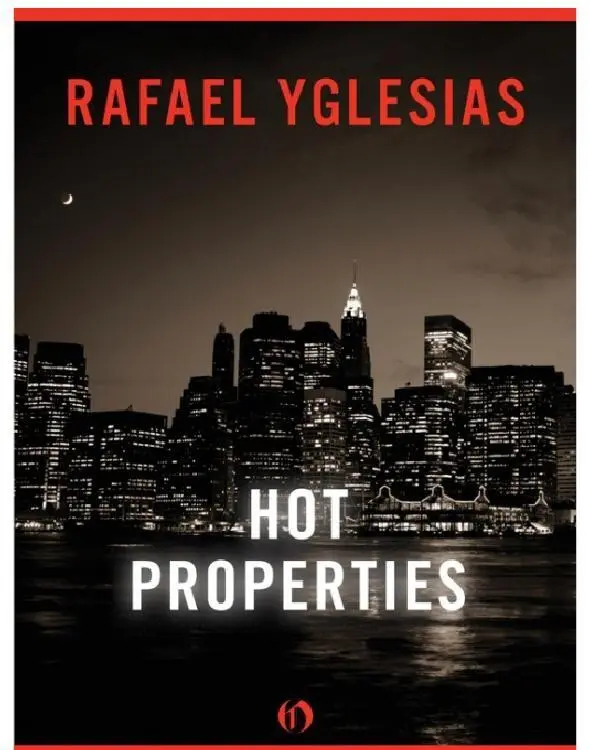
- Название:Hot Properties
- Автор:
- Издательство:Open Road Integrated Media LLC
- Жанр:
- Год:2010
- Город:New York
- ISBN:9781453205082
- Рейтинг книги:3 / 5. Голосов: 1
-
Избранное:Добавить в избранное
- Отзывы:
-
Ваша оценка:
Hot Properties: краткое содержание, описание и аннотация
Предлагаем к чтению аннотацию, описание, краткое содержание или предисловие (зависит от того, что написал сам автор книги «Hot Properties»). Если вы не нашли необходимую информацию о книге — напишите в комментариях, мы постараемся отыскать её.
Rafael Yglesias’s most sharp-tongued satire,
exposes the greed, envy, and backbiting in a media world bloated with money and power.
This ebook features a new illustrated biography of Rafael Yglesias, including rare photos and never-before-seen documents from the author’s personal collection.
Touted by the gossip columns as a roman a clef about the publishing world, Yglesias's fourth novel has definite commercial potential, since there are always people who like to read sordid tales about the media. Focusing on a group of ambitious, opportunistic New York yuppies, each desperate for success, power, fame, money and glamorous sexual partners, Yglesias follows his characters as their aspirations flourish or fade. And even for the one person who comes up with a smashing bestseller, happiness is an elusive emotion, banished by inner fear and self-loathing. The leading players in this fermenting brew are introduced in the book's opening scene, a dinner party so exquisitely awkward that even the reader is embarrassed. Thereafter we watch an aspiring playwright sell out to Hollywood; a sexy blonde discover she can really write, but must use her body to assure publication; a blocked novelist lose his scruples, professional and personal; a journalist at a leading newsmagazine realize that his way to the top has been sabotaged by office intrigue. Yglesias views his characters with cynicism, but he knows how to create the dramatic momentum that will have readers turning the pages. And if his book does become a bestseller, he will have the ironic last laugh.
Copyright 1986 Reed Business Information, Inc.
“
[is] the novel you want in the Hamptons. It lambastes the pretensions of the people you’ve been glaring at on the beach all day, and excoriates the city you’ve left behind.”
— “Sharp, funny, and fresh insight into the American literary world…”
—
From Publishers Weekly
Review
Hot Properties — читать онлайн бесплатно полную книгу (весь текст) целиком
Ниже представлен текст книги, разбитый по страницам. Система сохранения места последней прочитанной страницы, позволяет с удобством читать онлайн бесплатно книгу «Hot Properties», без необходимости каждый раз заново искать на чём Вы остановились. Поставьте закладку, и сможете в любой момент перейти на страницу, на которой закончили чтение.
Интервал:
Закладка:
She hadn’t slept with David for weeks. When she began the affair with Gelb, she had resisted enjoying the sex. Her lack of orgasm had piqued Gelb: he worked extraordinarily hard at the task of breaking her attempt at passive coolness; however, when she stopped fighting him, she was, now to her considerable annoyance, unable to come. Her loins would ache, her hard nipples plead in the air for liberation, but nothing could seem to push her over the plateau of mounting excitement into the blissful free-fall of release.
Finally, after two months of this agony, Gelb accused her of being afraid to give in to the final pleasure of sex because she equated that with love. She laughed at him, told him he was truly from another generation to believe that orgasm depended on emotion. He answered that he didn’t, but she obviously did. She mocked him. But that afternoon, she came, and had ever since. Often Gelb, thrilled at the breakthrough, would continue the lovemaking beyond his penis’ interest, to watch her groan again in his arms, relishing her surrender. Since then, she had been unable to enjoy sex with David, something she had not admitted to Gelb, knowing that he, armed with that information, would claim he had been right — orgasm equals love.
She felt guilt about her lack of desire to make love to David the most keenly of all the specific betrayals her affair involved. That she was fucking this man to insure her career made her hate herself (and certainly the world) but gave her a sense of justification in relation to David. He was so ambitious that she knew, in her spot, he would do the same. But the transfer of her lust to Gelb — an occurrence that she found incredible, despite the ferocious, almost voracious energy he applied to making love, because he was neither handsome nor sexy— was something to abhor and regret. Why was she such a nitwit? Why did she have to convince herself that her screwing Gelb was anything other than ambition? Part of her was attempting to conceal the opportunism behind sentiment. She knew her orgasms were lies. They had to be. Gelb was a contemptible, unscrupulous man — no amount of clitoral stimulation should convince her to feel passion for him.
David finished his monologue on the day, asked her perfunctory questions about her lunch with Betty, showing no interest at the appearance of Gelb. When she complained about his showing up (to be consistent with what she thought he knew of her relationship to him, namely that he had fired her), she discovered, to her disgust, that David had forgotten the story of her dismissal from Goodson Books.
“It was two years ago.” he said when she remarked on it. Shortly afterward he buried himself with business magazines in front of the television, responding only with grunts to her comments on the shows.
Betty phoned late. “I love it,” she said without a hello. “I love it.”
“Really?” Patty asked, pleased, and then wondered why she cared. Since the contract, Betty hadn’t made any criticisms of her pages, which she submitted chapter by chapter.
“You know what I’ve been thinking?” Betty said, her tone full of serious calculation. “I’m going to give it to Gelb right away. I think there’s some cutting we might do, but I don’t want to wait. He made that offer to read it at lunch— he probably wasn’t too serious, so I want to take him up on it before he has a chance to back out.”
“Cutting?” Patty asked, ignoring the rest. It was simply too absurd. Betty thinking herself brilliant, believing Gelb was simply being polite, missing the whole drama like a silly minor character in a farce.
Betty laughed. “God, you writers are all the same. Can’t touch a precious word.”
“I didn’t say that,” Patty snapped. “I merely wanted to know what we were cutting.”
“Nothing. Just little things. We’ll meet later in the week.” She lowered her voice. “I can’t really talk long. Tony’s in a mood. Just wanted you to know I love it.”
Patty hung up and looked at David, his nose in Forbes. “I’m going to bed,” she said, thinking that if he wanted to
make love, he’d go too.
“Okay,” he mumbled.
I said it too coldly. She softened her tone and smiled. “Sure you don’t want to come too?”
He looked up, his glasses off for reading, and squinted at her. “What?”
“Sure you don’t want to come to bed?” she asked with a broad wink.
“Oh,” he said, as though she had proposed having dinner with her parents. “I’m too …” He paused.
Dull, she decided for him. “Okay,” she interrupted breezily, and walked away, thinking: He doesn’t deserve me.
By nightfall, Fred was excited. His goddamn book was gonna be published. Tom Lear had invited him to a screening, and when Fred announced Holder’s praising reception, which Tom took to be an event that had been in suspense, since no one knew, not even Marion, that Fred had been writing the book virtually in collaboration with Holder, Fred could see in Lear’s response how much fun might lie ahead for him.
“Oh, you know who’s going to be at the screening? A lot of New York Times people. I bet Harry Reynolds will be there. Don’t let me forget to introduce you.”
Reynolds, being one of the Times’s daily book critics, would be a great prize if Fred could impress him enough to get a review. Lear pointed him out when they sat down. He was at the other end of the room. Since the screening was about to begin, Lear whispered, “We’ll get him on the way out.”
His faith in Tom had been borne out, He had stuck by Fred even after reading the original one hundred pages— which Fred now believed had been so bad that the thought of Tom reading them sometimes startled him awake when falling asleep, as though it was a war veteran’s memory of a terrible scrape with death.
While the film credits rolled at the end of the movie (traditionally at screenings everyone remained seated until the last name of the third assistant gaffer rolled by), Fred repeatedly rubbed his right palm against his pants, trying to dry it in anticipation of shaking hands with Reynolds. He closed his eyes to try to relax: he saw an image of Harold Reynolds printed in New York Times type loom and obliterate everything. He sat up and whispered to Lear, “Let’s go, I’m starving.”
“No, I want to introduce you to Reynolds.”
“It won’t do me any good,” Fred said.
“Sure it will,” Tom said, giving him a big wink. “Name recognition. Very important.”
The lights came up moments later. Lear dawdled on their aisle, allowing others to pass them, and surged forward when Harold Reynolds’ row conjoined with the flow out. “Harold!” Lear said as though he had just spotted him.
To Fred’s horror, Reynolds looked balefully at Tom and said in a low voice, “Hi,” in the way one might address a doorman, someone to whom a hello is necessary but certainly not fervently desired.
Lear stepped next to the book critic, walking out shoulder to shoulder. Fred hustled to get himself behind, momentarily relieved by his being out of sight. “I loved your review of Heller’s book. Hilarious.”
This seemed to warm Reynolds. “Piece of junk,” he mumbled.
“Gutsy of you to say so.”
“I don’t care if they fire me. Been here too long anyway.” All this in a whisper so that even Fred, who was standing directly behind them, had to strain to hear.
“Well, it needed to be said,” Lear answered in a solemn tone. They arrived at the elevator bank and Fred found himself facing them. “Oh,” Tom said, looking at Fred as though just discovering him. “Do you know my friend Fred Tatter? This is Harold Reynolds.”
Fred stuck his hand out.
“Hello,” Reynolds said with a nod, his eyes barely lighting on Fred and missing the fact that his hand was out. Fred quickly withdrew it and didn’t hear the conversation continue as he tried to calculate whether or not Harold Reynolds had done it intentionally, cleverly disguising the insult as distraction.
Читать дальшеИнтервал:
Закладка:
Похожие книги на «Hot Properties»
Представляем Вашему вниманию похожие книги на «Hot Properties» списком для выбора. Мы отобрали схожую по названию и смыслу литературу в надежде предоставить читателям больше вариантов отыскать новые, интересные, ещё непрочитанные произведения.








Обсуждение, отзывы о книге «Hot Properties» и просто собственные мнения читателей. Оставьте ваши комментарии, напишите, что Вы думаете о произведении, его смысле или главных героях. Укажите что конкретно понравилось, а что нет, и почему Вы так считаете.