Rafael Yglesias - Hot Properties
Здесь есть возможность читать онлайн «Rafael Yglesias - Hot Properties» весь текст электронной книги совершенно бесплатно (целиком полную версию без сокращений). В некоторых случаях можно слушать аудио, скачать через торрент в формате fb2 и присутствует краткое содержание. Город: New York, Год выпуска: 2010, ISBN: 2010, Издательство: Open Road Integrated Media LLC, Жанр: Современная проза, Юмористическая проза, на английском языке. Описание произведения, (предисловие) а так же отзывы посетителей доступны на портале библиотеки ЛибКат.
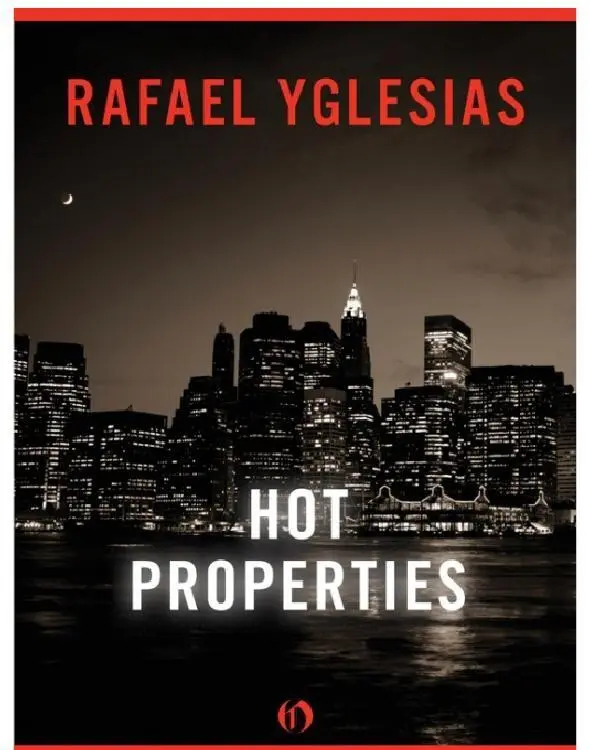
- Название:Hot Properties
- Автор:
- Издательство:Open Road Integrated Media LLC
- Жанр:
- Год:2010
- Город:New York
- ISBN:9781453205082
- Рейтинг книги:3 / 5. Голосов: 1
-
Избранное:Добавить в избранное
- Отзывы:
-
Ваша оценка:
Hot Properties: краткое содержание, описание и аннотация
Предлагаем к чтению аннотацию, описание, краткое содержание или предисловие (зависит от того, что написал сам автор книги «Hot Properties»). Если вы не нашли необходимую информацию о книге — напишите в комментариях, мы постараемся отыскать её.
Rafael Yglesias’s most sharp-tongued satire,
exposes the greed, envy, and backbiting in a media world bloated with money and power.
This ebook features a new illustrated biography of Rafael Yglesias, including rare photos and never-before-seen documents from the author’s personal collection.
Touted by the gossip columns as a roman a clef about the publishing world, Yglesias's fourth novel has definite commercial potential, since there are always people who like to read sordid tales about the media. Focusing on a group of ambitious, opportunistic New York yuppies, each desperate for success, power, fame, money and glamorous sexual partners, Yglesias follows his characters as their aspirations flourish or fade. And even for the one person who comes up with a smashing bestseller, happiness is an elusive emotion, banished by inner fear and self-loathing. The leading players in this fermenting brew are introduced in the book's opening scene, a dinner party so exquisitely awkward that even the reader is embarrassed. Thereafter we watch an aspiring playwright sell out to Hollywood; a sexy blonde discover she can really write, but must use her body to assure publication; a blocked novelist lose his scruples, professional and personal; a journalist at a leading newsmagazine realize that his way to the top has been sabotaged by office intrigue. Yglesias views his characters with cynicism, but he knows how to create the dramatic momentum that will have readers turning the pages. And if his book does become a bestseller, he will have the ironic last laugh.
Copyright 1986 Reed Business Information, Inc.
“
[is] the novel you want in the Hamptons. It lambastes the pretensions of the people you’ve been glaring at on the beach all day, and excoriates the city you’ve left behind.”
— “Sharp, funny, and fresh insight into the American literary world…”
—
From Publishers Weekly
Review
Hot Properties — читать онлайн бесплатно полную книгу (весь текст) целиком
Ниже представлен текст книги, разбитый по страницам. Система сохранения места последней прочитанной страницы, позволяет с удобством читать онлайн бесплатно книгу «Hot Properties», без необходимости каждый раз заново искать на чём Вы остановились. Поставьте закладку, и сможете в любой момент перейти на страницу, на которой закончили чтение.
Интервал:
Закладка:
“Right, right.”
Turned frowned. “I’m not sure your point there was clear to the audience. It’s a funny scene. Maybe it’s too funny, makes everybody think it’s only there for the laughs, and they don’t realize it carries the real point of the play.”
There were murmurs of agreement from the others. Tony had almost forgotten they were there. He suppressed a surge of anger at them, convinced they were too dumb to have noticed such a subtlety whether he was right or wrong to have put it in the play. They were merely parroting the influential playwright’s opinion. “You all feel that?” Tony asked, to be polite.
“Yes,” said Polly Howells, the resident feminist whom Tony had been told despised his work. Someone quoted her as saying, “He’s just another one of those Yuppie playwrights who writes plays complaining his parents didn’t encourage him enough,” a remark that hurt all the more for its potential accuracy. “Yes, I missed that,” Polly said, obviously glad to have something to say. She always seemed so eager to give opinions. Tony had been surprised by how long she had stayed silent. “I like the play a lot, Tony. I really think its a big step forward for you …”
Tony smiled at her, narrowing his eyes. He hoped she’d realize he was close to murdering her and stop talking in such a condescending fashion.
On the contrary, she warmed to her words. “But I felt, in the end, that you kept going for the easy one-liners just when you were about to break through to the heart of the theme.”
“That’s putting it strongly,” Turner said in a hurt tone, as though she were attacking him. “And, you know, it ain’t so easy to write funny one-liners like Tony’s. I can’t do it. I’ve tried. And I think I’d be a better writer if I could. Tony keeps a good balance in this play between heavy drama and social satire. It ends up being very real precisely because he touched both extremes.”
“Yes, yes, yes,” Polly said quickly. Tony smiled at her panicky withdrawal. She sucked up to Hal Turner constantly, always praised his work to excess, and it amused Tony to see how she didn’t even dare to question his opinions. “I think he has a wonderful play here. But, like you, I felt Tony buried some of his more serious questions — what is real political commitment? can we ever escape our parents’ expectations, no matter how far from home we go? — that he lost some of these in trying to be funny. Maybe you were a little scared to explore the pain involved here,” she added directly to Tony.
He had to admit she might be right in her dull sociological way. He knew this subject was a way for him to explore the challenge of his mother’s and father’s political past. Perhaps he made comedy out of the family scenes not because it was accurate or a good choice dramatically, but because he couldn’t look at the ugly face of his family without turning to stone.
He nodded after a pause, and that seemed to open the floodgates. Suddenly everyone, including those who had previously spoken only with praise of the play, found the same weakness, and hammered away with growing enthusiasm, like kids imitating each other.
Hilary cut it off at last. “All right, I think we’ve made our point to Tony.” There was self-conscious laughter. “I think we’re agreed we’ve got a good play here that needs some work at developing its theme.”
Tony got up wearily, and merely nodded yes to Hilary when she said he should call tomorrow to discuss the next step. He knew that the muck and the mire had risen once again — rewrite, discussion, compromise. He would have to struggle again: to get the play right, to get Hilary to put it on. He was tired of spinning his wheels in the snow, making what was once white, pure, and beautiful into brown sludge. Get me out, he asked New York’s night sky while walking home, after refusing Hal Turner’s invitation to have a drink. Get me out of this muddy ditch.
Because Patty wanted Gelb’s support for her novel to seem objective, she had insisted on absolute discretion. She demanded that he not gossip, that their meetings take place at an anonymous location, such as a hotel, rather than at the apartment of a friend who would have to be let in on the secret.
Thus she was infuriated when, on the day she went up to Garlands to deliver to Betty the final chapter of her novel, Gelb “happened” to drop by, feigning (badly, Patty thought) surprise at her presence.
“What are you here for?” he boomed.
“Her novel’s finished!” Betty announced with a wide smile, as though it were the accomplishment of a precocious child. “She’s a big girl and goes in the potty now,” was her tone. Patty loathed them both. She felt rage at being at their mercies, an anger redoubled by the fact that she had to pretend intimacy with them. Her child was in their care: its health in the hands of a lech and a coward. Why the hell doesn’t Betty have the sense to screw him, Patty thought, and really make sure of a big print run?
“When can I read it?” Gelb asked.
This is hopeless, Patty thought, noticing the look of astonishment on Betty’s face. Betty still thought of Gelb’s arrival at Garlands as a disaster, assuming that Gelb bore ill will toward Patty — a notion Patty encouraged — and now the big bozo was blowing it. “I’ll give it to you right away,” Betty said.
“I have to go,” Patty said.
“We’re having lunch!” Betty said.
“Oh, that’s right,” Patty admitted.
“You are? I don’t have a lunch. I’ll join you,” Gelb said. Patty was so disgusted, she almost stuck her tongue out at him. He wants everybody to know, she decided. Pride of ownership.
Betty looked seasick. “Great,” she said.
The three of them stood there for a moment. Betty opened her drawer, coming out with the bathroom key. “But Patty and I had better freshen up first.”
“Okay,” Gelb said.
“I’m fresh enough,” Patty said, not wanting to have to answer Betty’s questions yet.
So now Betty was stuck, the ladies’ room key in hand. “I’ll be right back,” she said, and walked out, turning her head away from Gelb and signaling violently with her eyes at Patty. Betty’s attitude toward Gelb was what Patty’s once was — a schoolgirl’s toward the principal — but having seen his lumpy buttocks while he stood at the bathroom sink angling his head to see if he had trimmed all his nostril hairs had altered Patty’s perspective.
Gelb moved at her the instant Betty was gone, his hands out. “How dare you!” Patty said, outraged, as he took possession, his hands reaching for her ass, his lips kissing her neck. “You’re making it so fucking obvious! You might as well come in with my panties in your teeth!”
He laughed into her hair and then murmured, “You’re so beautiful — I got a hard-on in the cab just thinking of you.”
“Fabulous,” Patty said, and pushed at his chest. “Anyone can see! Will you stop!”
He moved away. “Who cares if they find out?”
“I do! Everyone will think it’s the only reason I’m being published.”
“Nonsense,” he answered with a devilish smile. “Everybody knows I’m not that nice.” And then he laughed, delighted.
“Hilarious. I can’t trust you. The affair’s over.”
“Bullshit,” he said confidently, but his eyes were worried. “Your orgasms are too good. Last time you almost shattered the chandelier.”
“Don’t flatter yourself. If a dog licked my clit that long I’d come.”
Betty breezed in, her face set in a wide smile. Patty and Gelb both looked at the floor like guilty children. “All set?” Betty said with an even brighter smile.
On his way to see Holder for his weekly meeting, Fred passed Patty, Betty, and Gelb in the hail. His routine for the last six months had been to submit rewritten pages each Friday and meet with Holder on Monday and be given changes. This was to be the last of their conferences, since Fred was handing in the final ten pages.
Читать дальшеИнтервал:
Закладка:
Похожие книги на «Hot Properties»
Представляем Вашему вниманию похожие книги на «Hot Properties» списком для выбора. Мы отобрали схожую по названию и смыслу литературу в надежде предоставить читателям больше вариантов отыскать новые, интересные, ещё непрочитанные произведения.








Обсуждение, отзывы о книге «Hot Properties» и просто собственные мнения читателей. Оставьте ваши комментарии, напишите, что Вы думаете о произведении, его смысле или главных героях. Укажите что конкретно понравилось, а что нет, и почему Вы так считаете.