Rafael Yglesias - Hot Properties
Здесь есть возможность читать онлайн «Rafael Yglesias - Hot Properties» весь текст электронной книги совершенно бесплатно (целиком полную версию без сокращений). В некоторых случаях можно слушать аудио, скачать через торрент в формате fb2 и присутствует краткое содержание. Город: New York, Год выпуска: 2010, ISBN: 2010, Издательство: Open Road Integrated Media LLC, Жанр: Современная проза, Юмористическая проза, на английском языке. Описание произведения, (предисловие) а так же отзывы посетителей доступны на портале библиотеки ЛибКат.
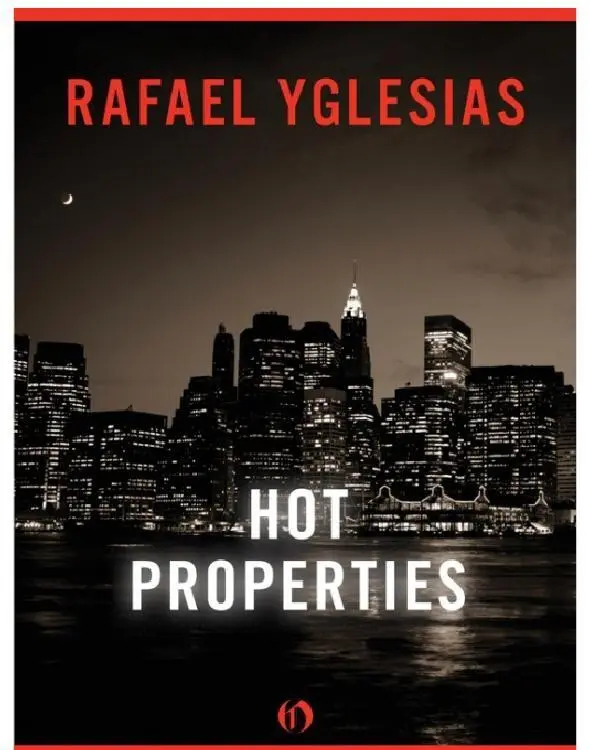
- Название:Hot Properties
- Автор:
- Издательство:Open Road Integrated Media LLC
- Жанр:
- Год:2010
- Город:New York
- ISBN:9781453205082
- Рейтинг книги:3 / 5. Голосов: 1
-
Избранное:Добавить в избранное
- Отзывы:
-
Ваша оценка:
Hot Properties: краткое содержание, описание и аннотация
Предлагаем к чтению аннотацию, описание, краткое содержание или предисловие (зависит от того, что написал сам автор книги «Hot Properties»). Если вы не нашли необходимую информацию о книге — напишите в комментариях, мы постараемся отыскать её.
Rafael Yglesias’s most sharp-tongued satire,
exposes the greed, envy, and backbiting in a media world bloated with money and power.
This ebook features a new illustrated biography of Rafael Yglesias, including rare photos and never-before-seen documents from the author’s personal collection.
Touted by the gossip columns as a roman a clef about the publishing world, Yglesias's fourth novel has definite commercial potential, since there are always people who like to read sordid tales about the media. Focusing on a group of ambitious, opportunistic New York yuppies, each desperate for success, power, fame, money and glamorous sexual partners, Yglesias follows his characters as their aspirations flourish or fade. And even for the one person who comes up with a smashing bestseller, happiness is an elusive emotion, banished by inner fear and self-loathing. The leading players in this fermenting brew are introduced in the book's opening scene, a dinner party so exquisitely awkward that even the reader is embarrassed. Thereafter we watch an aspiring playwright sell out to Hollywood; a sexy blonde discover she can really write, but must use her body to assure publication; a blocked novelist lose his scruples, professional and personal; a journalist at a leading newsmagazine realize that his way to the top has been sabotaged by office intrigue. Yglesias views his characters with cynicism, but he knows how to create the dramatic momentum that will have readers turning the pages. And if his book does become a bestseller, he will have the ironic last laugh.
Copyright 1986 Reed Business Information, Inc.
“
[is] the novel you want in the Hamptons. It lambastes the pretensions of the people you’ve been glaring at on the beach all day, and excoriates the city you’ve left behind.”
— “Sharp, funny, and fresh insight into the American literary world…”
—
From Publishers Weekly
Review
Hot Properties — читать онлайн бесплатно полную книгу (весь текст) целиком
Ниже представлен текст книги, разбитый по страницам. Система сохранения места последней прочитанной страницы, позволяет с удобством читать онлайн бесплатно книгу «Hot Properties», без необходимости каждый раз заново искать на чём Вы остановились. Поставьте закладку, и сможете в любой момент перейти на страницу, на которой закончили чтение.
Интервал:
Закладка:
“Charlie Huddleston on two,” she said.
“Okay,” he said, and got on again. He noticed with interest that Huddleston’s tone with him had the same casualness and ease, maintaining a respectful friendliness with no effort. “Hi! I’m hearing wild rumors. Should I be preparing a transfer-of-power story?”
“Gee, Charlie, I don’t know. Hey, you know there was something I wanted to ask you. Get confirmation.”
“What’s that?” Huddleston said.
“I heard from somebody that I’ve got a nickname at the magazine.”
“Oh,” Charlie said, nervousness creeping in.
Let’s make him wonder, David thought. “Yeah. Have you heard it? Little Chico.”
“No kidding,” Charlie said, now definitely shaky and confused. “I haven’t heard that.”
“Oh, good. It’s kind of insulting.”
“Yeah, it is. Oh, there’s my other phone. I’d better—”
“Sure.” David said with a smile. “Bye.” He hung up, feeling good. Feeling lucky. In control.
Tony stretched forward in his chair to relieve the dull ache in his back. The last lines were being said. He noticed with pleasure that they had the right tone of finality. The audience at this reading of his new play — the other members of the Uptown Theater and. especially important, its artistic director. Hilary Bright — were rapt, their expressions concentrated. There had been a lot of laughs, not quite as many as he had hoped, a few sounded automatic, polite, but the “heavy” scenes had played even better than he had expected. The success of this reading was important: Hilary Bright had arranged it to help her determine whether his play was ready for the Uptown Theater to do a production of it this fall.
Now came the applause. There would have been clapping no matter what they thought of the play — after all, everyone there had to suffer the same sort of evaluation at one time or another, and between compassion and fear there was never an insulting response at a reading. But this applause was loud, enthusiastic, and genuine. Tony had heard enough of the other kind to know the difference.
Hilary, while clapping, got up and moved in front of the actors seated on chairs, and turned to face the audience. “Well, that was delightful,” she said, smiling.
Delightful? Tony thought. It’s supposed to be either shattering or funny, but delightful? Sounds like a description of a magic act, not a good play.
“Tony,” she said, looking at him. “How can we be of help to you?”
She always asked this preposterous question, this fastball begging to be banged out of the park with a bat of sarcasm. And, predictably, Tony took his cut: “Got an empty theater?”
Laughter. Hilary smiled. “Not if we get plays like this,” she said, but hurried on, as though frightened by the commitment it implied. “Is there anything that surprised you about the play — hearing it read?”
“I thought it would be funnier,” Tony said. “But I don’t really want to talk about what I think. I’m sick to death of what I think. First I’d like to hear from the actors — who did a wonderful job,” he added, and began to clap, joined immediately by the audience.
When the applause died down, Hilary gestured to the row of performers seated on folding chairs, their copies of the play on their laps like prayer books. During the last six months, since he had dropped the screenplay, he had worked madly, joyously reworking his old play about the three civil-rights workers who were killed by the Klan, feeling younger, stronger, and happier with each day. Nearing the end, his confidence in the future had returned in earnest. He really believed this time it would happen, this time he would win the honors so long expected for him, so long taken for granted, and now so desperately needed for survival. He had broken free of the small autobiographical limitations of his early plays, he had forced his head through the birth canal and observed a world other than his own.
The actors began. Tony liked listening to their opinions and he sometimes changed things because of them, but never because of the content of their criticisms. Performers always believed their parts should be bigger, their motivations less selfish and explicated in greater detail. They were forever forgetting that their job was to tour the audience through a walk in the woods, not stop and discuss the bark of one tree endlessly. This time they were unusually content: they praised “the structure” (something they knew nothing about) and then talked about how much they “liked” their characters (the highest possible encomium). Then the audience of playwrights and directors began to comment. The toughest remarks at these readings were commonly from other writers, and that held true again, although the major criticism wasn’t posed aggressively.
“I didn’t think. Tony …” said Hal Turner, the most successful of the Uptown Theater playwrights, a likely candidate for that year’s Pulitzer Prize for his off-Broadway success. The Evening, a grim two-character play about a confrontation between a rapist and the husband of his victim. “I didn’t think,” he repeated, his eyes wandering to the ceiling musingly. Everyone fell silent, respectfully. “Though I loved many, many things, I didn’t feel, at the end, that you had really taken it far enough. I don’t think the ending is sufficiently dramatic.”
“You mean because the killing is offstage?” Tony said, his worst fear confirmed. He too had felt the ending was anticlimactic, but so far no one else had said anything.
“Uh … I’m not sure. I think your instinct to stay away from the killing is right. It wouldn’t really end the play, it would just kill the characters.”
“That’s an ending!” someone called out. Everyone laughed.
“You’ve raised terrific questions about these characters,” Turner went on. “You need to answer some of them.”
“Oh, but he does!” Hilary protested. “When—”
“He does answer some of them!” Turner quickly modified. “But I mean decisively, dramatically. I certainly wouldn’t want a talky finish, with everyone wrapping up their lives as though they know they’re about to die. I love the effect of the casualness just before they go off to be killed, the sense, the eerie sense, of them naturally assuming they will be back later and do this and that — it’s a powerful effect. But it leaves some of the play’s questions unanswered. Not unasked. But unanswered.”
“I don’t know that I can answer them,” Tony admitted. He glanced at Hilary and briefly worried that a frank discussion on his part might scare her off doing the play that fall— she seemed ready to commit. But when he returned his glance to Turner, a bright man whose talent he admired, an experienced playwright who was obviously sympathetic to Tony’s work, he wanted to continue. “I’ve asked myself over and over. Were these characters sincere? Were they risking their lives — sometimes I’m not even sure they really believed the threats — were they risking their lives out of pure altruism, or was it some kind of neurotic calling of their parents’ political bluff?”
“What do you mean by that?” Turned asked with the enthusiasm of a lonely soul discovering a kindred spirit. The others stayed quiet, fading into the background, as though they were medical students observing two surgeons conduct a dangerous and experimental operation.
“I guess this may come from my past,” Tony said, “but when one is raised by people who put a high value on dangerous political action, there’s a tendency to do what they want, carry it so far that it almost becomes a kind of rebellion …”
Turner smiled. “Yes, that’s what you mean by the funny scene with Stein’s mother.”
Читать дальшеИнтервал:
Закладка:
Похожие книги на «Hot Properties»
Представляем Вашему вниманию похожие книги на «Hot Properties» списком для выбора. Мы отобрали схожую по названию и смыслу литературу в надежде предоставить читателям больше вариантов отыскать новые, интересные, ещё непрочитанные произведения.






Обсуждение, отзывы о книге «Hot Properties» и просто собственные мнения читателей. Оставьте ваши комментарии, напишите, что Вы думаете о произведении, его смысле или главных героях. Укажите что конкретно понравилось, а что нет, и почему Вы так считаете.