Rafael Yglesias - Hot Properties
Здесь есть возможность читать онлайн «Rafael Yglesias - Hot Properties» весь текст электронной книги совершенно бесплатно (целиком полную версию без сокращений). В некоторых случаях можно слушать аудио, скачать через торрент в формате fb2 и присутствует краткое содержание. Город: New York, Год выпуска: 2010, ISBN: 2010, Издательство: Open Road Integrated Media LLC, Жанр: Современная проза, Юмористическая проза, на английском языке. Описание произведения, (предисловие) а так же отзывы посетителей доступны на портале библиотеки ЛибКат.
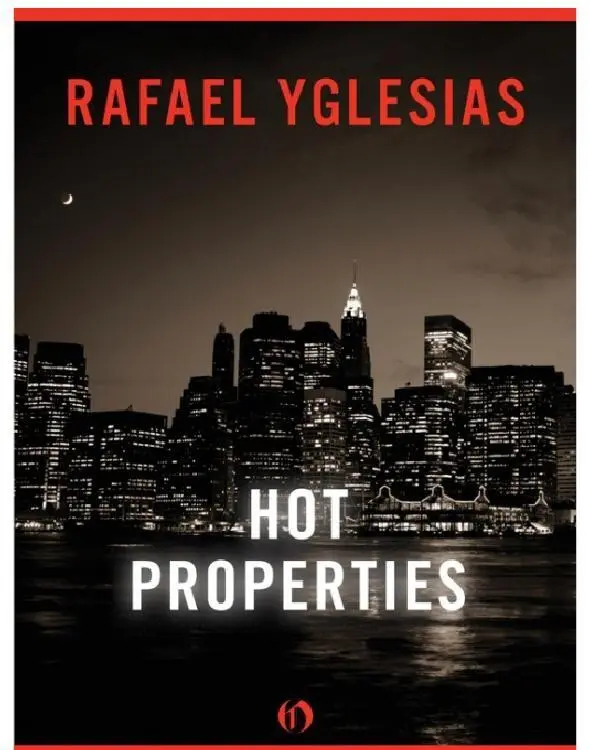
- Название:Hot Properties
- Автор:
- Издательство:Open Road Integrated Media LLC
- Жанр:
- Год:2010
- Город:New York
- ISBN:9781453205082
- Рейтинг книги:3 / 5. Голосов: 1
-
Избранное:Добавить в избранное
- Отзывы:
-
Ваша оценка:
Hot Properties: краткое содержание, описание и аннотация
Предлагаем к чтению аннотацию, описание, краткое содержание или предисловие (зависит от того, что написал сам автор книги «Hot Properties»). Если вы не нашли необходимую информацию о книге — напишите в комментариях, мы постараемся отыскать её.
Rafael Yglesias’s most sharp-tongued satire,
exposes the greed, envy, and backbiting in a media world bloated with money and power.
This ebook features a new illustrated biography of Rafael Yglesias, including rare photos and never-before-seen documents from the author’s personal collection.
Touted by the gossip columns as a roman a clef about the publishing world, Yglesias's fourth novel has definite commercial potential, since there are always people who like to read sordid tales about the media. Focusing on a group of ambitious, opportunistic New York yuppies, each desperate for success, power, fame, money and glamorous sexual partners, Yglesias follows his characters as their aspirations flourish or fade. And even for the one person who comes up with a smashing bestseller, happiness is an elusive emotion, banished by inner fear and self-loathing. The leading players in this fermenting brew are introduced in the book's opening scene, a dinner party so exquisitely awkward that even the reader is embarrassed. Thereafter we watch an aspiring playwright sell out to Hollywood; a sexy blonde discover she can really write, but must use her body to assure publication; a blocked novelist lose his scruples, professional and personal; a journalist at a leading newsmagazine realize that his way to the top has been sabotaged by office intrigue. Yglesias views his characters with cynicism, but he knows how to create the dramatic momentum that will have readers turning the pages. And if his book does become a bestseller, he will have the ironic last laugh.
Copyright 1986 Reed Business Information, Inc.
“
[is] the novel you want in the Hamptons. It lambastes the pretensions of the people you’ve been glaring at on the beach all day, and excoriates the city you’ve left behind.”
— “Sharp, funny, and fresh insight into the American literary world…”
—
From Publishers Weekly
Review
Hot Properties — читать онлайн бесплатно полную книгу (весь текст) целиком
Ниже представлен текст книги, разбитый по страницам. Система сохранения места последней прочитанной страницы, позволяет с удобством читать онлайн бесплатно книгу «Hot Properties», без необходимости каждый раз заново искать на чём Вы остановились. Поставьте закладку, и сможете в любой момент перейти на страницу, на которой закончили чтение.
Интервал:
Закладка:
“Yes,” he hissed like a creature from the dark, from the muddy swirling slime of the underworld.
“See you then.”
His hand trembled while putting the phone back, an addict suffering withdrawal. It was nine-thirty in the morning. He had only an hour to decide if he was going through with it. He had told himself he would make an appointment, because, after all, he didn’t have to keep it. There would be no penalty — except, of course, that if he changed his mind later and wanted to see her she might remember his voice and refuse to give him another chance. He was convinced she already recognized him from their two conversations, both of which ended with her hanging up on him. Each time he had tried to get an assurance that the experience would be pleasurable, that he could control what she would or wouldn’t do. Despite all his cynicism about the world, no matter how often he told himself that she must be a whore who would do what the customer wanted, he couldn’t rid himself of wild and terrible fantasies. That she might be mad and actually beat him mercilessly, perhaps cut off his penis, maybe kill him. How did he know? There would be no Better Business Bureau, no other employees to stop her, nothing, no restraint. It was an illegal act — and at that, an unusual one. Not a visit to a traditional whorehouse with bouncers, a madam, a clientele. This would be in some room, isolated, no one knowing where he had gone. Who would hear his last cry, his final whimper of agony?
He could disappear completely. One of those mysteries that haunt American cities. Perhaps, like a character in a Twilight Zone episode, he had found the answer to all the missing persons in the world, only to reject the answer as paranoia and then at the fadeout become one himself. A victim of some diabolical group picking off those who are vulnerable to perversion.
He got such a clear image of being chopped to bits by gruff hooded men, his money stuffed away, his clothes and identification burned. How could he be traced? Naturally they would assume he’d make every effort to get there unobserved and alone, with no record of the appointment or location left behind.
But, ultimately, it couldn’t be. She had ads on television, for God’s sake. If her clients were all being murdered, someone would put it together. Anyway, this was big money. Someone, probably the Mafia, was making a ton off the pathetic obsessions of people like himself. Why kill the golden goose? No, the truth, like always, was probably much duller than he imagined. Just a service, provided gruffly and sloppily, like all the other services to the middle class in New York.
But that was what the character in the Twilight Zone episode would tell himself, and then walk in confidently, a lamb to the slaughter.
He looked at the clock. Nine-forty. He’d have to leave in fifty minutes to be sure that he’d be at the phone booth on time. Why a phone booth? Why didn’t she give him the address right away? Probably some screening procedure. But if you were going to murder people and wanted to reduce the chance they’d write down the address somewhere, somewhere that the police … He’d have to cut this out. It was stupid. Paralyzing. An excuse to avoid what he knew, sooner or later, he would inevitably do: go and find out if these fantasies were something he wanted to be real.
He stood up. His feet almost gave out from weakness. “I can’t do it,” he said to the empty loft, a bent figure alongside the straight ridged columns, aloof with dignity. “I can’t do it,” he pleaded.
Fred walked into his apartment, his old apartment, the one he had lived in with Marion for years, but hadn’t seen for over seven months. “This is weird,” he said to her.
She laughed. Her mood was light, girlish. She seemed tipsy to him, not because they had had champagne at dinner, but generally in a state of amusement, giggles bubbling throughout her, sparkling in her eyes, lifting her shoulders, opening her heart. He kept having flashes of worry that this was some sort of practical joke. In the couples therapy everything that she said had been bitter — complaints about him, his treatment of her, and then of the world in general. More than ever Fred had realized that her gloomy existence with him, the frowns, the rushing off to bed to read alone, the sudden fits of irritation about trivialities, had all been little eruptions of a buried, boiling volcano of disgust, hatred, and resentment.
Months ago he had given up on the marriage. And even begun dating, not simply to get laid, but with a view toward the future. But the therapy had made it hard for him to see new women, he thought. Hearing the endless list of Marion’s fault-finding left with him a dim view of his own attractions. He almost felt at times that he should warn women that he was, apparently, a colossal bore to live with. Finding himself convinced that Marion’s criticisms were valid, he became enraged. Within the last few sessions he had lashed back, fighting for himself, advocating his good qualities with a passion and conviction he never guessed were in him. Then the doctor said they should see him individually and see each other socially if they wanted.
They had had two dates, quick things, going to a movie, out to dinner, chatting about their lives superficially — the therapy was always about the past, about ugly feelings, and so they had a lot to catch up on. Tonight had been the same at first, but then she began to flirt with him, getting high on the champagne (she had suggested they order it), and now, asking him back to the apartment. For Marion such behavior was wild, wanton. He liked her for this girlish happiness, remembered dimly that in college she was like that, but still he wasn’t comfortable with it either. She simply wasn’t the woman he had lived with for eight years, and that made him wary.
She settled on the couch, kicking her shoes off and putting her feet beneath her, her oval face dreamy. “Your book was accepted.”
“Yeah.” He didn’t know how to comport himself, Should he sit on the couch and begin necking (this sense that he was in a virgin sexual circumstance with Marion was really weird, silly, and embarrassing), or sit in one of the armchairs, more formal, like a meeting of superpowers?
“How come you didn’t tell me?”
He grunted. “Come on, you said over and over in the therapy that all I did was talk about my work constantly. As long as I live, I’m never telling you another thing about what I do.” He sat down in an armchair.
She pouted. She made a big show of it, but it was real. “Oh, that’s terrible. You don’t mean that.”
Fred looked down. She was trying hard. He wasn’t. He felt ashamed of himself. “No. I’m sorry. They accepted it about a month ago. Who told you?”
“I heard from somebody who knows Bob Holder that he’s wild about it. Getting everybody in the house to read it, talking to book-club people—”
“Really?” Fred said, looking up, surprised. He had assumed for so long that Holder’s talk was merely bluster that this came as a pleasant surprise.
“Yeah. Sounds like it’s gonna be a big book.”
“No,” Fred answered. “He hypes everything. You told me that yourself.”
“Did I?” she said, looking at the ceiling in wonderment.
“Oh yeah. Told me I was a fool to believe him.”
“Can’t believe I said that.”
“You did—”
“No, no,” she said, laughing at him. “I mean, what a bitch I was. I believe you. Just what an incredibly bitchy thing to say. Holder hypes books, but when he does, they sell.”
Fred smiled at her. She was great — he loved her like this. “I want to go to bed with you,” he said.
“Great,” she answered. And smiled, sitting there like a cheerful doll eager to be played with but helpless to initiate anything. “I thought maybe you’d found somebody else.”
Читать дальшеИнтервал:
Закладка:
Похожие книги на «Hot Properties»
Представляем Вашему вниманию похожие книги на «Hot Properties» списком для выбора. Мы отобрали схожую по названию и смыслу литературу в надежде предоставить читателям больше вариантов отыскать новые, интересные, ещё непрочитанные произведения.









Обсуждение, отзывы о книге «Hot Properties» и просто собственные мнения читателей. Оставьте ваши комментарии, напишите, что Вы думаете о произведении, его смысле или главных героях. Укажите что конкретно понравилось, а что нет, и почему Вы так считаете.