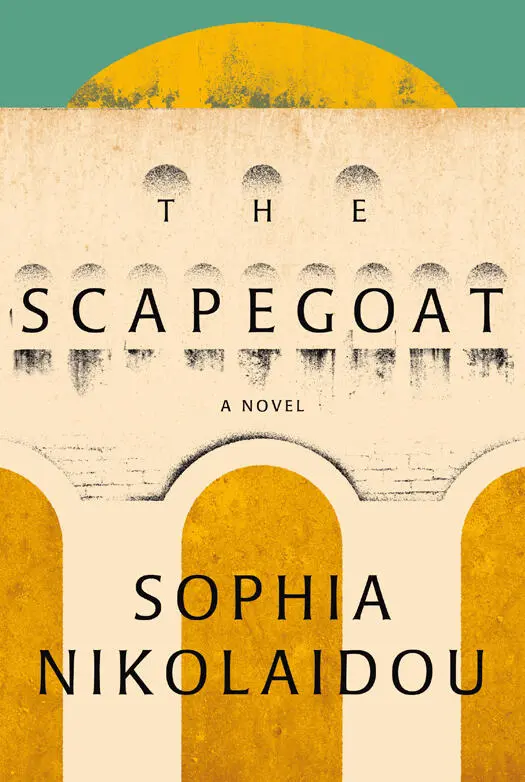
Sophia Nikolaidou - The Scapegoat
Здесь есть возможность читать онлайн «Sophia Nikolaidou - The Scapegoat» весь текст электронной книги совершенно бесплатно (целиком полную версию без сокращений). В некоторых случаях можно слушать аудио, скачать через торрент в формате fb2 и присутствует краткое содержание. Год выпуска: 2015, Издательство: Melville House, Жанр: Современная проза, на английском языке. Описание произведения, (предисловие) а так же отзывы посетителей доступны на портале библиотеки ЛибКат.
- Название:The Scapegoat
- Автор:
- Издательство:Melville House
- Жанр:
- Год:2015
- ISBN:нет данных
- Рейтинг книги:5 / 5. Голосов: 1
-
Избранное:Добавить в избранное
- Отзывы:
-
Ваша оценка:
The Scapegoat: краткое содержание, описание и аннотация
Предлагаем к чтению аннотацию, описание, краткое содержание или предисловие (зависит от того, что написал сам автор книги «The Scapegoat»). Если вы не нашли необходимую информацию о книге — напишите в комментариях, мы постараемся отыскать её.
Flash forward to modern day Greece, where a young, disaffected high school student is given an assignment for a school project: find the truth.
Based on the real story of famed CBS reporter George Polk — journalism’s prestigious Polk Awards were named after him — who was investigating embezzlement of U.S. aid by the right-wing Greek government, Nikolaidou’s novel is a sweeping saga that brings together the Greece of the post-war period with the current era, where the country finds itself facing turbulent political times once again.
Told by key players in the story — the dashing journalist’s Greek widow; the mother and sisters of the convicted man; the brutal Thessaloniki Chief of Police; a U.S. Foreign Office investigator — it is the modern-day student who is most affecting of them all, as he questions truth, justice and sacrifice. . and how the past is always with us.
The Scapegoat — читать онлайн бесплатно полную книгу (весь текст) целиком
Ниже представлен текст книги, разбитый по страницам. Система сохранения места последней прочитанной страницы, позволяет с удобством читать онлайн бесплатно книгу «The Scapegoat», без необходимости каждый раз заново искать на чём Вы остановились. Поставьте закладку, и сможете в любой момент перейти на страницу, на которой закончили чтение.
Интервал:
Закладка:
His statement kept changing, to come increasingly in line with the events. Once the accusation against his mother for collaboration had been dropped, none of the eminent lawyers who got involved in the case seemed to notice that the only basis for a ruling against him was a confused, nearly incomprehensible confession.
Gris had given that confession on his feet, over the course of several hours. His sentences ran amok, they had no consistency; his statement was packed with borrowed language, with the vocabulary of the security police. He spoke in the name of his country, praising its mighty past, expressing his abomination of communist ideals, taking the weight of the world on his shoulders. I was a communist, I was a member of the Communist Party of Greece, and I declare that Greece my Fatherland is innocent of the murder of Jack Talas, which has been unjustly laid at its feet. I impeach and indict the Communist Party of Greece and Cominform and Moscow as perpetrators of this crime. When a person becomes a Greek, he speaks the truth and nothing but the truth, and I have decided to become a Greek. As I sat in my cell my eyes were opened and I became a Greek. A person becomes Greek only once in his life .
Tzitzilis couldn’t have put it better himself. It was a statement of values, less confession than manifesto. Salonica was under strict martial law. The city slept and woke with a pistol to its head. The communists had bombed it, the citizens’ sleep was dogged by fear. Tzitzilis was the city’s protector.
Meanwhile, foreigners living in the city recorded their impressions and sent their reports to distant, carefree countries. One of them, Wallace Chilly — a Swiss-born British citizen with a degree in classical philology from Oxford and five foreign languages on his résumé, a distinguished rhetorician well-versed in ambiguous language and sophistry, an interrogator of prisoners of war, and therefore an expert torturer without consideration or shame , as Cavafy would have it — had the foresight to flee to Finland and lay low. His absence was covered up, though some commented on how he’d vanished off the face of the earth right after the murder took place, indeed even before the corpse was dragged from the sea.
Chilly’s superiors protected him: this was no time for Britain to get mixed up in a case that was, after all, an American affair. When his name was mentioned and the poison-penned reporters started sniffing around, the British officer under whose authority the issue fell announced — unofficially but emphatically enough for all interested parties to take note — that Chilly had the habit of undertaking dangerous spy operations. That was the reason I requested his transfer , he clarified, even before the Talas case broke .
Rumors that Chilly had murdered Talas elicited sarcastic smiles and sharp comments from those in the Foreign Office. The British often relied on unconventional characters, people who jumped out of airplanes without parachutes and didn’t hesitate to use extreme measures if they thought circumstances demanded it. Chilly was a perfect example. He and his men were waging a propaganda war against the communists. Fraudulent techniques were their bread and butter.
The situation was critical. Greece considered the United States its savior, and had welcomed the Americans with hosannas and wreaths of laurel. The negotiations regarding the Marshall Plan brought hope to the broken country. NATO was just beginning to take shape, and the Berlin blockade wasn’t far in the future. None of the involved parties, Greek, British, or American, wanted Talas’s murder to knock any of that off course.
And so they drowned any inconvenient suspicions like a baby in a bucket. At the trial the accused’s lawyer, a young man by the name of Dinopoulos, spoke at length, but avoided the strongest arguments, relying solely on rhetoric. Some supporters of Gris suspected Dinopoulos of compromise, but no one ever accused him outright.
The American general who had once given Tzitzilis a piece of his mind went along with the Greek officials. Through process of elimination Gris was the only name remaining on the initial list of suspects. Antrikos was silently crossed off thanks to a telephone call from the prime minister, while Zouzou had the fervent protection of her mother-in-law. There had been another woman on the list, a reporter, Kristen Sotiropoulos, a troublemaker with an American passport and connections in both the United States and Greece; she was the one who introduced Talas to Gris during their five-minute meeting, but she had supporters in high places, too. By a kind of reductio ad absurdum , Gris was the obvious solution. He wasn’t a well-known figure; he had very few connections; no one would rush to his support. He was, consequently, an easy target.
The American general had earlier expressed his suspicions to the State Department that the crime had been perpetrated by right-wing forces. His superiors were concerned, as he confided in personal conversations. The general cited his sources, but government officials were hesitant to implicate the right. A development of that sort would serve no one. On the contrary, it would harm their interests in the region. The American general rightly declared that, since his own compatriots were failing to verify the information they received, they couldn’t expect much more from the Greeks. His superiors chose not to add fuel to the fire. And the uncouth general, though known for his obdurate outbursts, also knew how to read the silences of his superiors. In this trial, justice was not the primary goal — political expedience had the upper hand, and anyone who imagined otherwise would do well to keep his mouth shut. Now and forever.
SCHOOL YEAR 2010–2011: “LET YOUR RAGE RUN FREE”
MINAS
Turns out we’re having a sit-in after all. The first-years organized it, they hung a banner and dragged all the desks to the front entrance. We took a vote, but it didn’t go down quite as it should have, since their representatives ran around to all the classrooms during the breaks making secret deals.
We decided to let the teachers into the building. The coordinating groups from the other schools say our occupation is a sham. Who ever heard of joining forces with the enemy in the heat of battle? When they found out our student council decided that seniors will still have class, so we don’t lose any prep time for the exams, they were furious. But it’s a school tradition, it wasn’t really ever in question. The world outside could fall apart, but the seniors would still go to class. Your only tradition is in being sissies , Dad teases. He’s a fine one to speak, making revolution from the comfort of his office.
The principal called an assembly, to give us an opportunity to share our views and articulate our demands. He invited the Parents’ Association, too. Everyone needs to accept responsibility for their actions, he said.
The teachers are bored by the whole thing. Except for the party-liners, most of them are opposed to a sit-in. They shake their heads at our demands. Grandma does, too, of course.
At the assembly the principal could barely keep it together. Just the other day he had assured the citywide school board that while occupations were being staged at surrounding schools, ours was an unwavering bastion of learning, a shining example of effective communication between students and teachers . Now he would have to let their offices know that the stronghold had fallen.
Spiros took a piece of paper from his pocket to read off the demands. Evelina would happily have strangled him. According to her, he was a lame, uncouth idiot. His sheet of paper was covered in scribbles and torn on one edge, where he’d ripped off a piece to spit his gum into. He took a deep breath and launched into the list. After complaining about a few run-ins with teachers and our lack of resources, he hurried on to his main issue: why did we need to learn ancient Greek? He just didn’t understand why we should spend so many hours memorizing the verb lyo or third-declension nouns. We want a school that’s alive , he said, we want to talk about things that affect our lives, not memorize words from a dead language .
Читать дальшеИнтервал:
Закладка:
Похожие книги на «The Scapegoat»
Представляем Вашему вниманию похожие книги на «The Scapegoat» списком для выбора. Мы отобрали схожую по названию и смыслу литературу в надежде предоставить читателям больше вариантов отыскать новые, интересные, ещё непрочитанные произведения.










Обсуждение, отзывы о книге «The Scapegoat» и просто собственные мнения читателей. Оставьте ваши комментарии, напишите, что Вы думаете о произведении, его смысле или главных героях. Укажите что конкретно понравилось, а что нет, и почему Вы так считаете.