Joshua Cohen - Witz
Здесь есть возможность читать онлайн «Joshua Cohen - Witz» весь текст электронной книги совершенно бесплатно (целиком полную версию без сокращений). В некоторых случаях можно слушать аудио, скачать через торрент в формате fb2 и присутствует краткое содержание. Год выпуска: 2010, Издательство: Dalkey Archive Press, Жанр: Современная проза, на английском языке. Описание произведения, (предисловие) а так же отзывы посетителей доступны на портале библиотеки ЛибКат.
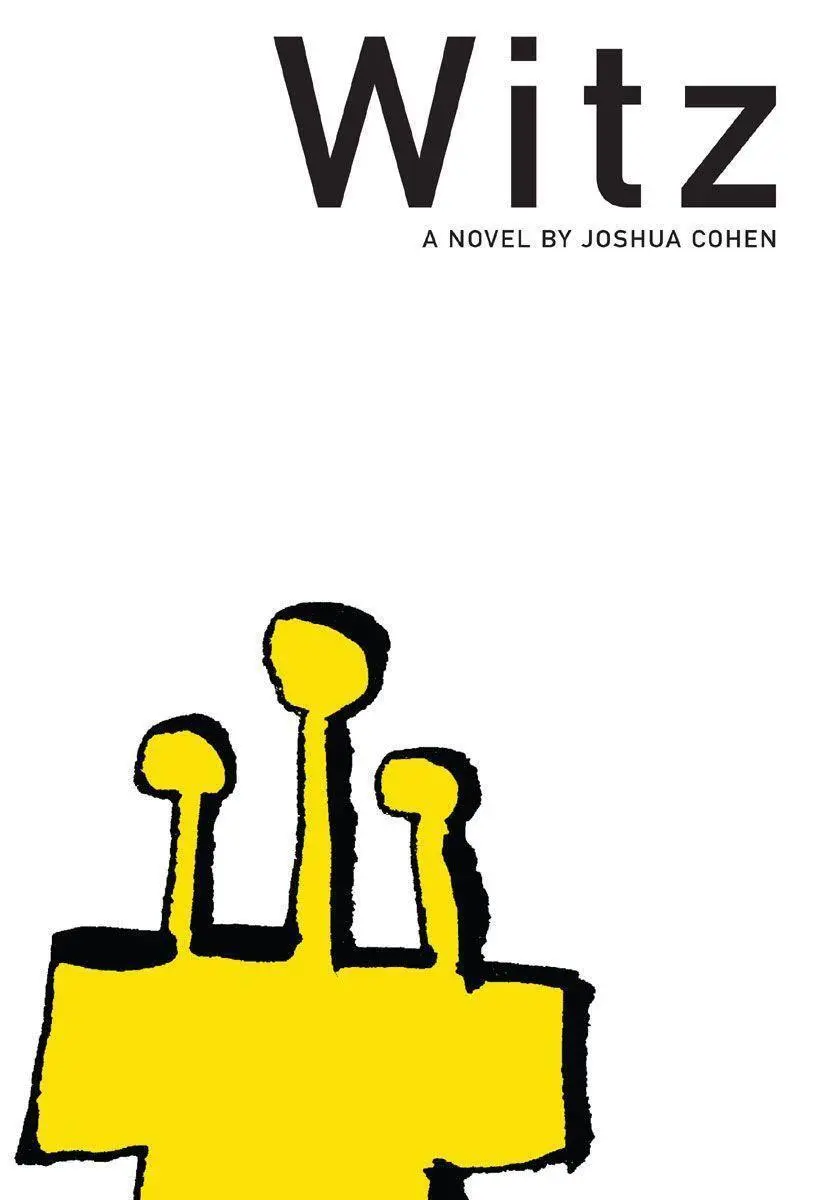
- Название:Witz
- Автор:
- Издательство:Dalkey Archive Press
- Жанр:
- Год:2010
- ISBN:нет данных
- Рейтинг книги:3 / 5. Голосов: 1
-
Избранное:Добавить в избранное
- Отзывы:
-
Ваша оценка:
Witz: краткое содержание, описание и аннотация
Предлагаем к чтению аннотацию, описание, краткое содержание или предисловие (зависит от того, что написал сам автор книги «Witz»). Если вы не нашли необходимую информацию о книге — напишите в комментариях, мы постараемся отыскать её.
Meanwhile, in the not-too-distant future of our own, “real” world, another last Jew — the last living Holocaust survivor — sits alone in a snowbound Manhattan, providing a final melancholy witness to his experiences in the form of the punch lines to half-remembered jokes.
Witz — читать онлайн бесплатно полную книгу (весь текст) целиком
Ниже представлен текст книги, разбитый по страницам. Система сохранения места последней прочитанной страницы, позволяет с удобством читать онлайн бесплатно книгу «Witz», без необходимости каждый раз заново искать на чём Вы остановились. Поставьте закладку, и сможете в любой момент перейти на страницу, на которой закончили чтение.
Интервал:
Закладка:
A referendum has been held, the table has been readied. Places have been laid. The guests have yet to be chosen. Our diningroom, the room with the longest and widest table, is still. Our island sinks deeper into borrowed creation, other time. As the fixed becomes unfixed, is given over to the fixed again, as one life in death is usurped by another, its mourning, the comfort found in concentration recedes — what once was community now is cramped, brotherhood gives way to resentment. Mistrust. Furtive eyes, with hands in pockets often not their own they stand apart. Picking them and noses. Against this insanity of existence, the exigencies of a situation out of all pockets and out of all hands, the clock still ticks — the sun’s face, blank and cold, setting behind the Great Hall, between immovable porticoes. Against the mystic absolute, the mundane must be strengthened. Despite death, it’s life we’re after. Its necessities. Becoming amenities. The schedule reigns. There’s work to be done. There is no chair at the head of the table, and so there is no head. To be left alone, one must first become oriented.
To the north, dim puffy women, former prostitutes and the metropolitan destitute dressed in tarnished overalls of pigskin emerge slowly from their lowslung, falling down cabins of corrugated tin, heaps, impediments to wind held up by the luck of a miracle; with hands gloved they wield their axes handled in bone, their blades sharpened on the sky. They’ve fallen the last trees of Staten Island, its Greenbelt, Moses Mountain high above the dump, having already deforested much of Brooklyn, Queens, the Bronx, and Manhattan’s Park in advance of the Temple, for its timber hard and dead, too frozen to degrade. Then, with measuringsticks held between their teeth, one holds the nails the other hammers, banging slabs into coffins, sixpointed, sixsided, skidding them out onto the ice offIsland, where they’re stacked for future use: stored empty, topless; filling up with the burial of snow.
To the south, workers are bound, constrained; the Garden’s tailors turning out piecework, new uniforms to be grown into, to death; needle and thread-folk sewn themselves into excessive bolts of cloth as protection from the elements: straightjacketed against the wind and fall, they’re swathed totally, windingsheets wound of sheet and human — they’re completely enshrouded, restrained, except for their hands, which have been left bare, exposed, to tailor free from any distraction, to work without the diversion of the other senses. They work in a tented gallery of burlap patched to canvas, stretched tightly just over the larval stoop of their forms, pegged with rope to spikes frozen to the ground. Beyond the flaps laps a fire (without a chimney, there are no other slits in the cloth, which is impenetrable; the smoke gathers, bellows, chokes), over which hunch their odd, shadowy forms, at their whirring machines, with panting foot ridiculously pedaling out their stitching, trimming and hemming, their taking in and letting out — shrouded themselves, they’re making shrouds, each monogrammed at the nape of the neck. They pile their finished products, as light and white as a whisper, in hulking bins of weathered hailresounding metal quartered at the edge of their encampment, once emptied of coal for inside heating — without the hindrance of meals or peers, bundled together against the cold in the warm they’ll eventually die in.
To the sanctifying east, which is the cardinality most consecrated, the olden orientation of the holy — down the singlelane, twoway access road rearing the Great Hall with its turreted vistas offering glary views over the ice to Governor’s, clear past the freeze as if one eye goes slipping as the other eye goes sliding across the slick to Red Hook, then north to Fort Greene, which like this Island is no longer a fort but only a plot of earth left indefensible as named; and between, the taut sinews of the Brooklyn Bridge, the delicate intestinal suspended to waver over the water, white and high and alone — there’s a tremendous cavern, secreted in a mound of ice, carved out roughly, its entrance blocked by a boulder that has to be rolled away every morning, an ordeal requiring the work of three of them, or that of any number with the strength altogether of three. It’s ritual by now; each to their own task: one mops pools stagnant to ice inside that first have to be pulverized with the handle of the broom used to sweep the floor littered with slop, old newspapers and plain brownpaper wrap, while another hoses down then wipes with rag the lavers clean, as yet another is tasked with the sacred office of examining then sharpening the knives kept stowed overhead, sharpdown amid a rash of bulbous and cankered tenderizing stones hung in their slings from racks and hooks, rusted, resembling to many of their visitors — the kashrut inspectors, assorted efficiency experts, the Commissary chefs — nothing less than the timeworn utensils of unenlightened torture. Then, to begin with the work of the day, which is slaughtering, the killing of meat, the knifing of it into product, into cuts as numerously diverse as appetites, and as grossly disarticulated, irreconcilable: these eyes of round allseeing, beeves in crosscuts, sirloins and tender-loins, rear rounds, roasts of flank and shank, brisket and chuck, butterflychops flitting through the dim, evading the chop of blades swung high to scalp, held as long and disjointedly sharp as the teeth of a starveling God; they’d cater also with chicken, with turkey, and innocent lamb: leg and rack, buffetworthy centerloin, neck slices alongside wings hacked flightless, breasts, thighs, legs and wholes, seething raw, porged, trabored, then soaked with salt — the carcasses even seeming to breathe and pant with the exhaustion of being sectioned and sold here, in the whirlwindy din of their slaughterhouse out at the edge of the Garden with a view from the top of its mound to the Battery and Brooklyn Herself; its partially underground vault a sepulcher of shrieks, snorts, and staggering animals with their throats slit lolling a roll of heads to death, its echoic expanse tolling thickly with the pitiless procedure of fast, mass execution; cleavers dull on meat, shattering to bone, to spew into the heavy moist air ringlings of sinew and vein as if the made flesh last gasp of an unfortunate fatling, death throes these scraps of gristle to garnish silence — the noise, though, stored within this facility as hermetically as if within one of the oversized masonjars stacked on the shelves that line the space, stocked with organs and glands.
These faithful surviving, they’re the staff butchers, the Garden’s onsite ritual slaughterers, their profession in their olden lives as well as that in these their new, not for long — though Shochets is the term they prefer, just as their fathers had preferred it and their fathers before them, on forever. Strictly glatt, lately they’ve been slaughtering as never before, in a blind and crazy, heedless, needless rage, as if their work, which is never finished — there will always be carcasses to carve — would serve, but how, to postpone the imminence of their own death; as if by providing sustenance to their kind, they themselves would be sustained, would outlive those they’ve lived to feed. As if by exacting the punishment that is the animal, they would be spared its fate. As if by killing, they would not be killed. Here in their matching aprons, retrieved on arrival from an unlaundered drape on hanger steaks, their paunches swaddled underneath them, hanging from the ribs like swollen tears, they work in a frenzied lust. Despite the fast — meat their life, the making of meat from death their only purpose: trimming fat stored upon the soul for lean years until last Xmas, its ingathering to the Island and this, their privileged employment, their slitting of throats to painless end. Butchers as their fathers before them were butchers, they might be brothers, too — fraternal in their flaw, which is only the quorum of their flaws, a bloody congregation. And though it’s impossible to ascertain just how many of them there are: they’re always coming and going, schlepping and slicing and slitting and bestially blooding — our sages hold that it takes all of them, however many of them there are, or were, to constitute what we would regard as one whole, intact person: as each is deformed, if grossly, lamentably, is mutilated, if only slightly, in his or its own way, uniquely and that, it’s interpreted, it might be this very mutilation that makes them family, that renders relationship to loss, conferring kinship upon such senseless blemish. Unsightly, but they can’t hear you. One’s missing a thumb, another a forefinger, another a middle, another a ring, yet another a pinkie; a knife dropped from up on high severs a thumb toe, a cleaver fallen middle toes, a band or circular saw deprives the foot of pinkies; one’s missing a right hand entire, another still a left, both hackedoff at the wrists, scarred purple and without hair. Occupational hazards. Condolence them not, though, they’re suitably insured. One’s missing an arm to the elbow, the stump of a stub, another to the nubby shoulder, a missing arm entire; one’s without a nose, in the way of risen sever, another lacks an upper lip to lick in concentration on the following blow, his other then, poorer a lower; two have eyes poked out in the disposition of one and one, workplace sacrifices, spurts over the low counters and cases hewn from ice. Know, also, our scholars say, that they cooperate, make do. That the one who’s missing his righthand works alongside the other that’s missing his left; that that other without an ear works alongside another lacking the ear opposite — more than each compensating for the other, for yet another, collaborative in their sin. It’s that they work, ultimately, as one organ, as a unified entity, a mass of single mind and purpose: a huge monstrous slaughterer, murdering away for the sake of the multitude; working despite the horror and hurt as routinely, as placidly, as the carcasses hang from their pitiless hooks, as if pendulums to clocks, swinging their bloods out of the bursting walkthrough — outside: an overflow freezer laid to leak its hold onto the Hudson’s ice, red currents flowing out to slake the bay.
Читать дальшеИнтервал:
Закладка:
Похожие книги на «Witz»
Представляем Вашему вниманию похожие книги на «Witz» списком для выбора. Мы отобрали схожую по названию и смыслу литературу в надежде предоставить читателям больше вариантов отыскать новые, интересные, ещё непрочитанные произведения.







Обсуждение, отзывы о книге «Witz» и просто собственные мнения читателей. Оставьте ваши комментарии, напишите, что Вы думаете о произведении, его смысле или главных героях. Укажите что конкретно понравилось, а что нет, и почему Вы так считаете.