Mavis Gallant - Paris Stories
Здесь есть возможность читать онлайн «Mavis Gallant - Paris Stories» весь текст электронной книги совершенно бесплатно (целиком полную версию без сокращений). В некоторых случаях можно слушать аудио, скачать через торрент в формате fb2 и присутствует краткое содержание. Год выпуска: 2002, Издательство: NYRB Classics, Жанр: Современная проза, на английском языке. Описание произведения, (предисловие) а так же отзывы посетителей доступны на портале библиотеки ЛибКат.
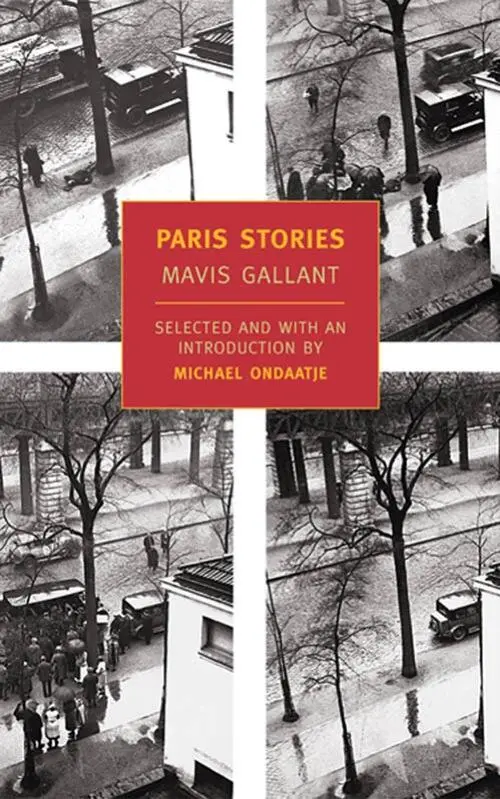
- Название:Paris Stories
- Автор:
- Издательство:NYRB Classics
- Жанр:
- Год:2002
- ISBN:нет данных
- Рейтинг книги:5 / 5. Голосов: 1
-
Избранное:Добавить в избранное
- Отзывы:
-
Ваша оценка:
Paris Stories: краткое содержание, описание и аннотация
Предлагаем к чтению аннотацию, описание, краткое содержание или предисловие (зависит от того, что написал сам автор книги «Paris Stories»). Если вы не нашли необходимую информацию о книге — напишите в комментариях, мы постараемся отыскать её.
Paris Stories — читать онлайн бесплатно полную книгу (весь текст) целиком
Ниже представлен текст книги, разбитый по страницам. Система сохранения места последней прочитанной страницы, позволяет с удобством читать онлайн бесплатно книгу «Paris Stories», без необходимости каждый раз заново искать на чём Вы остановились. Поставьте закладку, и сможете в любой момент перейти на страницу, на которой закончили чтение.
Интервал:
Закладка:
The shot of your face at the oven door, seen as though the viewer were actually in the oven, seemed to me original and clever. (Anny said she had seen the same device in a commercial about refrigerators.) I wondered if the oven was a convenient height or if you were crouched on the floor. All we could see of you was your face, and the hand wielding the spray can. Your nails were beautifully lacquered holly red, not a crack or chip. You assured us that the product did not leave a bad smell or seep into food or damage the ozone layer. Just as we had finished taking this in, you were replaced by a picture of bacteria, dead or dying, and the next thing we knew some man was driving you away in a Jaguar, all your household tasks behind you. Every movement of your body seemed to express freedom from care. What I could make out of your forehead, partly obscured by the mahogany-tinted locks, seemed smooth and unlined. It is only justice, for I had a happy childhood and a wonderful husband and a fine son, and I recall some of the things you told Robert about your early years. He was just twenty-two and easily moved to pity.
Anny reminded us of the exact date when we last had seen you: April 24, 1983. It was in the television film about the two friends, “Virginie” and “Camilla,” and how they meet two interesting but very different men and accompany them on a holiday in Cannes. One of the men is a celebrated singer whose wife (not shown) has left him for some egocentric reason (not explained). The other is an architect with political connections. The singer does not know the architect has been using bribery and blackmail to obtain government contracts. Right at the beginning you make a mistake and choose the architect, having rejected the singer because of his social manner, diffident and shy. “Virginie” settles for the singer. It turns out that she has never heard of him and does not know he has sold millions of records. She has been working among the deprived in a remote mountain region, where reception is poor.
Anny found that part of the story hard to believe. As she said, even the most forlorn Alpine villages are equipped for winter tourists, and skiers won't stay in places where they can't watch the programs. At any rate, the singer is captivated by “Virginie,” and the two sit in the hotel bar, which is dimly lighted, comparing their views and principles. While this is taking place, you, “Camilla,” are upstairs in a flower-filled suite, making mad love with the architect. Then you and he have a big quarrel, because of his basic indifference to the real world, and you take a bunch of red roses out of a vase and throw them in his face. (I recognized your quick temper.) He brushes a torn leaf from his bare chest and picks up the telephone and says, “Madame is leaving the hotel. Send someone up for her luggage.” In the next scene you are on the edge of a highway trying to get a lift to the airport. The architect has given you your air ticket but nothing for taxis.
Anny and Robert had not been married long, but she knew about you and how much you figured in our memories. She sympathized with your plight and thought it was undeserved. You had shown yourself to be objective and caring and could have been won round (by the architect) with a kind word. She wondered if you were playing your own life and if the incident at Cannes was part of a pattern of behavior. We were unable to say, inasmuch as you had vanished from our lives in the seventies. To me, you seemed not quite right for the part. You looked too quick and intelligent to be standing around with no clothes on, throwing flowers at a naked man, when you could have been putting on a designer dress and going out for dinner. Robert, who had been perfectly silent, said, “Alda was always hard to cast.” It was a remark that must have come out of old café conversations, when he was still seeing actors. I had warned Anny he would be hard to live with. She took him on trust.
My husband took some people on trust, too, and he died disappointed. I once showed you the place on Place d'Italie where our restaurant used to be. After we had to sell it, it became a pizza restaurant, then a health-food store. What it is now I don't know. When I go by I look the other way. Like you, he picked the wrong person. She was a regular lunchtime customer, as quiet as Anny; her husband did the talking. He seemed to be involved with the construction taking place around the Porte de Choisy and at that end of the avenue. The Chinese were moving into these places as fast as they were available; they kept their promises and paid their bills, and it seemed like a wise investment. Something went wrong. The woman disappeared, and the husband retired to that seaside town in Portugal where all the exiled kings and queens used to live. Portugal is a coincidence: I am not implying any connection with you or your relations or fellow citizens. If we are to create the Europe of the twenty-first century, we must show belief in one another and take our frustrated expectations as they come.
What I particularly admired, last night, was your pronunciation of “ozone.” Where would you be if I hadn't kept after you about your o's? “Say ‘Rhône,’” I used to tell you. “Not ‘run.’” Watching you drive off in the Jaguar, I wondered if you had a thought to spare for Robert's old Renault. The day you went away together, after the only quarrel I ever had with my son, he threw your suitcase in the backseat. The suitcase was still there the next morning, when he came back alone. Later, he said he hadn't noticed it. The two of you had spent the night in the car, for you had no money and nowhere to go. There was barely room to sit. He drives a Citroën BX now.
I had been the first to spot your condition. You had an interview for a six-day modeling job — Rue des Rosiers, wholesale — and nothing to wear. I gave you one of my own dresses, which, of course, had to be taken in. You were thinner than ever and had lost your appetite for breakfast. You said you thought the apricot jam was making you sick. (I bought you some honey from Provence, but you threw that up, too.) I had finished basting the dress seams and was down on my knees, pinning the hem, when I suddenly put my hand flat on the front of the skirt and said, “How far along are you?” You burst into tears and said something I won't repeat. I said, “You should have thought of all that sooner. I can't help you. I'm sorry. It's against the law and, besides, I wouldn't know where to send you.”
After the night in the Renault you went to a café, so that Robert could shave in the washroom. He said, “Why don't you start a conversation with that woman at the next table? She looks as if she might know.” Sure enough, when he came back a few minutes later, your attention was turned to the stranger. She wrote something on the back of an old Métro ticket (the solution, most probably) and you put it away in your purse, perhaps next to the diploma. You seemed to him eager and hopeful and excited, as if you could see a better prospect than the six-day modeling job or the solution to your immediate difficulty or even a new kind of life — better than any you could offer each other. He walked straight out to the street, without stopping to speak, and came home. He refused to say a word to me, changed his clothes, and left for the day. A day like any other, in a way.
When the commercial ended we sat in silence. Then Anny got up and began to clear away the dessert no one had finished. The debate on hepatitis was now deeply engaged. Six or seven men who seemed to be strangling in their collars and ties sat at a round table, all of them yelling. The program presenter had lost control of the proceedings. One man shouted above the others that there were people who sincerely wanted to be ill. No amount of money poured into the health services could cure their muddled impulses. Certain impulses were as bad as any disease. Anny, still standing, cut off the sound (her only impatient act), and we watched the debaters opening and shutting their mouths. Speaking quietly, she said that life was a long duty, not a gift. She often thought about her own and had come to the conclusion that only through reincarnation would she ever know what she might have been or what important projects she might have carried out. Her temperament is Swiss. When she speaks, her genes are speaking.
Читать дальшеИнтервал:
Закладка:
Похожие книги на «Paris Stories»
Представляем Вашему вниманию похожие книги на «Paris Stories» списком для выбора. Мы отобрали схожую по названию и смыслу литературу в надежде предоставить читателям больше вариантов отыскать новые, интересные, ещё непрочитанные произведения.





Обсуждение, отзывы о книге «Paris Stories» и просто собственные мнения читателей. Оставьте ваши комментарии, напишите, что Вы думаете о произведении, его смысле или главных героях. Укажите что конкретно понравилось, а что нет, и почему Вы так считаете.