John McGahern - The Pornographer
Здесь есть возможность читать онлайн «John McGahern - The Pornographer» весь текст электронной книги совершенно бесплатно (целиком полную версию без сокращений). В некоторых случаях можно слушать аудио, скачать через торрент в формате fb2 и присутствует краткое содержание. Год выпуска: 2009, Издательство: Faber & Faber, Жанр: Современная проза, на английском языке. Описание произведения, (предисловие) а так же отзывы посетителей доступны на портале библиотеки ЛибКат.
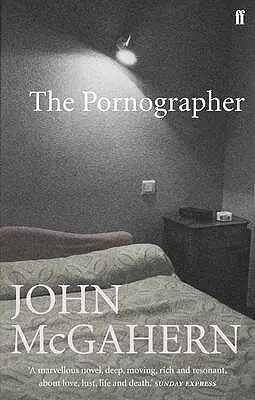
- Название:The Pornographer
- Автор:
- Издательство:Faber & Faber
- Жанр:
- Год:2009
- ISBN:нет данных
- Рейтинг книги:4 / 5. Голосов: 1
-
Избранное:Добавить в избранное
- Отзывы:
-
Ваша оценка:
The Pornographer: краткое содержание, описание и аннотация
Предлагаем к чтению аннотацию, описание, краткое содержание или предисловие (зависит от того, что написал сам автор книги «The Pornographer»). Если вы не нашли необходимую информацию о книге — напишите в комментариях, мы постараемся отыскать её.
The Pornographer — читать онлайн бесплатно полную книгу (весь текст) целиком
Ниже представлен текст книги, разбитый по страницам. Система сохранения места последней прочитанной страницы, позволяет с удобством читать онлайн бесплатно книгу «The Pornographer», без необходимости каждый раз заново искать на чём Вы остановились. Поставьте закладку, и сможете в любой момент перейти на страницу, на которой закончили чтение.
Интервал:
Закладка:
I’d get into London between five and six. I hadn’t to see her till lunch of the next day though I was supposed to ring if I got in earlier. I’d have the whole evening to rest and walk round streets.
I stood at the rail, feeling the warm wind on my face as the boat chugged out of the bay. Passing Howth in the distance, and wondering by this time whether or not to go to the bar, I felt a silken cloth in my pocket. When I pulled it out and saw what it was I hid it quickly in my fist. I looked around. No one was close or watching. It was as white as any of the gulls following the boat. The whole tender strange night was gathered round the softness of the texture. Keeping it would be like trying to hoard the night.
I opened my hand and the breeze took it. Two gulls dived towards it as it flew past the stern, where a fresh breeze lifted it again, and suddenly it was swallowed up in the raucous crowd of gulls following the boat.
As she was on the Northern Line we arranged to meet outside the ticket gate of Leicester Square Station. She saw me while she was still on the escalator, and started to wave. The wave seemed less certain of itself than when she used to come towards me down the cherry and almond avenue. Instead of waving to that drumming inner music — I’m walking and everything is beautiful — it seemed to hesitate: It’s all a bit confusing but boy I sure am keeping on trying. She was dressed in a tweed costume and she wore a pale blouse.
“You sure are one sight for sore eyes,” she kissed and kissed me again, her eyes brimming, a blast of dead air driven up from below by an incoming train.
“Would you like to have a drink? Or would you like to go and have lunch now?”
“Wait. Wait a minute. I need to get used to you. You don’t know how much I’ve missed you. I need to drink you in for some several quiet minutes.”
“We have all day. We can go round the corner to a pub.”
“I’d rather go and eat,” she said. “I’m sorry. I felt hungry all of a sudden coming in on the tube. There’s the two of us now. I’m sorry,” she said again as she took my arm. “You can’t imagine how much I’ve been looking forward to seeing you.”
“You look very well,” I said though I thought she looked nervous and tired.
“I don’t know. I find it hard to sleep. Last night I couldn’t sleep but that was the excitement.”
“Does the place you work at close on a Saturday?” I asked as we walked into Soho.
“The yard is open till twelve, but the office is shut. Wild horses wouldn’t drag me to work while you’re in town anyhow, and I’ve arranged to take as many days off next week as I need. Will you be able to stay the whole week?”
“No. I may even have to go back tomorrow morning. I’m expecting a message. My aunt is dying. I was going to put off coming but I didn’t want to change it.”
“Thank God you didn’t change it. But you may be able to stay the week?”
“It’s unlikely. If there’s no message for me, I’ll have to ring them. It’s unlikely I’ll be able to stay longer than a day or two.”
“Where are you expecting the message?”
“At the hotel.”
“You should have given my place.”
“I didn’t like to. Anyhow it’s done now.”
After pausing at the placards outside of a few expensive restaurants we picked a modestly priced Italian place in Old Compton Street. It had glass-topped tables, and a black and white blowup of the Bay of Naples along the whole length of one wall.
“I got spoiled with Jonathan,” she said as she looked through the menu. “We went out to all those expensive restaurants. And never looked at the price of anything. I’ll have minestrone.”
“You certainly can have anything you want on this menu. I wouldn’t worry about prices today.”
“I want minestrone, and after that I’ll have the veal and spinach. You don’t know what a pleasure it is to be sitting opposite you.”
“What happened between Jonathan and yourself?”
“O boy,” she said. “O boy, that’s a story.”
The waiter brought the minestrone and a carafe of red wine. I finished a glass of red wine while she ate the minestrone. I wasn’t hungry enough to begin with anything. I blamed it on the travelling. I asked the waiter to suggest something light, and he advised lamb cooked with rosemary. I drank a second glass of wine while waiting for the lamb to come while she told me about the magazine and Jonathan’s friends.
“It was a real eye-opener. Just because I was close to Jonathan I could influence what happened to movies and books and plays, give space to actors. I sure didn’t think the world was run that way.”
“What other way did you expect?” I was finding it difficult to curb my irritability in the face of the stream of words. “Who runs anything but people? Since God gave the Ten Commandments he’s stayed out of it.”
“I soon learned that. I thought things were run on lines of good and bad, according to some vague law or other. Virtue was rewarded, vice was punished. My eyes were certainly opened. I sure had some catching up to do,” and she went on to tell me incidents which I found hard to follow not knowing the people involved.
“But Jonathan himself was all right, wasn’t he?”
“I’m still fond of him. And basically he’s a good person. He got a raw deal I suppose. But when the chips were down he turned out to be very much the businessman too, ruthless and self-centred.”
“Isn’t everybody?”
“I can’t believe that. I couldn’t go on if I believed that.”
“But he had a point, didn’t he? He wanted to marry you. You wouldn’t marry him.”
“Well, he never showed that side of himself. He was always the gallant knight,” she said heatedly. “Roses and meals and wine and tears. And suddenly it was either-or. And it wasn’t a fair position.”
“But you seemed happy when you wrote to me about the wife’s suicide, the time you were afraid she’d come home and cause trouble if she found you in the basement.”
“He became a different person after that. He even made a pass at me. I had to use all my strength to resist him. And he said he was staying the whole night in the basement, so it would be as easy to sleep with him as not since I couldn’t make up my own sweet mind. And he said horrible things about you.”
“This all happened after the suicide?”
“A few days. Ο boy, will I ever forget that funeral service out in Golders Green. Apparently she used to gamble a lot. And she owned a racehorse once. And eight was her lucky number. This enormous floral wreath in the figure of eight — it must have cost the earth — went through the flap with the coffin. She’d put it in the will. They’d to hold it so that the flap didn’t sweep it off.”
“But why didn’t you marry him? The child would be secure. You were fond of him.”
“You weren’t very concerned about the child.”
“That’s true, but I didn’t claim to be, though that’s no virtue. You said we should have been married because of the child, that the child was more important than either of us. What then was so different in this case? According to that logic shouldn’t you have married Jonathan for the child’s sake?”
“You sound more like a lawyer than a person,” there were bitter tears in her eyes. “Everything was different. You were the child’s father. The child was conceived in love, on my part anyhow. Jonathan was old, older even than his years. It was a last clutching at life. For the advantages I might get, I’d have to give him my life. You may be fond of an old person but when they try to be young, you find you can’t help despising them. And I’d have to make love to Jonathan, like you and I used to make love, and no matter what you say there was nothing sinful or mean or ugly about our lovemaking. It was pure and healthy and natural. How could I make love to an old man, with the memory of that, and at the same time the child of those memories growing within me. Even if I married Jonathan I’d have to give up all hope of ever seeing you again, and there was no way I was ever going to do that.”
Читать дальшеИнтервал:
Закладка:
Похожие книги на «The Pornographer»
Представляем Вашему вниманию похожие книги на «The Pornographer» списком для выбора. Мы отобрали схожую по названию и смыслу литературу в надежде предоставить читателям больше вариантов отыскать новые, интересные, ещё непрочитанные произведения.




Обсуждение, отзывы о книге «The Pornographer» и просто собственные мнения читателей. Оставьте ваши комментарии, напишите, что Вы думаете о произведении, его смысле или главных героях. Укажите что конкретно понравилось, а что нет, и почему Вы так считаете.