John McGahern - The Pornographer
Здесь есть возможность читать онлайн «John McGahern - The Pornographer» весь текст электронной книги совершенно бесплатно (целиком полную версию без сокращений). В некоторых случаях можно слушать аудио, скачать через торрент в формате fb2 и присутствует краткое содержание. Год выпуска: 2009, Издательство: Faber & Faber, Жанр: Современная проза, на английском языке. Описание произведения, (предисловие) а так же отзывы посетителей доступны на портале библиотеки ЛибКат.
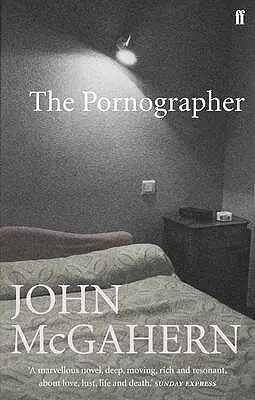
- Название:The Pornographer
- Автор:
- Издательство:Faber & Faber
- Жанр:
- Год:2009
- ISBN:нет данных
- Рейтинг книги:4 / 5. Голосов: 1
-
Избранное:Добавить в избранное
- Отзывы:
-
Ваша оценка:
The Pornographer: краткое содержание, описание и аннотация
Предлагаем к чтению аннотацию, описание, краткое содержание или предисловие (зависит от того, что написал сам автор книги «The Pornographer»). Если вы не нашли необходимую информацию о книге — напишите в комментариях, мы постараемся отыскать её.
The Pornographer — читать онлайн бесплатно полную книгу (весь текст) целиком
Ниже представлен текст книги, разбитый по страницам. Система сохранения места последней прочитанной страницы, позволяет с удобством читать онлайн бесплатно книгу «The Pornographer», без необходимости каждый раз заново искать на чём Вы остановились. Поставьте закладку, и сможете в любой момент перейти на страницу, на которой закончили чтение.
Интервал:
Закладка:
“He was very nice when I told him that I couldn’t, and then the very next Sunday he brought a tall Englishwoman, closer to his age than mine, and I saw he was behaving exactly towards her as he used to me; and there was no doubt but that she intended to marry him.
“I moved out at once. The place I found is in a tradesmen’s terrace, a house close to a football ground, and I’ve the upstairs, two rooms, a small kitchen.
“I’ve got a job, much like the job I had in the bank, if anything less glamorous, a firm that hires out scaffolding and ladders to small builders, and it’s only ten minutes on the bus, a half-hour’s walk from the flat.
“And now, after all this, I want to see you, to see you in London, to feast my eyes on you, my love, come soon.”
I wrote that I was sorry she didn’t take Jonathan’s offer but that was her business. My mind hadn’t changed and wouldn’t change, so that in practical terms she had to leave me out of all considerations of her life, except to lend her what help I could throughout the pregnancy. I’d go to London to see her but only to see if I could be of any help and to keep a promise. It sounded a priggish letter when I read it through but I sent it.
My aunt had grown dependent on the brandy, and I gave her warnings that I’d be away in London for some days. I was worried about what would happen if she couldn’t get her daily portion of oblivion.
“Will you be all right?” I asked for the umpteenth time when I went in to see her the evening before I was to leave for London, and when she was as vague as ever I pressed, “You know you don’t have to worry about me. I know you only take the brandy for the pain. If you need some, how will you manage while I’m away?”
For a moment she bridled at the question but then she said, “God bless you for asking. There’s a man comes round the ward in the morning with newspapers and fruit and that. If I want it, he gets it for me,” and with that she drew a big wad of notes from beneath her pillow and handed them to me.
“What’s that for?” I asked in amazement.
“You’re going to London, aren’t you? You’ll need money in London.”
“But I’ve enough money.”
“I know but all that brandy you’ve brought me in for so long doesn’t grow on the bushes. I just want you to know I know that. Take it. If you don’t need it, spend it for me.”
I took it, and little thought I’d see my aunt again before I got back from London.
I got the bus into O’Connell Street from the hospital. There, I went to the Elbow to see if I’d meet up with Maloney. He wasn’t there nor was there anybody from the paper. I had a slow pint of beer at the counter and then went back into O’Connell Street to mix with the jostling crowds in the summer evening.
The next day I’d take the boat to London to see her. A crowd of girls, their little flounces of laughter brushing out to the sharp clatter of high heels, got out of a taxi and went in through the swing doors towards the dancehall where we’d met. I started to follow them, not singling any out, just following their singing excitement. I fell in behind them in the queue, not caring to follow their speech too precisely, some words falling about pilots in Dublin Airport, knowing it would drag them down to some uncommon commonplace. I bought a ticket after they had left the window, one girl paying for the whole bevy. The pale red House Full placard was on its easel but faced to the wall. The ex-boxer in evening dress tore the ticket in two at the head of the stairs, searching our faces as he handed us one half of the ticket back, sticking the half he kept on a piece of wire, his handsome battered face expressionless.
I got a beer and sat at one of the tables, watching trousered and nyloned legs swish past the four steps. When it was no longer possible to see the dance floor I finished the beer and pushed my way through, the men crowding together at the top of the steps.
There was an interval between dances. The women were away to the left, standing between the tables off the floor, some sitting farther back. One whole corner was crowded, spilling on to the floor, blazing with skin and colourful cloth and glittering bits of metal and glass, the best stand in the market. She’d blazed there a few months before and I’d walked towards her and asked her to dance. Now she was in London. All that waste, too wasteful to each, a pall of sadness.
A waltz was called. I’d to move farther in off the floor, to the strip of carpet along the entrances, as the men around me crossed to the women. Soon I found myself standing alone on the floor. I stood there in the fascination of watching bodies, a miracle of shape in a profusion of different shapes and colours and still all the same shape, and all in the tawdriness and splendour of the self and many; I stood there as one might stand watching light on water, but it was more amazing.
The dance ended. Some of the dancers paired off. Others returned to their single places. Another dance was called, a slow foxtrot, a ladies’ choice, and suddenly a dark swarthy girl was standing in front of me and said, “Cheer up!”
I followed her onto the floor saying, “I didn’t think I looked that miserable; in fact I was having a good time,” when I suddenly saw that the girl I was about to dance with was the black-haired nurse from the hospital.
“You looked as if you were thinking,” she said. “Everybody looks miserable when they are thinking. Did you not see me?”
“No. I only recognized you just now.”
“You see, you weren’t paying attention. If you were paying attention you’d have seen me. Well, here we are at last.”
“I wanted to ask you out.”
“Well, why didn’t you?”
“It’s not easy, with people there. I was in the hospital this evening. I’ve been in most evenings in the last weeks. And I haven’t seen you.”
“I work another ward now.”
She danced with easy freedom, ripe and slack, but soon the floor was so crowded that we had to stand, just moving our bodies to the music. Whenever our eyes met she laughed. She had on a blue dress of shiny material and her shoulders were bare. I could feel her thighs against mine as we moved to the music and the bones between the thighs. Her whole body was soft and free, open.
“Will you come for a drink with me?”
“You don’t have to invite me for a drink because I used to nurse your aunt.”
“I know that.”
“Or because I asked you to dance,” she laughed.
“Not for that either,” I said and our lips met, she sealing the acceptance by closing her eyes and moving her lips over and back on mine. I put both arms round her and drew her closer. I stumbled as we moved off the floor but her arm held me. Arm in arm we went down to the bar and the waiter got us a window table.
“Here’s to your health,” the toast held a twisted echo of another not so long ago evening. A taunt, a warning.
“And to yours,” she touched my glass.
Below, in the orange light of the street, the small dark figures hurried. The cars streamed past. Beyond was the bridge and the faint black glitter of the Liffey.
She’d grown up on a farm outside Monasterevin, an only girl with eight brothers. She’d never been treated differently from the boys, being let drive the tractor, work the milking machines, fight and kick football with them in the river meadow, two uprights crossed with fishing twine.
“Maybe that’s why my aunt thinks you’re a bit of a wildcap.”
“Does she think of me that way?” she was taken aback by the careless springing of this picture of herself in another’s eyes.
“Just a remark I happened to remember. Apparently, one day you danced in the ward.”
“Maybe it is because of having grown up with boys that I’m such a poor hypocrite. I can’t stand women who are lady-like and fragile, never sniffing at a fact of life, while they’d carve you up in small pieces without batting an eyelid.”
Читать дальшеИнтервал:
Закладка:
Похожие книги на «The Pornographer»
Представляем Вашему вниманию похожие книги на «The Pornographer» списком для выбора. Мы отобрали схожую по названию и смыслу литературу в надежде предоставить читателям больше вариантов отыскать новые, интересные, ещё непрочитанные произведения.







Обсуждение, отзывы о книге «The Pornographer» и просто собственные мнения читателей. Оставьте ваши комментарии, напишите, что Вы думаете о произведении, его смысле или главных героях. Укажите что конкретно понравилось, а что нет, и почему Вы так считаете.