John McGahern - The Pornographer
Здесь есть возможность читать онлайн «John McGahern - The Pornographer» весь текст электронной книги совершенно бесплатно (целиком полную версию без сокращений). В некоторых случаях можно слушать аудио, скачать через торрент в формате fb2 и присутствует краткое содержание. Год выпуска: 2009, Издательство: Faber & Faber, Жанр: Современная проза, на английском языке. Описание произведения, (предисловие) а так же отзывы посетителей доступны на портале библиотеки ЛибКат.
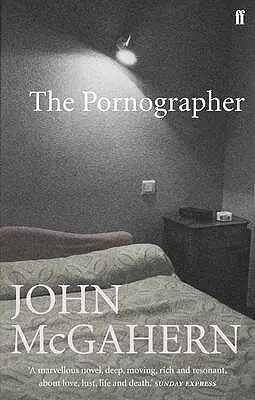
- Название:The Pornographer
- Автор:
- Издательство:Faber & Faber
- Жанр:
- Год:2009
- ISBN:нет данных
- Рейтинг книги:4 / 5. Голосов: 1
-
Избранное:Добавить в избранное
- Отзывы:
-
Ваша оценка:
The Pornographer: краткое содержание, описание и аннотация
Предлагаем к чтению аннотацию, описание, краткое содержание или предисловие (зависит от того, что написал сам автор книги «The Pornographer»). Если вы не нашли необходимую информацию о книге — напишите в комментариях, мы постараемся отыскать её.
The Pornographer — читать онлайн бесплатно полную книгу (весь текст) целиком
Ниже представлен текст книги, разбитый по страницам. Система сохранения места последней прочитанной страницы, позволяет с удобством читать онлайн бесплатно книгу «The Pornographer», без необходимости каждый раз заново искать на чём Вы остановились. Поставьте закладку, и сможете в любой момент перейти на страницу, на которой закончили чтение.
Интервал:
Закладка:
The tiredness dropped away from Mavis, the whole week of the pool like old crumpled clothes left in the bathroom. She snuggled close to the Colonel, “They should have no gear-sticks in cars,” unbuttoned his fly, drew out the already swelling tool, teasing it till it stretched rigidly towards the flickering needle on the dashboard.
He pulled his driving glove off, holding it in teeth before dropping it on top of the dashboard and let his hand trail up the long lovely stretching limbs, the warm firm smoothness of young flesh, drew the cloth down, let the finger stroke, slid the hand beneath the cheeks, closing it gently on the hair and soft skin, “I’m holding the whole world in my hand,” he said. Shyly they caught one another’s eyes in the driving mirror and smiled with the faintest vague plea of apology and drew tighter. “Being so feathered with those wonderful plucking fingers, holding the centre of the world in my hand, I start to find the grey arse of that milk tanker I’ve been trying to pass for the last ten minutes growing beautiful. It’s never a change we need. What we need is to hold the familiar eternally in love’s light.”
“Never mind your psychology,” she laughed. “And don’t get carried away and drive up that milk tank. Metal is not to be confused with soft flesh. It’s a harsh grave.”
“Everything is riding high,” he said, and seeing a clear stretch of road, he drew out, pressing remorselessly down on the accelerator, the powerful engine taking up with a roar.
She leaned her head closer, so that the blonde tresses brushed the foreskin, and then she took the helmet in soft lips and started to caress and draw.
The tanker seemed to stand still, the long line of traffic, and swelling in her hands — cunning young hands — the sperm beat out towards the climbing needle behind the lighted glass, the whole glass milked over by the time the car pulled in ahead of the line of traffic, and the needle fell back to a steady seventy. After the sudden race of speed, the car seemed to stand still, rocked by a light wind and tide, while gently his ungloved hand stroked till rising above the gearstick, fingers gripping the top of the dashboard, her lips going low to touch the sperm on the glass, she came with a cry that seemed to catch at something passing through the air. She tidied up what had been undone, stretching back in delicious tiredness and warmth as the car rolled on at seventy. “I’ve been waiting all day for that,” the Colonel said. “Getting it off on the road like that is like having a trout in the bag after the first cast. It’s like being in the army while there’s no war. You’re doing your duty while just lazing about.”
“I’ve a feeling it’s going to be a wonderful, wonderful weekend. And it’s already started.”
After Longford, a great walled estate with old woods stretched away to the left and children from a tinker encamment threw a stone that grazed the windscreen. In the distance, between rows of poplars, the steel strip of the Shannon began to flash.
“There it is. And there’s the bar on the left. The Shannon Pot.”
“Charles said he’d have us met there if he couldn’t be there himself.”
The bar was empty. A large pike in a lighted glass case, its jaws open to display the rows of teeth, was the only hint of a connection with water. A man in a well-cut worsted suit broke off his conversation with the barman and came towards them to enquire, “Would you be the people from Dublin?” and shook hands in the old courtly way. “Mr Smith asked me to give you his apologies. He was called away to England on a sudden bit of business. He hopes to get back before you leave, but if he doesn’t he’ll write. And he asked me to see that you lack for nothing.”
“That’s very kind of old Charles,” the Colonel said.
“What’ll you have?”
“Mr Smith left orders that everything had to be on the house. You’ll not be let buy a drink to save your life,” he said truculently, and introduced them to the barman, a young man in shirtsleeves. They all decided on hot whiskeys with cloves and lemon. They’d hardly touched their glasses when another round appeared, and then another.
“We’d better see the boat,” the Colonel had to protest.
“No hurry at all,” Michael waved his arm. “The man that made time made plenty of it.”
“We better see the boat,” the Colonel insisted. “That is, while we’re able to see anything at all.”
“It’s just across the road. There’s nothing to it,” he said with poor grace, but led them out.
It was a large white boat with several berths, a fridge, gas stove, central heating and a hi-fi system. The Shannon, dark and swollen, raced past its sides. Night was starting to fall.
“There’s nothing to these boats,” he said and switched on the engine. It purred like a good car, the Fibreglass not vibrating at all once it was running. “And there’s the gears — neutral, forward, neutral, reverse. There’s the anchor. And that’s the story. They’re as simple as a child’s toy. And still you’d grow horses’ ears with some of the things people manage to do to them. They crash them into bridges, get stuck in mudbanks, hit navigation signs, foul the propeller up with nylons, fall overboard. I’ll tell you something for nothing: anything that can be done your human being will do it. One thing you have to give to the Germans though is that they leave the boats shining. They spend the whole of the last day scrubbing up. But do you think your Irishman would scrub up? Not to save his life. Your Irishman is a pig.”
Because of his solid, handsome appearance, his saintly silver hair, it’d be difficult to tell that he was as drunk as he was except for the wild speech. When Mavis opened the fridge she gave a little cry. It was full of wine, smoked salmon, tinned caviar, steak, cheese. There were all kinds of spirits and liqueurs in a cabin beside it.
“It’s very like old Charles not to do anything by half,” the Colonel acknowledged.
“Mr Smith wanted everything to be right for yous. Mr Smith is a gentleman,” Michael chorused.
When the Colonel wiped the misted port window clear, the gleam of the water was barely discernible in the last light.
“I don’t suppose we’ll make Carrick tonight,” the Colonel said. “I was looking forward to a few tender loins tonight, including your dear own,” the Colonel pinched. “But I suppose we’d better be sensible and inspect it in daylight instead.”
“We’ll have a drink,” Michael said and proprietorially got whiskey and glasses out.
“No more than a taste,” Mavis laughed as she withdrew a glass. “I just need the faintest aphrodisiac.”
“Like Napoleon,” the Colonel said. “Do you ever feel like an aphrodisiac, Michael?”
“To tell you the truth, I never sooner one drink more than another. Just whatever gives me the injection.”
“You get on well with old Charles?” the Colonel asked as they drank. “He’s a nice man.”
“A gentleman. Mr Smith is a gentleman. No other way to put it. The English are a great people, pure innocent. But your Irishman’s a huar. The huar’d fleece you and boast about it to your face. Your Irishman is still in an emerging form of life.”
“Did you grow up close to here?”
“A mile or two down the road, a few mangy acres. The galvanized shack is still standing. I still hang out there for the summer, the hay and that, it does for the summer. In the winter I live on one or other of the boats. It’s in the winter we do up the boats.”
“Do you do any farming?”
“Well, I wouldn’t go as far as to call it that. I run a few steers on it.”
“Who looks after them when you’re on the boats?”
“A neighbour. I let him graze a few of his own on it that keeps him happy. That’s been going on since my poor father and mother died, God rest them. Before the boats started I used to work here and there at carpentry. I never wanted to depend on the land. Depending on the land is a terrible hardship. I saw it all,” and he filled his glass again to the brim, trying to press more on the Colonel and Mavis.
Читать дальшеИнтервал:
Закладка:
Похожие книги на «The Pornographer»
Представляем Вашему вниманию похожие книги на «The Pornographer» списком для выбора. Мы отобрали схожую по названию и смыслу литературу в надежде предоставить читателям больше вариантов отыскать новые, интересные, ещё непрочитанные произведения.






Обсуждение, отзывы о книге «The Pornographer» и просто собственные мнения читателей. Оставьте ваши комментарии, напишите, что Вы думаете о произведении, его смысле или главных героях. Укажите что конкретно понравилось, а что нет, и почему Вы так считаете.