Jan Kjaerstad - The Discoverer
Здесь есть возможность читать онлайн «Jan Kjaerstad - The Discoverer» весь текст электронной книги совершенно бесплатно (целиком полную версию без сокращений). В некоторых случаях можно слушать аудио, скачать через торрент в формате fb2 и присутствует краткое содержание. Год выпуска: 2009, Издательство: Arcadia Books, Жанр: Современная проза, на английском языке. Описание произведения, (предисловие) а так же отзывы посетителей доступны на портале библиотеки ЛибКат.
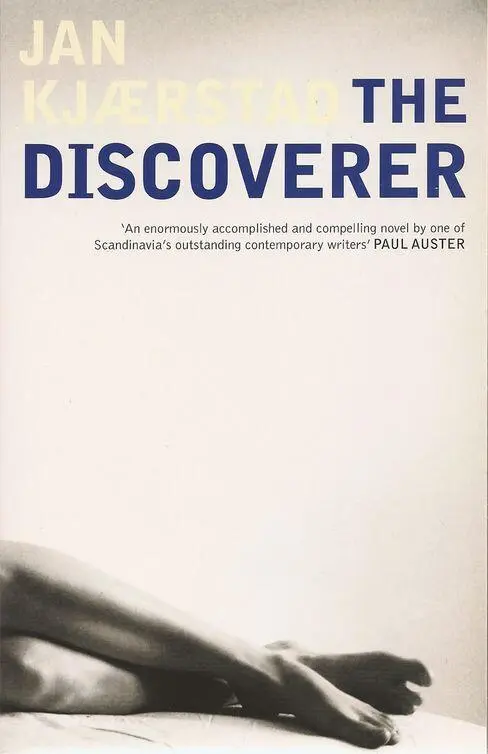
- Название:The Discoverer
- Автор:
- Издательство:Arcadia Books
- Жанр:
- Год:2009
- ISBN:нет данных
- Рейтинг книги:5 / 5. Голосов: 1
-
Избранное:Добавить в избранное
- Отзывы:
-
Ваша оценка:
The Discoverer: краткое содержание, описание и аннотация
Предлагаем к чтению аннотацию, описание, краткое содержание или предисловие (зависит от того, что написал сам автор книги «The Discoverer»). Если вы не нашли необходимую информацию о книге — напишите в комментариях, мы постараемся отыскать её.
The Discoverer — читать онлайн бесплатно полную книгу (весь текст) целиком
Ниже представлен текст книги, разбитый по страницам. Система сохранения места последней прочитанной страницы, позволяет с удобством читать онлайн бесплатно книгу «The Discoverer», без необходимости каждый раз заново искать на чём Вы остановились. Поставьте закладку, и сможете в любой момент перейти на страницу, на которой закончили чтение.
Интервал:
Закладка:
Possibly because he had been sitting facing the Golden Elephant restaurant, Jonas had been thinking about the one subject that was often in his thoughts, although he was not always conscious of it. Her. Always her. Even when he imagined that he was thinking about other girls. He would experience the same thing again, or a slight variation on it, some years later when he found himself in another almost deserted square, a very long way from Grorud, although here too he was surrounded on three sides by buildings — albeit of a more monumental and very different character. Jonas Wergeland was in that place in the world which had been the goal of his dreams, a shimmering pinprick inside his skull, for as long as he could remember: Samarkand. To Jonas Wergeland this fact seemed so incredible — and so mind-boggling — that he might as well have been standing on Saturn’s moon Titan.
His dreams of Samarkand could be laid, of course, at the door of his Aunt Laura and years of veiled references to a city which, as far as he could gather, was the most important place in her life. ‘Tell me who you met in Samarkand,’ he urged her time and again as he lay on the sofa, letting himself drift dreamily into all the rugs on her walls. ‘As for Samarkand and what I found there, that I can never tell you,’ she would always reply patiently from the corner where she was working at her glittering little goldsmith’s bench. ‘You will have to go there yourself.’
It was odd, really. He had come here, travelled such a ridiculously long way, all because Aunt Laura would not tell him what had happened to her here. It was not a story, but the absence of a story that had led him deep into Central Asia. From the moment when he first heard his aunt pronounce those syllables, Sa-mar-kand, he had longed to visit this place. The very word itself fascinated him. For Jonas, Samarkand had become the one place in the world most likely to hold the answer to the riddle of every human being. Sometimes Jonas felt that all that was needed for him to become complete was a tiny cog, and that this last little piece just happened to be in Samarkand. He had to go there. Jonas Wergeland’s trip to Samarkand was, in the very truest sense, a formative experience or, as it used to be called in the old days: a Grand Tour.
Perhaps that was why getting there proved so difficult. Nowadays, when everybody and their uncle is circling the world on a bike with a video camera and a laptop, or visiting every city in the world beginning with the letter B in the course of a year, it is as easy to get to places as it is hard to discover anything knew, anything semi-original. Of all the journeys Jonas Wergeland made, there was only one which he considered to have been really gruelling, and that was the trip to Samarkand. For a Norwegian in the seventies, it was one of the few places which was completely out of reach. It presented a challenge on a par with crossing Antarctica on crutches. Getting in to Uzbekistan, in that far-flung corner of the Soviet Union, at that time — with no excuse other than an incomprehensible urge to see Samarkand — was an accomplishment, a feat of daring unparalleled in Jonas Wergeland’s life. Strictly speaking it could not be done, but Jonas did it. Thanks to the art of persuasion, bluffing, bureaucratic hurdling, charm, patience and amazing luck. And, not least, wrath. Jonas simply got so mad that he won through. For a short while his anger found a direction, a clear purpose.
So the contrast, once he was actually there in Samarkand, was all the greater. Because no one appeared to care any more. It was all very peaceful and undramatic. He may well have been under surveillance, but he was free to go where he pleased, see whatever he liked, alone, ostensibly at any rate, in a city which nestled so beautifully among the snow-covered mountains; where everything, as far as he could tell, revolved around cotton and melons. And silk — a reminder of a time when this city was a bustling hub on the Silk Road. Jonas had the feeling that he knew this place. He found himself thinking, of all things, of Snertingdal. He half expected to see a sign saying ‘The Norwegian Organ and Harmonium Works’.
He knew what he wanted to see first: Registan Square, the centre of the city, this too once a marketplace. And when he sank to the ground there, simply sat right down with his legs crossed, he knew that it had been worth all the travails of the preceding days; all the hassle, all the discouragement, all the dirty looks from officials in hilarious big hats. Although Aunt Laura refused to tell him about her own experiences, she had described this place to him again and again, told him that it was far and away the finest public square in the world — the West had nothing to equal it. She had compared it to a square with the most imposing gothic cathedrals on three of its four sides. ‘Imagine the Town Hall Square,’ she said, ‘And then imagine another, almost identical, Town Hall where the Western Station is, and a similar building on the spot where Restaurant Skansen sits. And all of them covered in the most exquisite ceramic tiles. Can you picture it?’ Yes, Jonas could picture it. The Town Hall in Oslo was, for many reasons, his favourite building in Norway.
Jonas sat in a sort of lotus position on the edge of the square, soaking up these ornamental riches, now partially restored after years of neglect. The buildings — the Ulug Beg to the west, the Tillya Kari to the north and the Shir Dar to the east — had once been madrasahs , Muslim colleges. Minarets flanked the three massive façades, in each of which was a doorway thirty to forty metres tall. The entire complex was faced with glazed tiles in bright colours, a mass of geometric patterns, floral motifs and Kufic calligraphy. An incredible jigsaw puzzle. Jonas lingered over each wall in turn, not worrying about the time, loving the way the slowly shifting light kept revealing new details in the mosaics. He opened up. Tried to make himself open to something which lay within him and was only waiting for him to find a way of drawing it out. He would find a missing piece here, a story, or at least a snippet of a story.
He had sensed it the moment he reached the square and sank down onto the ground.
Jonas sat there gazing at the three façades. Like three gigantic oriental rugs. They almost seemed to cancel one another out, to generate a void of sorts, concentrated nothingness. He could lose himself in those walls, in the ornamentation, disappear into them. Get to the back of them, he thought. If he stared at them for long enough he might even be able to step out into Aunt Laura’s bazaar of a flat, where he had played as a child, with a torch in the dark.
Samarkand was more than a place. Jonas was conscious of a Samarkand beyond Samarkand, something which was not a city, but a crucial insight. This feeling was confirmed as he sat cross-legged on Registan Square. Because if there was any truth in his suspicion, that the world was flat, then here, in Samarkand, he had found the edge. Samarkand had to be a good place for an outsider. An outside-left position from which one could open up the game, change the rules almost. Not for nothing had Samarkand’s greatest ruler invented a variation on chess using twice as many pieces. For an instant, Jonas had a sense of being back in the world as it was before Copernicus, before people knew that the earth was round. Of being able to start afresh. Follow another fork in the road than that which humanity had so far taken.
And then, just as he felt that something vital was about to rise to the surface, that Samarkand beyond Samarkand, much in the way that one feels a sneeze building up, suddenly it slipped away and in its place was another thought, or a cluster of thoughts, as impenetrable and manifest and rich in nuance as one of the glowing façades before him: Margrete. He had come to this place because he thought he would meet Margrete here. Or at least that there was a possibility of meeting her here. If there was the slightest chance of meeting her anywhere in the world it had to be here, in Samarkand. After all, what was Margrete like? Margrete was the sort of person who could easily take it into her head to go to Samarkand. He realised, although he had never come anywhere close to formulating such a thought before, that he was sure he would meet Margrete here. It was the same sensation, albeit greatly intensified, which he had occasionally experienced as a lovesick teenager: you would go a long way out of your way, or ski for miles, if there was even the most microscopic chance of running into the girl you loved, as if by pure accident. And Jonas saw that, unconsciously, this was exactly what he had been thinking this time too. If he went to Samarkand, the most unlikely place in the world, he was bound to run into her. It was a simple as that.
Читать дальшеИнтервал:
Закладка:
Похожие книги на «The Discoverer»
Представляем Вашему вниманию похожие книги на «The Discoverer» списком для выбора. Мы отобрали схожую по названию и смыслу литературу в надежде предоставить читателям больше вариантов отыскать новые, интересные, ещё непрочитанные произведения.





Обсуждение, отзывы о книге «The Discoverer» и просто собственные мнения читателей. Оставьте ваши комментарии, напишите, что Вы думаете о произведении, его смысле или главных героях. Укажите что конкретно понравилось, а что нет, и почему Вы так считаете.