Josep Pla - Life Embitters
Здесь есть возможность читать онлайн «Josep Pla - Life Embitters» весь текст электронной книги совершенно бесплатно (целиком полную версию без сокращений). В некоторых случаях можно слушать аудио, скачать через торрент в формате fb2 и присутствует краткое содержание. Год выпуска: 2015, Издательство: Archipelago, Жанр: Современная проза, на английском языке. Описание произведения, (предисловие) а так же отзывы посетителей доступны на портале библиотеки ЛибКат.
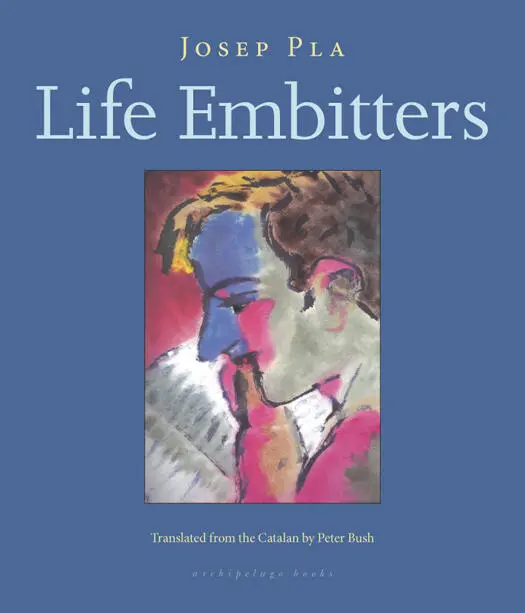
- Название:Life Embitters
- Автор:
- Издательство:Archipelago
- Жанр:
- Год:2015
- ISBN:нет данных
- Рейтинг книги:4 / 5. Голосов: 1
-
Избранное:Добавить в избранное
- Отзывы:
-
Ваша оценка:
Life Embitters: краткое содержание, описание и аннотация
Предлагаем к чтению аннотацию, описание, краткое содержание или предисловие (зависит от того, что написал сам автор книги «Life Embitters»). Если вы не нашли необходимую информацию о книге — напишите в комментариях, мы постараемся отыскать её.
Life Embitters — читать онлайн бесплатно полную книгу (весь текст) целиком
Ниже представлен текст книги, разбитый по страницам. Система сохранения места последней прочитанной страницы, позволяет с удобством читать онлайн бесплатно книгу «Life Embitters», без необходимости каждый раз заново искать на чём Вы остановились. Поставьте закладку, и сможете в любой момент перейти на страницу, на которой закончили чтение.
Интервал:
Закладка:
Maria gesticulated impatiently and snapped out of her frozen stance.
“Well then, what are you intending to do?”
“Stay here!” said Sr Souza forcefully.
“No! The police are on their way …” said Maria almost choking on her words.
“What?”
“The police are coming …” his daughter repeated timidly, her hands trembling.
“No! Not the police!” shouted Sr Souza like an astonished child. “Why are the police coming? What’s my connection with the police?”
“Why do we have to argue?” asked a weary, edgy Maria.
Sr Silva put his hands over his face. Perhaps he was crying.
“And you, Sr Souza, the most excellent Sr Souza, as you like to be called, why do you place me in this kind of situation?” asked Silva, reacting suddenly, a glint in his eyes. “Who gave you the right to think we poor people don’t have feelings?”
“We poor people? Am I not poor too?” asked Sr Souza, dropping his hands despondently by his side. “The fact is, Silva, that you don’t love me, nobody loves me … he added, limply acknowledging defeat.
After she’d greeted Maria in that derisory, rude fashion we described previously, Sra Silva now surveyed the figure of Srta Souza again, disdainfully and insultingly with the harshness a squint-eye often brings. Her bad eye seemed even more remote — completely absent. Conversely, her good one was active, an intolerable, gimlet presence.
A bell rang. Maria disappeared immediately.
Sr Souza went over to Sra Silva.
“Senyora,” he asked in a defeated, exhausted voice, “what would you do?”
“I would stay!” she retorted defiantly.
And added ironically, “But I am a woman.”
“So you would stay, would you?” drawled Sr Souza, laughing sarcastically, separating out his syllables in a mocking, mortifying manner.
Sra Silva’s whole body shook indignantly. A black line set over her furrowed forehead; she swung round, put her hat on and walked out of the kitchen after scowling contemptuously at the two men.
His wife’s attitude led Sr Silva to react. He stopped daydreaming. He walked boldly over to Sr Souza and poked his arm with a fingertip.
“What did this lady do to you to act like this?” he asked, looking at him askance. “What did she think she was doing? We should sort this out here and now …”
Souza looked at him as if he were gazing at a toad. He didn’t feel compelled to respond.
At that very moment Sra Silva appeared in the doorway flanked by two policemen. Tense and apoplectic under her graveyard wreath of a hat, her forehead knitted, her sinister eyes squinting, she looked like a harpy dressed in rags.
A policeman pointed to Sr Souza and they started to walk. There was complete silence, a damp squib of a finale.
The woman walked in front, and, no doubt to emphasize the dire nature of the situation, she felt obliged to be provocative and sashay grotesquely. Silva had fallen back into daydreaming, but was now openly sobbing. He walked second, his yellow parcel tucked under his arm. Sr Souza came last between the two policemen, his huge, downcast head sunk between his shoulders, his cardboard suitcase in his right hand and his hat in his left.
They walked slowly across the passage like three sleepwalkers. Pacheco opened the garden gate for them. Maria watched her father walk across the top of the stairs from the porthole on the second floor landing. When she did so, she’d have wept profusely if she hadn’t bitten on her handkerchief. Then she watched him leaving the house from her bedroom window that looked over the garden.
The moment he walked through the door to the street, Sr Souza spoke to the policeman to his right.
“You must understand … for a man like me to be in this state …” he said anxiously, with the smile of an ineffably human fool.
The policeman said nothing. He took his arm and made him speed up.
“I’m sorry,” said Sr Souza, “have a little pity. I can’t walk like you. I really can’t.”
Maria stood there, pressing her forehead against the windowpanes for a while, nervously biting her handkerchief. When the group turned the first bend in the road, she collapsed. Sobbing, crying, shaking nervously, her hair disheveled, she took a few tottering steps into her bedroom and collapsed on her bed.
So I am one of the few who can say that near Estoril I have witnessed the victory of innocence.
From Estoril to Cascais the road follows the river estuary. When you reach this town, situated above the sand bar of the Tagus, the Atlantic comes into view in its all raw splendor. The road makes a right-angled turn and heads northwards. The landscape changes completely. The ocean stays on the left, and a desolate, deserted coast, eroded by the presence of the sea, rises above the narrowest strip of sand. The coast isn’t high but is precipitous, rugged, jagged, and inhospitable. A reddish swath of earth and rocks, stained by the scorched green of gorse, runs parallel to the depression. From this elongated balcony you get a view of the white-flecked Atlantic: its subdued colors and mute wildness, impressive in its solitude, furrowed by depressions and swells that churn slowly and monstrously. The horizon fractures into a gray, leaden haze. A black steamer looms like a phantom out of the swirling mists. Though your balcony isn’t high up, it does create the sensation of an abyss. This sensation charges the air with all manner of dreams and imaginings. The lines by Maragall come inevitably to mind:
Sweet Lusitania — by the side of the great sea —
sees how the waves come and how the stars flee:
dreams of worlds arising and worlds already gone
Its dreams ever expanding as it faces the infinite .
On this cliff, the four lines have an astonishing geographical, cosmic, emotional precision. They sum up Portugal.
As I was saying, the road to Cascais runs northwards; at specific moment it turns right and climbs inland. This is the Sintra road properly speaking. This famous town is located in a recess in the chain of mountains that separates the Portuguese hinterland from the Atlantic rim. Lush vegetation springs up immediately on either side of the road. Colhares is halfway up the mountain — a “romantic village,” says George Borrow in his book. I mean The Bible in Spain that is so fondly remembered by all who have read it. After Colhares comes Sintra.
Borrow speaks enthusiastically about Sintra — and emphatically. “If there be any place in the world,” he writes in the first chapter of his book, “entitled to the appellation of an enchanted region, it is surely Sintra: Tivoli is a beautiful and picturesque place but it quickly fades from the mind of those who have seen the Portuguese Paradise.”
This is merely Mr Borrow’s personal opinion, and it is understandable given tendencies in matters of taste at the time. It is a comparison that has no objective basis in reality.
By Sintra he means the whole area: the city, the palace — the Pena castle — the buildings, woods, and Moorish ruins … “Nothing is more sullen and uninviting than the south-western aspect of the stony wall, which, on the side of Lisbon, seems to shield Sintra from the eye of the world, but on the other side is a mingled scene of fairy beauty, artificial elegance, savage grandeur, domes, turrets, enormous trees, flowers, and waterfalls, such as is met with nowhere else beneath the sun.”
Borrow’s description is rather superficial and stagey, but the final list has a serious tone, and is a broad brushstroke that really fits Sintra.
Set on a lofty peak, surrounded by a wild garden with wonderful foliage, the castle of Pena is hugely theatrical. However, it’s not at all significant architecturally. It is simply an accumulation, I’d almost say a heap of different building styles from mudéjar to modernista , and done quite gracelessly. That’s to say, Pena has suffered the worst that can happen to a piece of architecture: a process of one restoration being superimposed on another. This stylistic chaos is, nonetheless, saved by the veneer of the place and its historical importance, because it holds within it the history of the Portuguese monarchy in miniature. It isn’t a building like El Escorial or Versailles, constructed all of a sudden, in the course of a reign and according to the taste of one prince, but is a building elaborated over time that reflects different tendencies.
Читать дальшеИнтервал:
Закладка:
Похожие книги на «Life Embitters»
Представляем Вашему вниманию похожие книги на «Life Embitters» списком для выбора. Мы отобрали схожую по названию и смыслу литературу в надежде предоставить читателям больше вариантов отыскать новые, интересные, ещё непрочитанные произведения.





Обсуждение, отзывы о книге «Life Embitters» и просто собственные мнения читателей. Оставьте ваши комментарии, напишите, что Вы думаете о произведении, его смысле или главных героях. Укажите что конкретно понравилось, а что нет, и почему Вы так считаете.