Josep Pla - Life Embitters
Здесь есть возможность читать онлайн «Josep Pla - Life Embitters» весь текст электронной книги совершенно бесплатно (целиком полную версию без сокращений). В некоторых случаях можно слушать аудио, скачать через торрент в формате fb2 и присутствует краткое содержание. Год выпуска: 2015, Издательство: Archipelago, Жанр: Современная проза, на английском языке. Описание произведения, (предисловие) а так же отзывы посетителей доступны на портале библиотеки ЛибКат.
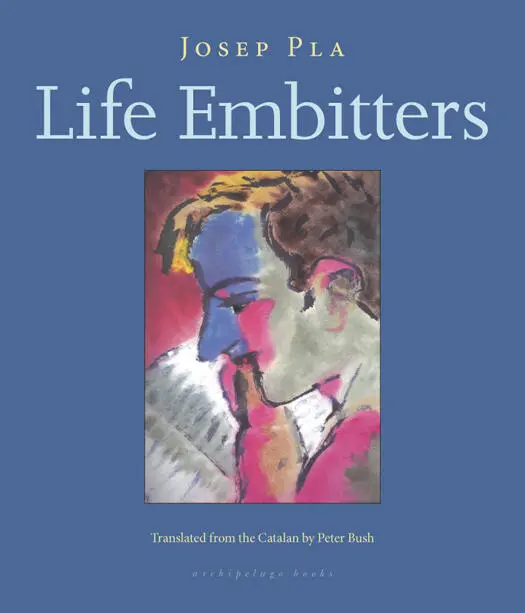
- Название:Life Embitters
- Автор:
- Издательство:Archipelago
- Жанр:
- Год:2015
- ISBN:нет данных
- Рейтинг книги:4 / 5. Голосов: 1
-
Избранное:Добавить в избранное
- Отзывы:
-
Ваша оценка:
Life Embitters: краткое содержание, описание и аннотация
Предлагаем к чтению аннотацию, описание, краткое содержание или предисловие (зависит от того, что написал сам автор книги «Life Embitters»). Если вы не нашли необходимую информацию о книге — напишите в комментариях, мы постараемся отыскать её.
Life Embitters — читать онлайн бесплатно полную книгу (весь текст) целиком
Ниже представлен текст книги, разбитый по страницам. Система сохранения места последней прочитанной страницы, позволяет с удобством читать онлайн бесплатно книгу «Life Embitters», без необходимости каждый раз заново искать на чём Вы остановились. Поставьте закладку, и сможете в любой момент перейти на страницу, на которой закончили чтение.
Интервал:
Закладка:
Surprised? I must confess I was extremely surprised. I was quite mistaken about Portugal. People tend to think there is a single differentiating factor on the Iberian Peninsula: the sea. However, the moment you reach Portugal, you are forced to acknowledge there is another. Portugal is sea-conscious, it lives immersed in the Atlantic climate. But here one encounters the river dimension. Peninsular rivers on this side, when you enter Portugal, increase in volume, and are extremely important. Oporto is a river city. Lisbon is a river city. It is impossible to ignore Portugal’s rivers. The impact of the nearby sea is, of course, striking. “Portugal,” said Camoës, “is the country where the earth ends and the sea begins …” The gravitational pull of the sea that the rest of the Peninsula feels — if at all! — along a narrow strip of coast is present everywhere in Portugal. Thanks to the rivers that cross the country, Portugal has broad and amenable gateways to the sea. And, thanks to these rivers, the sea takes its warm embrace inland. It is by and large a land kneaded by ocean winds that climb upstream and by the mud the currents drag with them. Northern Portugal is all this plus the heavy downpours of Galicia. The south is dry, African, white.
Consequently, I arrived in Lisbon and almost automatically thought of Venice. At first glance I thought the city was a Venice that was milder in color, more washed out, an almost dying fall. The soft, swooning, slightly bloodless nature of the colors must be caused by the damp, misty, supremely benign qualities of the Atlantic climate. Some countries tend to present things in their pure outline, separating them out from the atmosphere where they exist, while others display them immersed in their own haze.
The water element, the aquatic touch — that is often felt more than seen — perhaps explains why Portugal is closer to our idea of a continental climate than to our idea of the Peninsula. The vertical contours of the interior, that confront Castile, Extremadura, and Andalusia, are, one might say with a degree of license, a continuation of central Spain. The wide coastal belt — irrigated by broad rivers, touched by the Atlantic — is very different. This is the great surprise the country holds in store: the gentle waters and silt of its rivers, the salt water and Atlantic winds. Portugal pulled seawards. Portugal, gateway to the Atlantic: the sensation of land ending and sea beginning with infinite horizons …
Open to the sea, the Praça do Comércio is a perfect, unified ensemble of buildings. It is one of the most pleasant places in Lisbon. In periods of culture, creators of distinct forms, — in this case, the eighteenth century — grasped with remarkable vision that the most inhospitable, relentless natural formations and the magma of water called out for rational, symmetrical, perfect structures. A statement made by a culture that openly opposes nature. Following identical intuitions, Italian architects in the age of neo-classicism built Stockholm and Saint Petersburg, that experience the harshest, most inhuman nature on the continent.
An extension of the square’s architectural order — the streets from the Praça do Comércio lead to the Rossio. Straighter and more refined, with immaculate linked gradients and cornices, they constitute the center of the city, the atmosphere of cosmopolitan Lisbon. I wander and idle here. I listen to Portuguese being spoken.
Years ago a Portuguese theater troupe came to Barcelona. Our adorable bourgeoisie packed out the theatre and prepared expectantly to see and hear the work. Everyone was shocked by the first scene. It was impossible to understand a word of what was being said on stage. People strained their ears, snarled, and looked glumly at fellow spectators
“What an earth are these actors speaking?” they asked rather indignantly.
The actors perhaps spoke very correct Portuguese or perhaps a Portuguese that wasn’t so correct: the fact is nobody understood them.
This led to a surprise development. When it seemed that everything would give way to total indifference — not to say hostility — nerves gradually calmed, and the strangeness always produced by the sound of an unintelligible language vanished. The audience became almost drowsy, blithely rocked by the soft, soft lilt of the Portuguese language. The melodious vowels slowly suffused the auditorium and the performance ended wonderfully.
Don Joan Margall would say that Portuguese is an obscure language — he meant darkly hued. Rather than obscure, I would say it is a velvety, shadowy language with damp mossy vowels. Portuguese vowels are dark green, deep, and gentle on the ear, with sensuous, unctuous, sinuous inflections. Delicious.
Strolling along the streets squeezed between the Praça do Comércio and Rossio hoping to capture the subtlest shades and features of the language, I didn’t perhaps follow the advice linguists usually give. Perhaps it isn’t the place to hear the purest Portuguese. In these matters there are always people who know where the language is best spoken — which is usually two or three hundred kilometers from where you happen to be. No matter, despite the slack grammar ruling those streets, I thought the phonetics of Portuguese carried the scent and color of violets. I understood how you can do so much with raw material that is so dense, so silky and modulated. Perhaps even too much. The year of my trip to Portugal was 1921. All the harshness left by the First World War had spread across Europe. That harshness hadn’t yet succeeded in destroying the softness of Portuguese vowels. Thanks to these phonetics, the young ladies here seem the most feminine on the continent and the young men look as if they have a gently resigned propensity to commit suicide. Suicide, driven by love, naturally. However straight their hair, they bring to mind Antero de Quental, who eliminated himself in a moment of sweet melancholy, who practically melted into the phonetics. At that level, you see very clearly that these phonetics preceded saudade . Not that saudade is its most suitable means of expression. On the contrary, saudade is one of the last — often dramatic — effects of their phonetics.
The beauty of Lisboa — that the Portuguese pronounce Lisboua — is astonishing. According to Humboldt the geographer — the greatest traveler of his time — it stands, with Constantinople and Naples, as one of the best located, best positioned cities in the universe.
From the Praça do Comércio one can see the landscape that extends beyond the southern bank of the river. It is quite unattractive — a flat, monotonous, featureless landscape. Lisbon, on the other hand, should be seen from this bank, from the opposite bank of the river. You pay a small toll, and one of the small boats that ply between one bank and the other will take you there. Then you can observe over the broad waters of the Tagus how the tide swells or shrinks, raises or sinks, according to the moment, the wondrous amphitheater of the city astride the undulations, humps, and depressions of its famous seven hills. There is little in Europe that can rival this magnificent spectacle. Once seen, it’s never forgotten. It is a vista devoid of ugliness that contains not a single item that human love of measure rejects. In that sense it is gracefulness by the grace of God.
The history of Lisbon is severed by the earthquake of 1755 that destroyed most of the city. Very few traces remain of what existed before that horrendous eruption. Tirso de Molina’s Don Juan has a description of the city as it was before the earthquake: a small, narrow, Gothic walled city with a suspicious, unfriendly demeanor. The Marquês de Pombal, a friend of Rousseau and Voltaire, rebuilt it with French, Italian and Portuguese architects. Given the dominant ideas when it was reconstructed, it is only natural that Lisbon — the Marquês de Pombal’s, I mean — should be similar to neo-classical cities in the era of enlightened, absolutist monarchies. Neo-classicism was the taste defining the century of Louis XIV and the court of Versailles. The palace of Versailles was in fact the starting point for this taste that shaped every expression of European culture and left remarkable architectural landmarks.
Читать дальшеИнтервал:
Закладка:
Похожие книги на «Life Embitters»
Представляем Вашему вниманию похожие книги на «Life Embitters» списком для выбора. Мы отобрали схожую по названию и смыслу литературу в надежде предоставить читателям больше вариантов отыскать новые, интересные, ещё непрочитанные произведения.


Обсуждение, отзывы о книге «Life Embitters» и просто собственные мнения читателей. Оставьте ваши комментарии, напишите, что Вы думаете о произведении, его смысле или главных героях. Укажите что конкретно понравилось, а что нет, и почему Вы так считаете.