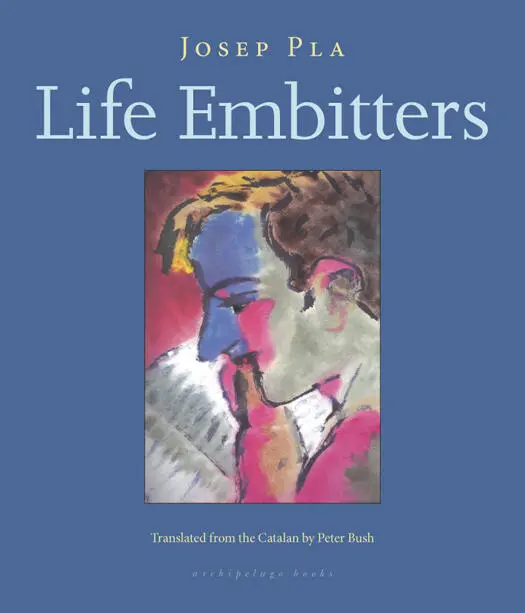
Josep Pla - Life Embitters
Здесь есть возможность читать онлайн «Josep Pla - Life Embitters» весь текст электронной книги совершенно бесплатно (целиком полную версию без сокращений). В некоторых случаях можно слушать аудио, скачать через торрент в формате fb2 и присутствует краткое содержание. Год выпуска: 2015, Издательство: Archipelago, Жанр: Современная проза, на английском языке. Описание произведения, (предисловие) а так же отзывы посетителей доступны на портале библиотеки ЛибКат.
- Название:Life Embitters
- Автор:
- Издательство:Archipelago
- Жанр:
- Год:2015
- ISBN:нет данных
- Рейтинг книги:4 / 5. Голосов: 1
-
Избранное:Добавить в избранное
- Отзывы:
-
Ваша оценка:
Life Embitters: краткое содержание, описание и аннотация
Предлагаем к чтению аннотацию, описание, краткое содержание или предисловие (зависит от того, что написал сам автор книги «Life Embitters»). Если вы не нашли необходимую информацию о книге — напишите в комментариях, мы постараемся отыскать её.
Life Embitters — читать онлайн бесплатно полную книгу (весь текст) целиком
Ниже представлен текст книги, разбитый по страницам. Система сохранения места последней прочитанной страницы, позволяет с удобством читать онлайн бесплатно книгу «Life Embitters», без необходимости каждый раз заново искать на чём Вы остановились. Поставьте закладку, и сможете в любой момент перейти на страницу, на которой закончили чтение.
Интервал:
Закладка:
“Recondite? The ways of grace are always gracefully transparent.”
“It’s obvious that this discussion has gone completely off the rails and it is futile to continue, if we cannot a priori separate out the temporal from the spiritual.”
“Your modernity is pernicious.”
“Oh, come, come!”
“It’s of no matter. The queen must be saved — whatever it takes. The services she rendered were positive and quite remarkable. Besides, she has a fine literary reputation, and we can’t afford the luxury of scorning anything from the six century, spelling errors included. Besides, she was the queen of a country that is intent on growing in importance …”
In the meantime, while propping up a column in Paradise’s room of wasted opportunities, the holy man was commenting on these bygone deeds to a circle of friends and colleagues.
“My friends, you can now see,” he said, “the depths we have sunk to. You all know me and are aware of the efforts I have always made to keep to the high ground of good faith. I believed that my participation in the business of the ring and the fish was positive because it avoided an outbreak of passion, violence, bloodletting, and chaos. Now you see how they deal with me and those events. But that’s how men and women on impious earth speak, who will probably always speak in a like manner. I confess, nevertheless, that any bodily suffering could never compare to my present sorrows. I find this gang of casuists and toffee-nosed sages disgusting, and I’d never heard so much tripe in so short a time. Those amongst us who have a gift for soothing troubled waters know that, in effect, it is a thankless task. Our actions are always caught between two lines of fire: they please some and upset others. All human works are ever thus. Why then don’t we make the effort to transpose the study of this matter to a purely platonic realm? From the point of view of the king’s self-interest, the miracle of the ring and the fish was quite unfortunate. From the point of view of the queen, it was, on the other hand, and though I am hardly the one to say this, it was sublime and angelical. But the fact remains that if we don’t make the effort to rise above these miserable trifles we will never achieve anything serious. It is impossible to legislate for these acts. To enable miracles to come within the reach of everyone would be insane. The only solution would be to have miracles performed for ideal ends, for general reasons, properly measured by our own individual grace. I believe that the establishment of a period of peace and prosperity for bonny Scotland will always justify my participation. Yet, the truth is that once the deed is done, it will always be best to bury and forget it and get on with life. That is why I said you should measure the miracle with your own individual grace. I don’t think anything could be clearer. And so, friends and colleagues: a few yards from this room a gang of lunatics is holding forth on the only thing they shouldn’t speak about. Isn’t that appalling? Now you see the way the wind is blowing, I suppose you will immediately grasp why this gathering puts years on me and turns my hair gray. I’d heard a lot about human ingratitude, but aren’t these fools overstepping the mark! Do you see how they’ve rewarded me …!”
If they hadn’t repeatedly agreed that he was most certainly in the right, Mungo would have started moaning and whining.
A First Trip to Portugal
I first traveled to Portugal via the inland route. Past the Estación del Mediodía there was a station in Madrid that people called the Station of Fleas — its official name being the Station of Delights — and that’s where I boarded the night express armed with the correct ticket. And nobody else much joined the train before it reached Portugal.
The train turned out to be a slow one, and when the first light dawned in the east, we were still in the province of Cáceres. From my compartment window you could see a large expanse of undulating land that shifted from dark red to purple and was unremittingly bleak and icy. A yolk-yellow sash of cloud extended along the eastern horizon, as if heralding the arrival of the new day. The sky was a cold, lustrous green. It was autumn and the temperature was quite unappealing. The poor land by the rail-track was punctured by huge crumbling granite rocks. The cork-oak woods scarred by the recent peeling seemed to writhe in pain. As day slowly broke, the train chugged along the edge of a deep ravine that looked like the sickly lip of a deep incision; its floor was dotted by pools of freezing water. That stunning desolate scene was occasionally broken, in the distance, above dry, sallow, parched undulations, by rather pompous, if elegant and handsome, holm oaks. The sight of Plasencia’s vegetable gardens and quarried stone, wine-dreg black houses, was like an oasis lost among pure geological formations.
When the first rays of sun spread over the earth, a herd of white pigs emerged by the side of the holm-oak woods. They stood still for a moment, snouts up, tails curling, and watched the train. The sun brought the murky gleam of old silver to their pink backs.
Extremadura’s skeletal frame is quite different to Castile’s. Castile is a long spacious country — la espaciosa y triste España — with sharp contours and gently sloping, fiercely eroded terrain dotted with gray-brown adobe villages that look like piles of sun-dried birdshit. The huge vault of the sky soars above pale earth smudged by the wandering shadows of massive, castellated spongy white clouds that meander by, dramatic and luminous, white as foam, or cream in the yellow conflagration of the silent, dying afternoon.
Beyond its borderlands, shaped by the beauty of fighting-bull territory, Extremadura is convulsed and scored by deep ravines, and is much darker than Castile with its lofty and proud, acerbic and remote terrain, its sky higher than any other sky, and a somber, overwhelming, tragically pristine blue. The colors are solemn and stern: burnt cinnamon, deep reds, dark greens, white granite, and purple basalt. The scent is august, full of rural innocence.
We pass through Marvao and across the frontier. The Portuguese province on the other side has the same tone as the land we have just left behind. It too is called Extremadura. The same grandiose contours, under an identical sky open to the four points of the compass. The same human life: holm oaks, acorns, herds of pink or blackish pigs roaming free on thin patches of grass under cork-oaks. The people: small, tough men, stocky, like miniature giants; young girls, like little saints, enraptured and ecstatic. And the solitude … Sometimes a vulture glides high in the sky …
But the train starts on a gradual descent and we enter farmed cork-oak territory with yellow stubble or reddish fallow beneath the light gray trees. The countryside becomes more populated. We have entered land shaped by the hand of man. From the care and skill that has gone into these trees, it is immediately obvious that the cork-oak is the national tree of Portugal. As we proceed, the air becomes sweeter, the atmosphere gentler and the sky’s steely blue fades to a warmer, opaque, fine gray. The first hint of the Tagus is like a freshly opened flower. It is the onset of the Atlantic climate. The atmosphere becomes pink and fuller, the land spreads and flattens out, and the vegetation thickens and softens. The air carries something stronger than the scent and savor of wet earth and smells of ocean winds. It is my first real contact with Portugal.
The lower reaches of the Tagus are astonishing. It is a broad, fatherly river with a gentle flow. The land is moist and flat. River barges glide by on the horizon hoisting square sails tinged with nicotine or orange juice hues. The appearance of these vessels amid the fields makes you wonder: “Where are we? Are we in Holland? Are we in the Po valley, with Venice as its grand finale?” No. It’s not Holland. Holland is even greener, softer, and spongier. It’s a watery, feathery pillow. There is a similarity with Venice. I think the European landscape most resembling what we know generically as Venetian is the lower stretch of the Tagus.
Читать дальшеИнтервал:
Закладка:
Похожие книги на «Life Embitters»
Представляем Вашему вниманию похожие книги на «Life Embitters» списком для выбора. Мы отобрали схожую по названию и смыслу литературу в надежде предоставить читателям больше вариантов отыскать новые, интересные, ещё непрочитанные произведения.





Обсуждение, отзывы о книге «Life Embitters» и просто собственные мнения читателей. Оставьте ваши комментарии, напишите, что Вы думаете о произведении, его смысле или главных героях. Укажите что конкретно понравилось, а что нет, и почему Вы так считаете.