Josep Pla - Life Embitters
Здесь есть возможность читать онлайн «Josep Pla - Life Embitters» весь текст электронной книги совершенно бесплатно (целиком полную версию без сокращений). В некоторых случаях можно слушать аудио, скачать через торрент в формате fb2 и присутствует краткое содержание. Год выпуска: 2015, Издательство: Archipelago, Жанр: Современная проза, на английском языке. Описание произведения, (предисловие) а так же отзывы посетителей доступны на портале библиотеки ЛибКат.
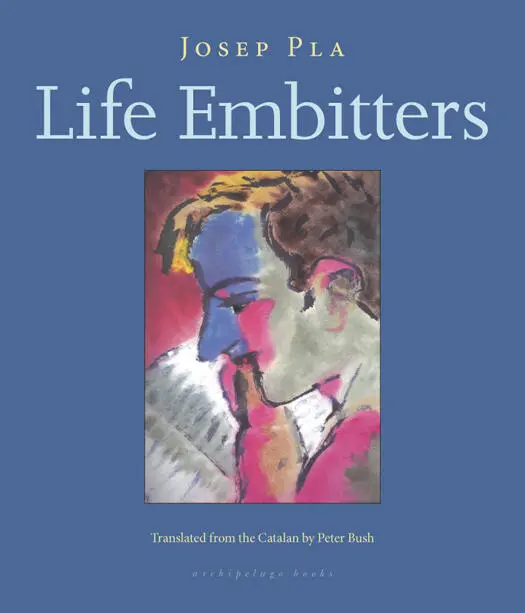
- Название:Life Embitters
- Автор:
- Издательство:Archipelago
- Жанр:
- Год:2015
- ISBN:нет данных
- Рейтинг книги:4 / 5. Голосов: 1
-
Избранное:Добавить в избранное
- Отзывы:
-
Ваша оценка:
Life Embitters: краткое содержание, описание и аннотация
Предлагаем к чтению аннотацию, описание, краткое содержание или предисловие (зависит от того, что написал сам автор книги «Life Embitters»). Если вы не нашли необходимую информацию о книге — напишите в комментариях, мы постараемся отыскать её.
Life Embitters — читать онлайн бесплатно полную книгу (весь текст) целиком
Ниже представлен текст книги, разбитый по страницам. Система сохранения места последней прочитанной страницы, позволяет с удобством читать онлайн бесплатно книгу «Life Embitters», без необходимости каждый раз заново искать на чём Вы остановились. Поставьте закладку, и сможете в любой момент перейти на страницу, на которой закончили чтение.
Интервал:
Закладка:
Sr Fabregat was a man of mature years, a hardworking, active man who wholeheartedly embraced moderate ideas, was one of those fantastic if mediocre individuals who had not only managed to amass a fortune, but had, at least for the moment, successfully held on to it. He found Ostend extremely wearisome, and, if it hadn’t been for the continuous correspondence he conducted with his office, I doubt that he would have withstood the indolence in the air. He was obsessed with the post, whether there were any letters — “Hasn’t the postman come?” he would ask at the most unlikely moments. He was a man whose mental potential was all spoken for: his labors as an industrialist fulfilled his love of what was tangible, his passion for detail, the pleasure he found in undoing knots and sorting out messy, labyrinthine situations. He had the outlook of a mechanic, was fascinated by the way the countless cogs of an engine synchronized, and infatuated by machines in motion. Conversely, his involvement with the Stock Exchange satisfied his imagination. He had invested part of his fortune in the safest, rock-solid stocks, but he wasn’t a passive shareholder awaiting inevitable meltdown. He didn’t believe anything was definitive or stable in this area of his life. As far as he was concerned, being a good investor meant keeping one’s capital in constant circulation. He bought and he sold. What were his criteria when decision-time came? I never did find out. He never showed any sign of being abreast of the news, or of seeking advice from someone or other who might be thought to be well-informed. I never saw him read a newspaper, or any specialist publication, and he never mentioned anyone he confided in. He operated, I imagine, on the basis of pure intuition, and perhaps the fact that he had no advisors meant his antennae were always on alert, and that was always handy when it came to avoiding pitfalls from suggestions that were never going to be disinterested. As an investor, he allowed himself to be guided by the pleasures of his imagination, and, for the moment at least, his method seemed to be producing the goods. A most extraordinary fellow!
At first I found it quite surprising that I’d never seen him read a newspaper, but then, as I got to know him, I realized it was entirely plausible. One only ever scratches the surface of the mysterious enigma that is a human being. There will always be unimaginable surprises. Sr Fabregat had read the Spanish translation of The Three Musketeers every day of his life since he turned thirty — and this was his only verifiable reading matter. He ingenuously confessed to me that he’d read the immortal book twenty-two times and never tired of it. As the leaves fell from the trees, he would lick his lips in anticipation and the first cold spell always coincided, as far as he was concerned, with the voluptuous pleasures of a fresh rereading. The book had perhaps contributed to his peculiar demeanor. He was a short man, driven by a mania about being tall. His whole body had an arrogant swagger, generated by his puny stature. Moreover, he was a man whose face always looked disgruntled, not because his health was poor but because he always looked ill-tempered. His forehead was rather narrow and depressed, his large ears stuck out, his bulging, bloodshot eyes floated in yellowish lymph, his mustache was a handlebar, his jaw slightly jutted, his skin was pallid though his nose and mouth were normal — jarring with the general makeup of his face and thus peculiar, his legs were bandy like brackets. He was a man who looked irascible and I found it amusing to imagine him asleep in that state. But his downfall was his mustache, and if I’d felt sufficiently in his confidence, I’d have told him to shave it off, because a small man with a high-profile mustache looks a real clown.
Once you’d made his acquaintance Sr Fabregat was easygoing and proved to be pleasant and charming. I realized he had one or two hobbyhorses and I tested them out, to see if he was a man of character. One of his manias was animals. He couldn’t understand why the world needed cats and dogs, chickens and hens, lions and elephants. He said he thought that the Creation was amazing enough to be able to do without these irrational creatures. One day when he was outlining his convictions in this respect, I replied that, in my opinion, the existence of cats, hens, and elephants was based on reasons of natural philosophy that were as powerful as anyone might use to speak of human beings. As I spoke, I could see him surveying himself as if he was deeply perturbed by the idea that he might have said something truly idiotic. The next day, however, he spelled out his zoological ideas in similar terms: I deduced that he was a man with deeply rooted convictions.
Sra Fabregat told me that same afternoon that the pimple on the nape of her daughter’s neck did seem stable but was apparently taking on a pinker hue, which might be a sign that, in the near or far future, that it would probably become poisoned. I told her I preferred to wait patiently and resignedly and let nature run its mysterious course and had always found this philosophy to be highly soothing: it would be rash to claim that I convinced her. She seemed worried and anxious. That blemish seemed to unnerve her in an extraordinary way. Human understanding has worked miracles in the field of engineering and technology, but we will always find this simplest of facts to be incomprehensible: that one of the reasons why the nape of the neck exists is to enable pimples to flourish. But I didn’t dare spell out this obvious truism. I’m sure she would have hit the roof.
Sra Fabregat was a Matilde — as I mentioned a moment ago — and her husband called her Tita. She was a slight, rather dumpy lady, with neat rolls of fat, a rather pert nose, bluish black hair, and magnificently white skin that showed off the stylish freckles on her cheeks. She used lipstick, was free-and-easy, and liked to cause a stir. When you conversed with her it was as if someone was shaking you up and down and turning over your insides and putting you in her thrall, like a bottle of medicine being shaken by a chemist. I remember how I would arrive back at the hotel after my conversations with her feeling at the end of my tether, physically exhausted and in a mental fog. It was really difficult to cope with. I occasionally had to splash water over my face to calm down.
It was impossible not to imagine her in the gallery of her flat on the Carrer de Girona, at ten o’clock, when skivvies have migrated to the market and noisy tykes are having a lie-in and the Eixample has become almost an oasis of peace. At that time of day flats still vaguely reek of the greens cooked the previous night. A pleasant breeze wafts in through the wide open gallery. The ladies of the house, their infamous housecoats wrapped around their ample, docile curves, with pink cheeks and curlers in their hair, maneuver beneath the canary’s cage between furniture perpetually under wraps and paintings by Russinyol, Mir, and Cases. Sra Fabregat was from Mataró and felt a love for this city that she expressed in strident hoots if anyone dared to level the slightest criticism. It was admirable in every way.
Matilde Fabregat had been brought up properly and though her conversation always took on a rather peremptory, bossy tone, it could have its pleasanter sides. A full member of the Royal Academy of Fine Literature, the author of various poetic efforts, inspired by obscure episodes in our country’s ancient history, had for many years visited the Fabregats on a Saturday to drink coffee and smoke a cigar. His assiduous visits hadn’t left any spectacular traces, but neither had they brought no benefit whatsoever. Sr Fabregat used to sum up his wife’s potential with a graphic phrase, namely that she was a person who could listen to a lecture without dozing off. And how true that was!
Читать дальшеИнтервал:
Закладка:
Похожие книги на «Life Embitters»
Представляем Вашему вниманию похожие книги на «Life Embitters» списком для выбора. Мы отобрали схожую по названию и смыслу литературу в надежде предоставить читателям больше вариантов отыскать новые, интересные, ещё непрочитанные произведения.




Обсуждение, отзывы о книге «Life Embitters» и просто собственные мнения читателей. Оставьте ваши комментарии, напишите, что Вы думаете о произведении, его смысле или главных героях. Укажите что конкретно понравилось, а что нет, и почему Вы так считаете.