S. Agnon - Shira
Здесь есть возможность читать онлайн «S. Agnon - Shira» весь текст электронной книги совершенно бесплатно (целиком полную версию без сокращений). В некоторых случаях можно слушать аудио, скачать через торрент в формате fb2 и присутствует краткое содержание. Год выпуска: 2014, Издательство: Toby Press, Жанр: Современная проза, на английском языке. Описание произведения, (предисловие) а так же отзывы посетителей доступны на портале библиотеки ЛибКат.
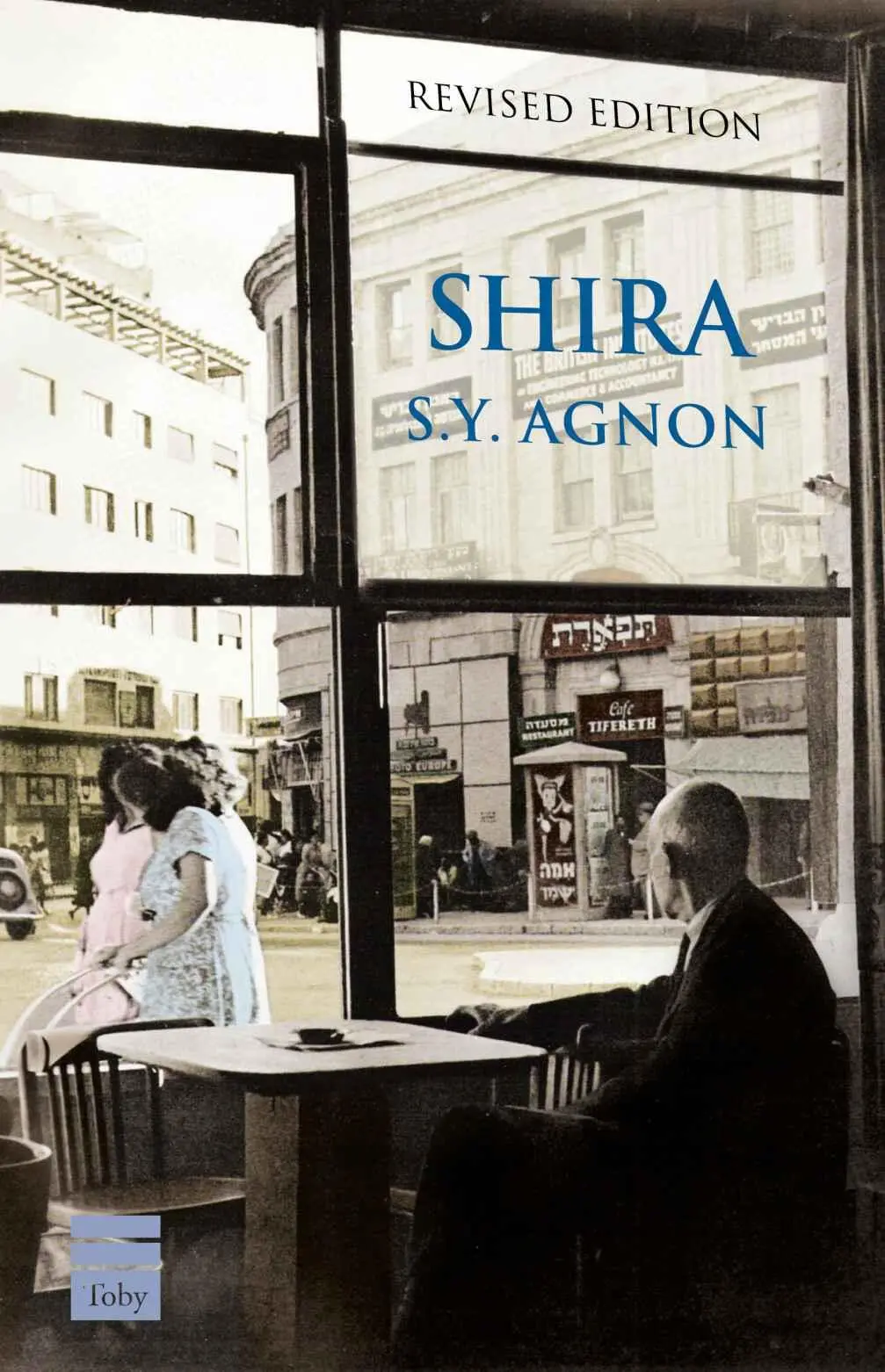
- Название:Shira
- Автор:
- Издательство:Toby Press
- Жанр:
- Год:2014
- ISBN:нет данных
- Рейтинг книги:5 / 5. Голосов: 1
-
Избранное:Добавить в избранное
- Отзывы:
-
Ваша оценка:
Shira: краткое содержание, описание и аннотация
Предлагаем к чтению аннотацию, описание, краткое содержание или предисловие (зависит от того, что написал сам автор книги «Shira»). Если вы не нашли необходимую информацию о книге — напишите в комментариях, мы постараемся отыскать её.
Shira — читать онлайн бесплатно полную книгу (весь текст) целиком
Ниже представлен текст книги, разбитый по страницам. Система сохранения места последней прочитанной страницы, позволяет с удобством читать онлайн бесплатно книгу «Shira», без необходимости каждый раз заново искать на чём Вы остановились. Поставьте закладку, и сможете в любой момент перейти на страницу, на которой закончили чтение.
Интервал:
Закладка:
Most of all, Herbst was terrified of moving. Since the night he had heard gunfire at first hand, close to his ear, he recognized, understood, knew that he should move. But moving a household with three thousand books — apart from journals, offprints, and pamphlets — would involve giving up work for weeks, months, a year, even longer. Such an interruption, at a time when he was deeply involved in his work, would be emotional suicide.
I said three thousand books, but it’s not necessarily so, because books are sometimes counted by title, sometimes by volume. And sometimes, as a sign of affection, one includes a pamphlet or a booklet. So don’t be surprised if, in another context, I cite another figure in accounting for Herbst’s books.
His terror of moving led him to think about transporting the books from one apartment to another and arranging them in a new place, for he really must leave this apartment in Baka, where he has lived since he arrived in Jerusalem. Books that stand on shelves for many years are sedentary citizens, who prefer order and permanence to wandering. Even if they are sometimes willing to step out, to visit in another home, they have no desire to leave their place forever. True, years ago they were accustomed to wandering, but they were young then and few in number. Some of Manfred Herbst’s books remember being able to make do with two planks hung from four tightly woven wires on the wall opposite his bed. How charming Manfred was in those days. He was extremely appealing, with his chestnut hair, a lively devil who fingered those books constantly, covering them in colorful paper and showing them all manner of affection. He spread silver paper over the planks and fastened the paper with tacks that gleamed like gold. Some of the books are not very old, but their contents are ancient. They like to recall how and when they were acquired by Manfred. It happened at Manfred’s bar mitzvah. Some of his friends and relations, knowing there was nothing he cherished so much as books, brought them as gifts. How dear they are to Manfred. Though he has read them many times and actually knows some of them by heart, he still treats them graciously. Other books here are also not very old, but their discourse is like that of an aged relative. Were it not for the fact that they are scholarly books, which don’t deal in legend, they would have recounted the number of nights he did without sleep on their behalf, struggling to uncover their secrets, for the deep secrets they contain are disclosed only through great effort. There are still other books, four, five, six generations old, though they have been with Dr. Herbst not longer than half a generation. Although the authors of some of these volumes were mortal enemies, they live together in peace on Herbst’s shelf, clinging to each other in filial harmony, content with their situation, with the dim green light shining on them from the windows and garden, and with little Firadeus, who brushes them with a soft towel and sweeps off their dust. They don’t complain about the odd smell Dr. Herbst inflicts with a gadget that breathes smoke, to which they are unaccustomed. And now, my good people, lovers of peace, enemies of war, isn’t it criminal to uproot such books and crowd them into a tight city apartment? True, Henrietta is capable and conscientious, guided by good taste and intelligence, but her youthful vigor has been spent. Much as she would try to make the new apartment attractive, it wouldn’t be like this one. Surely not for the books.
Now let’s look at the state of the books in the homes of Herbst’s friends who live in town and in the new neighborhoods, beginning with those of Julian Weltfremdt. Julian Weltfremdt arrived in Jerusalem laden with books. He spent half the money he brought with him on import taxes, brokers, and porters; the other half, on shelves and the construction of a book shed, since there wasn’t enough space in his apartment. He didn’t arrive in proper style; he shipped his possessions, as well as his wife Mimi’s piano, in assorted crates. His books had been scattered in the towns and cities of Germany, for he had wandered from place to place, and, wherever he settled, he left some of his belongings and some of his books, until he arrived in the Land of Israel, where everything came together. When he went up to Jerusalem, he brought all his books along and built bookcases for them, as well as simple shelves. The books that were in the house, he placed in bookcases; those in the shed, he placed on simple shelves. He was so busy arranging his books that he didn’t concern himself with his livelihood, assuming that whoever had any use for someone such as him would take the trouble to find him. But those who might have had use for him didn’t bother to look, settling for those who took the trouble to make themselves available. Mimi shopped on credit, while Julian occupied himself with his books, climbing up and down the ladder, taking out a book, putting it back, cursing and deploring the villainy of inanimate objects, for the books he was looking for eluded his fingers, while the ones he had no interest in jumped into his hand. He kept running between the house and the shed, climbing up the ladder and down again. Once the books were arranged by subject and ordered in terms of his needs, he gave some thought to a job. What he had in mind was to teach at the university, but those jobs were already taken. What was true of the university was true of all the other educational institutions. When he agreed, for the time being, to consider a position in a secondary school, someone else had preceded him. At first, he laughed at the educational administrators for not knowing what sort of teachers the younger generation needed. Then he began cursing them, as well as the teachers who had taken all the jobs — above all, his relative Ernst Weltfremdt, who didn’t lift a finger on his behalf, out of snobbishness masked by a cloak of self-righteousness. Be that as it may, I didn’t mean to discuss Julian Weltfremdt; I meant to discuss matters that pertain to books.
And so, Julian Weltfremdt’s extensive collection of books was in good order. Those that were not in frequent use were put in the shed in his yard; those used more often stood upright in bookcases in his house. Consequently, he spent his days running from the house to the yard, from the yard to the house, sometimes to get a book, sometimes to catch a mouse, sometimes to dispose of a mouse stuck in the trap. It would have been a good idea to keep a cat in the shed. Not only did he fail to get a cat, he chased cats from the premises, because Mimi used to leave the milk and the meat on the table while she was at the piano. The cats would take over, leaving only scraps. He therefore decided to do without a cat and trap the mice instead. Mousetraps are more hazardous than mice. For example, when he found a mouse in the trap and tried to remove it, the spring would snap on his finger. And when he found a live mouse in the trap, he didn’t know what to do with it. He couldn’t just kill it, because he was squeamish; he couldn’t burn it alive, because that would have been too cruel.
In addition to the hazard of mice, there was the hazard of the elements. A sweltering summer that damaged the books was followed by a snowy winter. Snow fell, covering the houses. Their upper halves were in snow accumulated from below, the lower halves in snow falling from above. All the roads were covered with snow. No earth was to be seen, and nowhere could one find solid footing. Business was at a standstill. One could not even find a crust of bread for a child. But this is not what I want to tell. I want to tell the story of the books and the snow. Roofs began to sag under the weight of snow piled on top of them, while snow piling up from below weakened the substructures. The snow was accompanied by a violent storm that uprooted trees and damaged houses. When the snow stopped falling and the storm subsided, people began to venture outside. Julian Weltfremdt went out to his yard and found that his shed was crumbling. Heavy branches had been torn from the trees, and entire trees were wrenched from their places and scattered all over the shed, as well as along the path leading to it. Here and there, the snows were melting, producing a stream of water that gushed into the yard. Melting snow dripped onto the shed from above, so the entire space was water upon water. Julian Weltfremdt didn’t hesitate. Blazing a trail through the snow, puddles, and broken branches, he arrived at his shed, only to find himself knee-deep in water. His wife was standing in front of the house, shouting, “Julian, Julian, come back before you get sick, before you catch your death of a cold.” He gave no thought to his own welfare or to her warnings. He was determined to save his books. He saved what he saved, and what he didn’t save didn’t get saved. Meanwhile, Mimi caught a cold, as well as an ear infection, from standing outside without warm clothes. But I don’t mean to tell about Mimi now; I mean to tell about books. After the destruction of the shed, Julian Weltfremdt began to console himself with the books in the house. One day he took a book off the uppermost shelf and discovered that it was damp. This was true of a second, third, and fourth book, and so on, down the row. Not only that row, but most of the books on the upper shelves of the bookcases in his house were steeped in water. He took them down and put them out to air. He assured himself, every so often, that they would recover and, just as often, plunged into despair over his books and himself — to think that they could do this to him, after all his efforts on their behalf. In the end, some of them had to be rebound. You know, of course, how bookbinders are: not only do they do an inadequate job, but they leave out pages and expect to be rewarded for their vandalism. And how was he to pay? From the paltry funds sent by his wife’s family. This is the tale of some of Julian Weltfremdt’s books and their trial by water. What about his good books, those that weren’t damaged? They escaped destruction but didn’t remain in his hands. Though they withstood the cruelty of the elements, they did not withstand human cruelty. Julian Weltfremdt didn’t find a job and was forced to sell some of his books. After selling some of his possessions when his daughter took sick because of the drafty apartment, he had to sell the remainder in order to get food for her and pay her medical bills. His relative Professor Ernst Weltfremdt often boasted that he paid for the grave and burial expenses, but the doctors’ fees and medications were paid for by Julian. Things came to such a pass that, even while he was writing his popular pamphlet ( The Seventeen Primary Factors Leading Us to Unequivocally Oppose the Appointment of Master Plato of Greece to the Position of Lecturer in Philosophy at Any University, Particularly One in Germany ), when he wished to refer to some of the books he called “professors’ books,” he had to quote from memory. Needless to say, he made some errors, which provided a pretext for the charge that his work was unscholarly.
Читать дальшеИнтервал:
Закладка:
Похожие книги на «Shira»
Представляем Вашему вниманию похожие книги на «Shira» списком для выбора. Мы отобрали схожую по названию и смыслу литературу в надежде предоставить читателям больше вариантов отыскать новые, интересные, ещё непрочитанные произведения.










Обсуждение, отзывы о книге «Shira» и просто собственные мнения читателей. Оставьте ваши комментарии, напишите, что Вы думаете о произведении, его смысле или главных героях. Укажите что конкретно понравилось, а что нет, и почему Вы так считаете.