S. Agnon - Shira
Здесь есть возможность читать онлайн «S. Agnon - Shira» весь текст электронной книги совершенно бесплатно (целиком полную версию без сокращений). В некоторых случаях можно слушать аудио, скачать через торрент в формате fb2 и присутствует краткое содержание. Год выпуска: 2014, Издательство: Toby Press, Жанр: Современная проза, на английском языке. Описание произведения, (предисловие) а так же отзывы посетителей доступны на портале библиотеки ЛибКат.
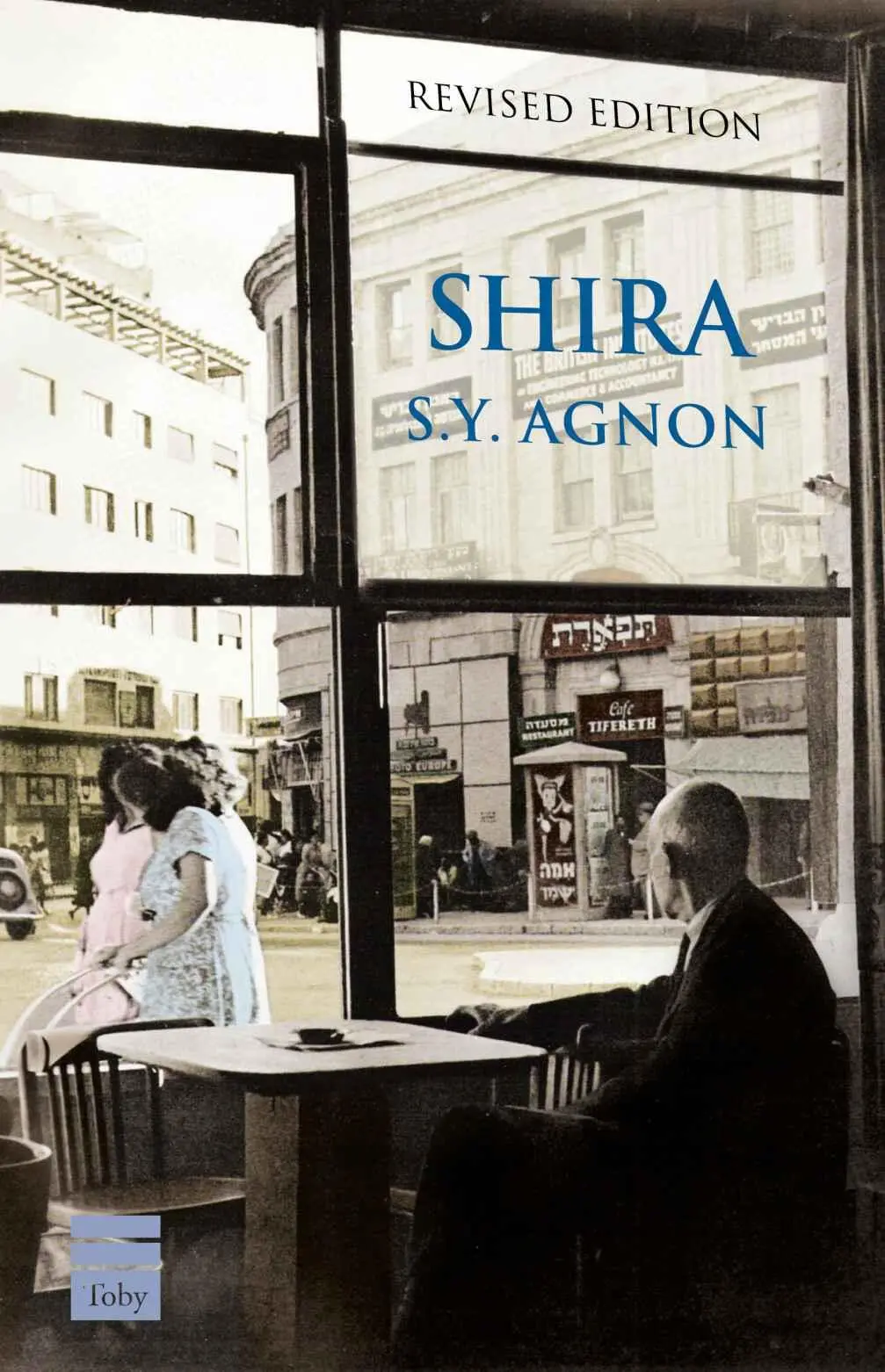
- Название:Shira
- Автор:
- Издательство:Toby Press
- Жанр:
- Год:2014
- ISBN:нет данных
- Рейтинг книги:5 / 5. Голосов: 1
-
Избранное:Добавить в избранное
- Отзывы:
-
Ваша оценка:
Shira: краткое содержание, описание и аннотация
Предлагаем к чтению аннотацию, описание, краткое содержание или предисловие (зависит от того, что написал сам автор книги «Shira»). Если вы не нашли необходимую информацию о книге — напишите в комментариях, мы постараемся отыскать её.
Shira — читать онлайн бесплатно полную книгу (весь текст) целиком
Ниже представлен текст книги, разбитый по страницам. Система сохранения места последней прочитанной страницы, позволяет с удобством читать онлайн бесплатно книгу «Shira», без необходимости каждый раз заново искать на чём Вы остановились. Поставьте закладку, и сможете в любой момент перейти на страницу, на которой закончили чтение.
Интервал:
Закладка:
She withdrew her hand from his and groped for something on the bedside table. She brushed aside the roses sent by the mysterious hand, as well as the presents brought by her husband. Manfred said, “What are you looking for?” Henrietta said, “I’m not looking for anything. Did you write to the girls?” Manfred said, “I wrote, and I also phoned Zahara.” Henrietta said, “You phoned Zahara? What did she say?” “She didn’t say anything.” Henrietta said, “Please, Fred, what do you mean, ‘she didn’t say anything’? You just told me that you phoned her.” “I did, but the fellow who answered the phone wouldn’t stop talking, and by the time they called Zahara, my time was up and we were disconnected.” Henrietta sighed and said, “Too bad. But will they tell her you called?” “They’ll tell her.” “You didn’t call Tamara? Why didn’t you call Tamara?” “Why? Because she has no telephone.” Henrietta said, “She has no telephone? She always had a phone.” Manfred said, “She used to have one, but she doesn’t now.” Henrietta said, “Just for spite — when we didn’t need to call her, she had a phone. Now that we need to call her, she has no phone.” Manfred said, “It’s not a matter of spite. Like most things that happen, it’s chance.” Henrietta said, “So we’re into philosophy.” Manfred said, “That’s not philosophy. When she lived in a house with a phone, she had a phone. Since she moved to a house without a phone, she has no phone.” Henrietta said, “Good, good.” Manfred said, “Who’s saying ‘good, good’?” Henrietta said, “By chance, I am.” Manfred said, “Then you admit, Henriett, that there is such a thing as chance.” Henrietta said, “Did I claim there was no such thing as chance? Of course there is.” Manfred said, “When I said it was chance, you laughed at me and cried, ‘Philosophy!’“ Henrietta laughed and said, “Dear Fred, I have no answer, only ‘good, good.’ Now, my darling, get ready for the nurse. Don’t you want to see Sarah?” “Sarah? Who’s Sarah?” Henrietta said, “Didn’t we agree to call our new daughter Sarah?” “We agreed? Good, good.” Henrietta said, “A good heart says, ‘Good.’ The nurse will soon come and show you Sarah. Actually, I could show her to you myself, but as long as the baby is here, the nurses are in charge.”
The nurse Shira was back. We barely recognized her. She wore a midlength gray dress and a silver filigree necklace, which set off her face to advantage, like that of a chaste woman whose beauty is emphasized by some trinket. One more striking thing: on her lovely, small feet she wore shoes made by a skilled craftsman, which lent special elegance to her bearing, and, as the day was beginning to darken, her elegant bearing was evident, but not its source. She held her hat in her hand, as a girl does, and it hid her purse, so one couldn’t tell she was ready to go. Henrietta glanced at her and said, “Shira the nurse looks charming. If I had known she would change so much, I would not have been so eager to put my husband in her hands. He might decide to leave me for her.” Shira said, “Do I give Mrs. Herbst a little pleasure?” Mrs. Herbst said, “That’s a big question. Not just a little. More than a little. Now, Fred, my dear, have a pleasant evening.” “We’ll try, Mrs. Herbst, we’ll try,” Shira said. Mrs. Herbst offered Shira her hand and said, “Yes, yes, nurse. Now let’s show the father his daughter…. Now that you’ve seen her, give me your hand, and I’ll say goodbye. If you want a kiss, no need to be shy. These are ordinary events. Good night, Fred. Good night, nurse.” Shira answered, “A fine and blessed night.”
Chapter ten
When they were outside, Shira said, “Actually, I would rather not go to a restaurant.” “Then where would you like to go?” Herbst whispered, his heart beginning to flutter. Shira said, “Let’s walk a little, so I can clear my head.” Herbst said, “I don’t know where one can walk in Jerusalem without being stopped at every step.” Shira said, “We don’t have to go to Rehavia.” Herbst said, “Beit Hakerem or Talpiot wouldn’t be any better. In Beit Hakerem, you run into teachers; in Talpiot, you meet professors. Wherever you turn, there are people you know. They choose to live out of the city in order to escape its tumult, and they drag the tumult with them. By now, the only difference between a suburb and the city proper is the distance and the bus fumes. This nation does everything in public. Because religion is public, it has become the custom to do everything in public.”
Shira looked at him searchingly and asked, “Are you Orthodox, Dr. Herbst?” “Why?” “Because you referred to religion. I don’t care for the Orthodox, nor do I care for religion.” Herbst said, “In your childhood, you were probably Orthodox too.” Shira said, “Even my father wasn’t Orthodox. He enjoyed tradition, and for that reason alone he fulfilled some of the commandments, but only those that didn’t require much effort. And, even then, he was rather casual, which is surely the case with me. I hardly know what tradition is or what it is for.” Herbst said, “I have very little information about the nurse Shira.” Shira said, “And my knowledge about the professor is limited as well.” Herbst said, “Actually, I know nothing about you.” Shira said, “When I get to know someone, I never concern myself with his beginnings.” She reached into her purse and rummaged around without taking anything out. Herbst said, “I think the lady was going to say something.” Shira said, “No, I wasn’t going to say anything.” Herbst said, “Then I was wrong.” Shira said, “Yes, Dr. Herbst was wrong.” She took a step and stopped. Herbst stopped and circled her with his eyes. Shira said, “I wasn’t going to say anything, but now I will. The only person about whom I knew everything was someone I loathed more than anyone.” Herbst said, “Am I allowed to ask who he was?” Shira said, “You are allowed to ask, and I am allowed not to answer.” Herbst said, “Pardon me, madam. In that case, I won’t ask.” Shira said, “Pardon me, sir, for not giving a proper answer.” They took a few steps. She stopped, groped in her purse, and said, “You asked who it was that I loathed more than anyone, and I didn’t answer. It’s not really a secret, only a memory, a piece of the past that is no longer painful. If you want to know about it, I’ll tell you.” Herbst said, “When I get to know a person, I want to learn all about him, and the more I learn about him, the closer he is to me.” Shira said, “Someone removed from life would say that, but those who know the world and are involved in it pay no attention to the past.” “Really!” Herbst declared, astonished. Shira laughed and said, “Yes, really.” Again she reached into her purse. She took out a cotton ball, rubbed the tip of her nose, threw the cotton away, and said, “Let’s take this turn. There’s a new road that connects this neighborhood with Sanhedria. No one comes this way. What is it, professor? You’re pouting like a child whose nanny has promised to tell him a lovely story but doesn’t keep her word. Dear professor, my story is not at all lovely. The man I loathed more than anyone was my husband.” Herbst asked in a whisper, “You were married?” Shira said, “I was married.” Herbst said, “I assumed that — “ Shira interrupted him, laughing, “What did you assume? That…that I was a virgin?” Herbst stammered, “No, but I…In fact, I don’t know what I assumed.” Shira said, “Don’t torture yourself over it. It’s not worth the trouble. Let’s stand here awhile and watch the sun.”
Shira continued, “The sun is setting, painting the empty new houses red, painting the bare windows no one looks out of yet with its golden flush. I’m a city girl, born in an old house. Here in Jerusalem, I live in an old house too, built several generations before I was born. But when the sun begins to set and I walk through the new neighborhoods and see all the new houses being built, my heart is filled with yearning and desire. Why is my heart so full of yearning and desire? Perhaps because I yearn to live in houses no one has lived in yet. But why, when in a day the novelty will be gone and they’ll be like other houses? Nonetheless, that desire becomes more and more intense. The sun has already set. Its golden flush has vanished. Everything sinks and disappears, even the sun, with all its dazzle, leaving nothing behind, no further dramas to unfold.”
Читать дальшеИнтервал:
Закладка:
Похожие книги на «Shira»
Представляем Вашему вниманию похожие книги на «Shira» списком для выбора. Мы отобрали схожую по названию и смыслу литературу в надежде предоставить читателям больше вариантов отыскать новые, интересные, ещё непрочитанные произведения.










Обсуждение, отзывы о книге «Shira» и просто собственные мнения читателей. Оставьте ваши комментарии, напишите, что Вы думаете о произведении, его смысле или главных героях. Укажите что конкретно понравилось, а что нет, и почему Вы так считаете.