S. Agnon - Shira
Здесь есть возможность читать онлайн «S. Agnon - Shira» весь текст электронной книги совершенно бесплатно (целиком полную версию без сокращений). В некоторых случаях можно слушать аудио, скачать через торрент в формате fb2 и присутствует краткое содержание. Год выпуска: 2014, Издательство: Toby Press, Жанр: Современная проза, на английском языке. Описание произведения, (предисловие) а так же отзывы посетителей доступны на портале библиотеки ЛибКат.
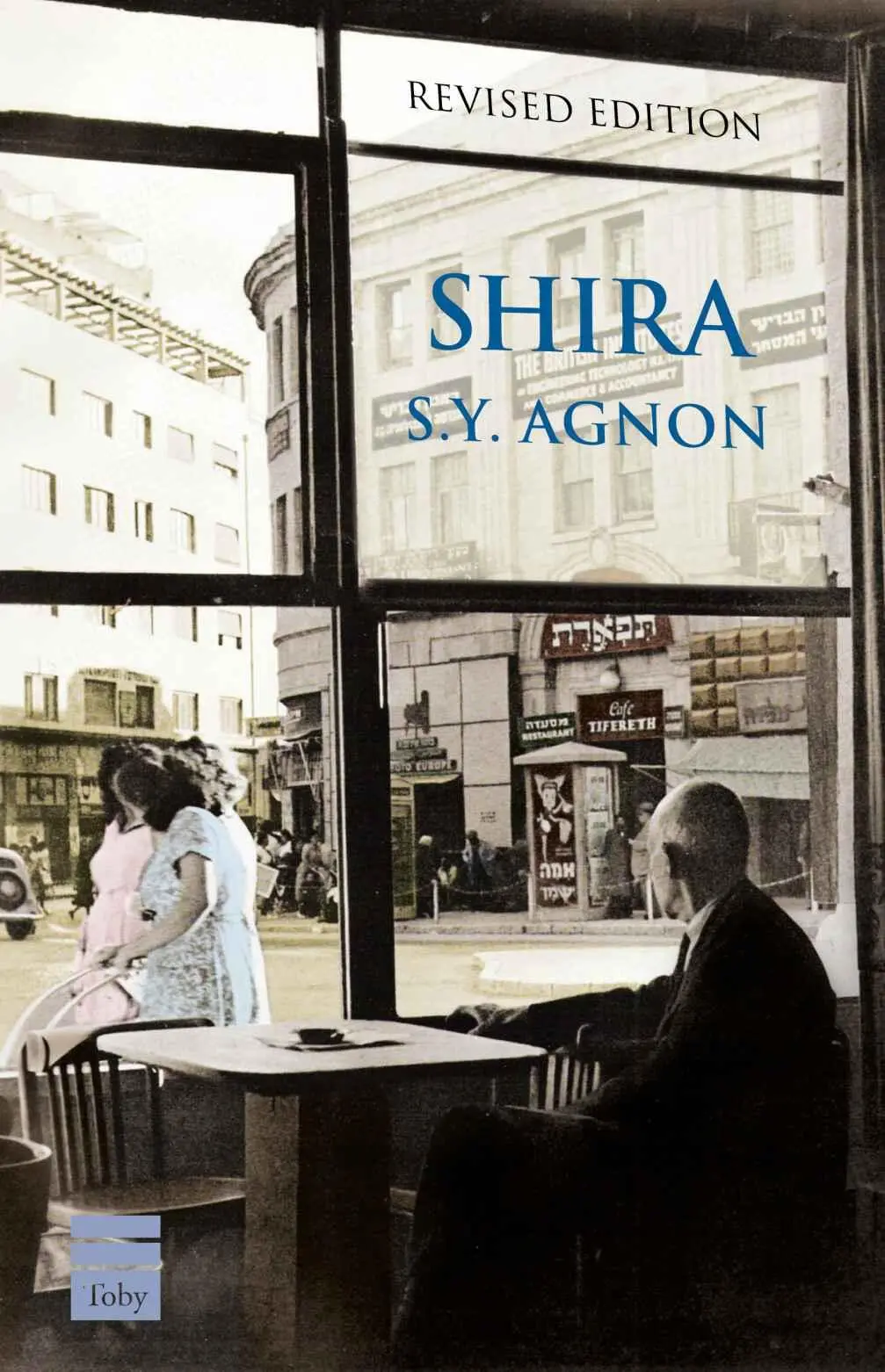
- Название:Shira
- Автор:
- Издательство:Toby Press
- Жанр:
- Год:2014
- ISBN:нет данных
- Рейтинг книги:5 / 5. Голосов: 1
-
Избранное:Добавить в избранное
- Отзывы:
-
Ваша оценка:
Shira: краткое содержание, описание и аннотация
Предлагаем к чтению аннотацию, описание, краткое содержание или предисловие (зависит от того, что написал сам автор книги «Shira»). Если вы не нашли необходимую информацию о книге — напишите в комментариях, мы постараемся отыскать её.
Shira — читать онлайн бесплатно полную книгу (весь текст) целиком
Ниже представлен текст книги, разбитый по страницам. Система сохранения места последней прочитанной страницы, позволяет с удобством читать онлайн бесплатно книгу «Shira», без необходимости каждый раз заново искать на чём Вы остановились. Поставьте закладку, и сможете в любой момент перейти на страницу, на которой закончили чтение.
Интервал:
Закладка:
Fearing the sand flies, Herbst went to bed without light and without a book. Since his return from the war, he would never lie down without a book. Even in bad times, during the unrest that followed the war — when municipal lighting, both gas and electric, was suspended — he had read by a small candle or a carbide lamp. Here, he lit neither a candle nor a lamp. For a time, the moon lit up the window and shone into the room. It vanished, appeared, vanished, and didn’t appear again. It may have reappeared after he dozed off. Anyway, he wasn’t asleep now. He was very alert, because of the fresh air, because of the lecture, because of his conversations. The lecture was a success. It wasn’t new; he had given the same lecture when he was first appointed to the university. But new elements were introduced tonight. As he presented new insights, many eyes shone responsively, unlike that first night, when the evil eye lurked everywhere, awaiting his downfall. Not that he had been usurping anyone or that there were other candidates for his position, a position that was created for him because of Professor Neu. But the primal law holds; for every Abel there is a Cain, if not to commit actual murder, then to invoke the evil eye that destroys one’s spirit. Another thing about the lecture in Ahinoam; it was spoken rather than read.
Herbst lay in bed recalling the people who had been in his audience this evening. Herbst was attached to his university students, knew each one of them, with their particular spiritual qualities, and was fond of them, perhaps more than they realized. But how many were they? Five or six a semester. Here in Ahinoam, fifty or sixty young men and women came to his lecture, healthy, vigorous, lively. And that Byzantine girl — if I were going to add pictures to my book, hers would be the first. All of these youngsters, males and females alike, invest their youth, designed for joy and pleasure, in work and drudgery. They sacrifice much-needed sleep to hear a scholarly lecture on a subject remote from their lives. As for me — the lecturer, for whom scholarship is, presumably, the axis of life — I waste my time on…Lo and behold, what he failed to do on all other nights, he succeeded in doing on this night. He took charge of his thoughts and did not dwell on Shira.
That night, as was always the case when his mind was stimulated by work, he resolved to devote all his energies to completing his book, fortifying his conclusions, leaving no grounds for the charge that the author was inventive but unconvincing. Convincing, convincing…Who invented that ugly word, and what is it doing in a scholarly context? Are we political agitators? Scholarship involves going with the data. Whatever conclusions this forces upon us, we are required to present them without equivocating, even if they are contrary to what we had in mind. I don’t specialize in the Hasmonean period, but, if I were to deal with it, I would conclude that much of what Antiochus demanded of the Jews, the Hasmonean kings did willingly. And I wouldn’t hesitate to make this fact public, although it detracts from our glory, demonstrating that, given the chance, we behave like any other nation. Similarly, if I were to write a book about national character, I wouldn’t hesitate to generalize about Jews, to declare that it isn’t a state and political life that Jews are after, but the opportunity to serve God and support themselves. Which is what Mattathias and his sons were after when they were pressed to violate the rules of their religion. When the Hasmonean kings behaved corruptly, many leaders in Jerusalem chose to give up the kingdom and beseeched Pompey to protect them from the rule of the Hasmoneans. I know that such ideas are a challenge to Zionism, and Zionism has, after all, saved my life and brought me here, at a time when so many fine and prominent individuals are in mortal danger. I am repaying a good turn with a bad one. But those who engage in scholarship value it, and we must stand by its truths. As for my book, I must get back to work and finish it. Should new material fall into my hands, it would be wise to ignore it. It is sometimes better to close one eye than to add material that pretends to add to the substance but merely doubles the bulk.
Herbst lay in his bed reviewing his manuscript. He undertook this review to determine what to highlight and what to play down, in the interest of completing the book and preparing himself for a new project. It was not yet clear to him what it would be, but he had a sense of it, as though he were already collecting material.
So as not to interfere with his sleep, he began thinking about a simple aspect of the work: how to set up a new box for his new notes. Even if he completes his large work, the boxes won’t be empty. Those boxes are amazing; though he takes out endless notes for colleagues, students, or minor articles of his own, they always fill up again. When your soul is fixed on a particular idea, you discover it in everything, and, in this process, new notes are constantly created. That night, he decided to abandon the tragedy he had intended to write about the Byzantine woman of the court, the nobleman Yohanan, and Basileios, the faithful servant, which I have described in preceding chapters. Even, before this night, Herbst had begun to suspect that he had nothing to contribute; that, even if he were to make a great effort, he wouldn’t accomplish very much; that whatever he might achieve would be so slight that it would not approach even the tiniest fraction of what Gerhart Hauptmann achieved in Heinrich the Unfortunate , his dramatization of a superb story. Herbst was not presumptuous. He had no illusions about himself as a visionary. Not in his wildest imagination did he compare himself to such a famous poet. But, having given up the idea of composing a tragedy, he began analyzing the work of various authors and ended with Gerhart Hauptmann and his play Heinrich the Unfortunate .
Once he decided to give up the tragedy, he felt a surge of relief and lightness. From now on, his time was his own. He was free to pursue his interests and devote himself to his current book, as he had done when writing the first one. Actually, there was a big difference between the two. One was written in German, a language with thousands of volumes on the subject, while the other was to be written in Hebrew, in which there was not a single pamphlet on the subject. His first book was written in a language with standard, set, accepted terminology, whereas Hebrew possesses no standard terminology, and scholarly writers must improvise, translating or creating terms from scratch. Either way, they struggle and waste time on something a living language simply provides, demanding no effort. Herbst was pleased to be writing in Hebrew, rather than in one of the languages of the world, though those languages promote an author’s name. And he was pleased to be repaying a debt to the language in which he now lectured, at a time when many far more distinguished scholars were being deprived of their posts and were in mortal danger.
From the bed opposite his couch, he could hear Henrietta’s breathing. Her breaths were even and regular. Three long ones and one short one, one short one and three long ones, each breath timed to fit in with the others. Even in her sleep, she wasn’t undisciplined. A woman who is orderly when awake is orderly when asleep. He turned toward her and told himself: Those old bones need rest. Let her sleep. She’s tired, she’s tired from the trip. She was so alert on the way. She noticed every mountain, hill, and forest, every snip of cloud, each bird and grasshopper — everything that crossed the road, man as well as beast, not to mention grasses and flowers. Her eyes soaked up the colors of every blossom. If I were to draw an intelligent woman, one whose vitality has not been diminished by the years, I would draw Henrietta as she was when she sat in the dining room with those girls. Henrietta sat among them like a mother with daughters awaiting her in many different places, with such intense anticipation that their places can no longer contain them, so they come together, and, as soon as she arrives, they swarm around her, fixing their eyes on her lips as she tells each one what she wants to know. This is how it was with Henrietta and those girls: until she spoke, they didn’t know what they were after. When she spoke, they knew she was saying what they wanted to hear. More than surprises or miracles, the heart needs answers to unformed questions.
Читать дальшеИнтервал:
Закладка:
Похожие книги на «Shira»
Представляем Вашему вниманию похожие книги на «Shira» списком для выбора. Мы отобрали схожую по названию и смыслу литературу в надежде предоставить читателям больше вариантов отыскать новые, интересные, ещё непрочитанные произведения.









Обсуждение, отзывы о книге «Shira» и просто собственные мнения читателей. Оставьте ваши комментарии, напишите, что Вы думаете о произведении, его смысле или главных героях. Укажите что конкретно понравилось, а что нет, и почему Вы так считаете.