S. Agnon - Shira
Здесь есть возможность читать онлайн «S. Agnon - Shira» весь текст электронной книги совершенно бесплатно (целиком полную версию без сокращений). В некоторых случаях можно слушать аудио, скачать через торрент в формате fb2 и присутствует краткое содержание. Год выпуска: 2014, Издательство: Toby Press, Жанр: Современная проза, на английском языке. Описание произведения, (предисловие) а так же отзывы посетителей доступны на портале библиотеки ЛибКат.
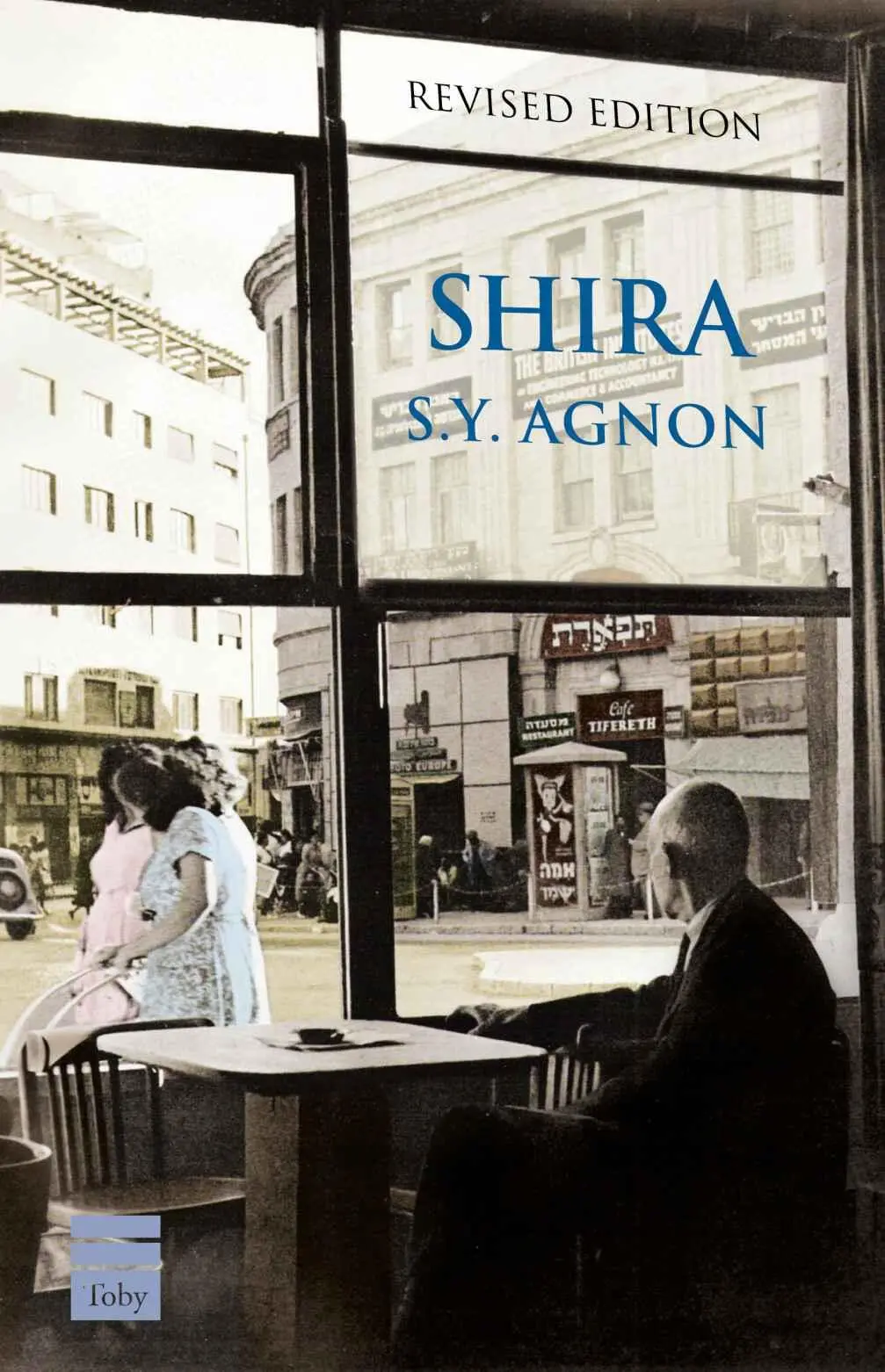
- Название:Shira
- Автор:
- Издательство:Toby Press
- Жанр:
- Год:2014
- ISBN:нет данных
- Рейтинг книги:5 / 5. Голосов: 1
-
Избранное:Добавить в избранное
- Отзывы:
-
Ваша оценка:
Shira: краткое содержание, описание и аннотация
Предлагаем к чтению аннотацию, описание, краткое содержание или предисловие (зависит от того, что написал сам автор книги «Shira»). Если вы не нашли необходимую информацию о книге — напишите в комментариях, мы постараемся отыскать её.
Shira — читать онлайн бесплатно полную книгу (весь текст) целиком
Ниже представлен текст книги, разбитый по страницам. Система сохранения места последней прочитанной страницы, позволяет с удобством читать онлайн бесплатно книгу «Shira», без необходимости каждый раз заново искать на чём Вы остановились. Поставьте закладку, и сможете в любой момент перейти на страницу, на которой закончили чтение.
Интервал:
Закладка:
Herbst’s mode of thought begins with an overview and includes a range of subjects — skimming the surface, touching yet not touching — until, finally, he ends up where he began. In his lectures, he begins with essentials, never straying far from the heart of his subject, patiently clarifying and elucidating it. He is careful not to startle the listener with new interpretations and refrains from emphasizing any particular word. Just as he wouldn’t underline a phrase in one of his books, so, on the same principle, he doesn’t emphasize words when lecturing. It is not his way to begin at a barely audible pitch and work up to a crescendo.
On this night, he changed his tack — not in terms of form, but in terms of the lecture itself, introducing material that was somewhat tangential. He began with the prohibition against keeping corpses overnight that prevailed in the holy cities of ancient Greece. In this context, he formulated the very essence of Greek philosophy and the principles of religion. He looked at the arts, theater, the circus, athletic games, and the marketplace, where citizens dealt with issues of state — the entire range of Greek manners and pastimes before Christianity appeared, obliterating everything. Herbst, a disciple of Neu, who viewed economics as a force but not a primary force, mentioned the economic factor without dwelling on it. Finally, he came to the decline of Greece and of all civilization until the rise of Christianity, which delivered the fatal blow. Having mentioned the holy cities of Greece, he remarked on the Greek cities in the Land of Israel, too — how they were maintained, how they were destroyed. Finally, he told of the destruction of Gaza and the struggles of Porphyry, the bishop of Gaza, who witnessed its destruction. Here, Herbst offered facts not noted by Marcus the Deacon or by any other chronicler.
Chapter twenty-three
The lecture was successful beyond all expectations. I have already described Herbst’s prowess; now let me describe the prowess of his listeners. They listened, not merely with their ears, but with their soul, alerting their ears so their soul could hear. Those who had left school to come to the Land of Israel, abandoning their studies in the middle, remembered things they had been too young to appreciate. Now that Herbst was bringing up these subjects, they recognized what they had lost, and what was lost to the world with the destruction of Greece. When had their loss occurred? The day they left their parents’ home and the town in which they were born. Throughout Herbst’s lecture, some of our friends sat summing up accounts vis-àvis the Land of Israel, comparing themselves to the last of the Greek philosophers, who watched as Christian invaders destroyed all that was good in the world, stamping out life’s joy and beauty. Were it not for the Land of Israel, they would be with their families, tranquil in their homes, serene in their towns, free from fiscal worries, hostile Arabs, and the blistering heat of hamsin winds.
Others, who came from the study houses of Galicia, knew hardly anything about Greek cities beyond what appears in the Gemara and in Josephus. Macedonia, for example they related to Alexander of Macedon, conqueror of Judea in 322 b.c.e.; Athens, to the elders of the Athenian school, and to Rabbi Yehoshua ben Hananiah; Corfu, to news items about its citrons on Sukkot. They were astonished by everything Dr. Herbst said, especially about burial customs. Jerusalem was known to be the only place in the ancient world with a prohibition against keeping corpses overnight; now he claimed that idol worshipers lived by the same rule. They were further astonished to hear him refer to worldly scholars as zaddikim . Though they themselves had changed since childhood, their faith in these righteous zaddikim was intact. And who were the zaddikim ? They were rabbis whose greatness was on the lips of everyone, the teachers of the Hasidim . When these young people moved away from the Torah and began reading secular books, they found support for much of what they had heard. Herbst, as you know, always responded to young people’s questions as if they were those of a scholar and made every effort to satisfy them. Now he was quiet, reflecting on statements he had heard from Shira. Once, walking together on a Shabbat afternoon, they encountered a group of Hasidim. Shira was annoyed and imputed all sorts of evils to those pious people, Hasidim and zaddikim alike. But his mind didn’t dwell on Shira. The road, the village, the lecture dissolved the image of Shira.
Others, because of poverty or the effects of war on their childhood, had never studied and never read. Still, they considered what Dr. Herbst told them and thought: What Dr. Herbst described may have happened in the past, one or two hundred years ago; in more recent times, such things couldn’t happen.
One by one, several kvutza members slipped away to do chores. Those who were at leisure stayed on with the Herbsts. They brought tea and cake, and presented Herbst with further questions, which they had forgotten but remembered again. A breeze began to blow. Mrs. Herbst said, “Why don’t we go outside. You don’t mind, do you, Fred?” They got up, went outside, and stretched out on the lawn behind the dining room.
The fresh grass gave off a fragrance enhanced by the myrtle trees alongside the steps, whose scent was diffused by evening dew. They brought straw mats, which they spread on the grass, and blankets. The Herbsts sat on their mat and covered themselves with blankets. The affection of their hosts was all around them; bright stars were embedded in the darkness above. A light suddenly began to twinkle in the grove at the edge of the village; it split into several lights, and a bark resounded from the cucumber field where Shomron slept. The bark was followed by three cries, then the call of a nightbird.
From the western part of the village, where the light was, came the sound of singing and the smell of burning twigs. Henrietta looked in that direction and turned so she could listen. Someone noticed and explained, “The Palmach people have built a campfire. They like to sit around it and sing.” Henrietta nodded and said, “I see, I see.” She was thinking: Tamara is already grown and Sarah is still small. Because of age and circumstance they’re safe from such adventures.
Herbst was still holding the glass of tea he had taken with him from the dining room and giving profound answers to the questions he was being asked. Finally, there were no further questions, and Herbst was asked to talk about whatever he liked. He sat talking. It was many years since he had lectured before such an audience, since he had been in the company of such youngsters. It was many years since Henrietta had heard Herbst lecture and since she had heard him say the sort of things he was saying here. On this night, these two things came together. Most important, she understood the lecture, which was not the case when Manfred began lecturing at the university. At that time, she still didn’t know a word of Hebrew. At many points during his talk, she had felt like stroking his hand. Now that she was sitting next to him, she took his hand and clasped it in hers, not letting go until they got up.
Chapter twenty-four
It was nearly midnight when Avraham-and-a-half and Heinz I accompanied the Herbsts to their room. Heinz I is Heinz the Berliner. The numeral I was appended to his name so he wouldn’t be confused with Heinz from Darmstadt, who became Heinz II. Avraham-and-a-half walked with Zahara’s mother, while Heinz I walked with Herbst. After a bit, they were joined by Heinz II and Marga — the Marga who had given Herbst the idea of lecturing on images of Byzantine women. Marga adds nothing to the story of Herbst and Shira. Her only relevance is that she had brought Herbst water and now gave Mrs. Herbst some sprigs of myrtle. She had planned to bring them in the morning, but Heinz II had said, “What you picked tonight, bring tonight; tomorrow you’ll bring more.” As she spoke, Marga was chewing a myrtle leaf. Herbst thought she was smoking a cigarette. Marga and Heinz were accompanied by Shomron, who always joined the night watch. Shomron was pleased with himself for having controlled the impulse to bark at Zahara’s retinue. He didn’t bark at them now either. But he would have liked to bark an inquiry: Why was everyone nodding at those people. Marga and Heinz had no effect on the Herbsts’ walking pattern. Henrietta continued to trail behind Avraham-and-a-half, and Heinz I walked with Manfred. Henrietta’s conversation was exclusively about Zahara and Dani, about the arrangements in the kvutza , which were ideal for babies but less than ideal for nursing mothers. Even had they been ideal for nursing mothers, they were not ideal for Zahara, who, though we wouldn’t call her weak, was nevertheless delicate. Abraham-and-a-half devoured every word uttered by Zahara’s mother, although he didn’t grasp its meaning. The more she talked, the more fond he became of the old lady who was so fond of Zahara, and his mind raced ahead: In a few years, when we’re really settled, we’ll build a parents’ house. We’ll invite Henrietta and Herbst to live with the other old people, and every day, in the evening, Dani will visit Grandpa and Grandma. He will come back and tell his friends that Grandpa and Grandma speak Yiddish to each other. How odd it is that Henrietta and Herbst, who take such pains with their speech and whose German is so literate, will be perceived by the local children as Yiddish speakers. Avraham was deep in thought and didn’t realize he was taking the Herbsts the long way around when he ought to be leading them directly to their room. It was already late, and they must be tired from their journey. Heinz and Marga weren’t paying attention to the route and noticed neither the Herbsts nor the fact that they had left them without saying goodbye.
Читать дальшеИнтервал:
Закладка:
Похожие книги на «Shira»
Представляем Вашему вниманию похожие книги на «Shira» списком для выбора. Мы отобрали схожую по названию и смыслу литературу в надежде предоставить читателям больше вариантов отыскать новые, интересные, ещё непрочитанные произведения.







Обсуждение, отзывы о книге «Shira» и просто собственные мнения читателей. Оставьте ваши комментарии, напишите, что Вы думаете о произведении, его смысле или главных героях. Укажите что конкретно понравилось, а что нет, и почему Вы так считаете.